
Presentation
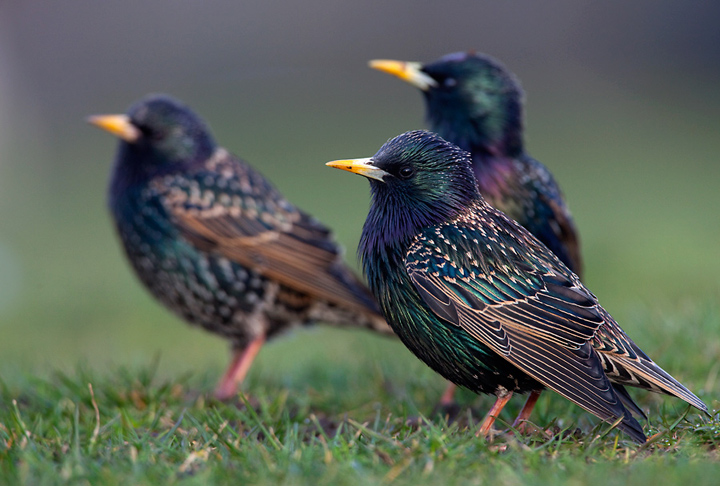
The European Starling is a medium-sized songbird recognizable by its iridescent black plumage with green and purple sheens, marked with fine pale spots in winter. Widespread across Europe and North Africa, it thrives in agricultural areas and cities alike. Highly social, it forms vast flocks that perform spectacular coordinated flights, especially at dusk. An excellent mimic, it reproduces the calls of other birds and various sounds from its environment. Its dietary adaptability and reproductive success have made it a common species, sometimes considered invasive outside its native range. In Tunisia, it is observed particularly in winter in large gatherings.
The European Starling measures approximately 20 cm long with a wingspan of 37 to 42 cm. Its bill is yellow during breeding season and darker in winter. The black plumage displays iridescent metallic sheens that shift with the light, with whitish spots more prominent in autumn and winter.
Characteristics
Indicative values: they vary by subspecies, sex and region.
Habitat and distribution
The species occupies a wide variety of open habitats: grasslands, farmland, urban and suburban areas. It favours open spaces for ground feeding, near nesting sites such as old buildings, cliffs or cavity-bearing trees. It adapts readily to human presence.
CURRENT RANGE
The common starling is native to Europe, North Africa and temperate Asia. It has been successfully introduced to North America, Australia and South Africa, where it is now abundant. In Tunisia, it is present mainly as a winter visitor from European populations.
Behaviour
Highly social, the European Starling lives in groups that may number several thousand individuals, especially outside the breeding season. The synchronized flights in fluid formations, called murmurations, likely serve to protect against predators. It is a vocal bird, capable of mimicking the calls of other species and certain mechanical sounds. It nests in cavities and defends a limited territory around the nest during breeding.
Reproduction
The female typically lays 4 to 7 pale blue eggs in a cavity, often a tree hole or building crevice. Incubation lasts about 12 to 15 days and is carried out mainly by the female. Young birds leave the nest roughly three weeks after hatching. Two broods per season are possible depending on conditions.
Peculiarities
Its vocal mimicry abilities are remarkable among songbirds. Murmurations—those coordinated clouds of birds moving together across the sky—are among the most studied avian behavioural phenomena. Its plumage changes with the season, shifting from sleek black iridescence in summer to speckled plumage in winter.
Threats and conservation
The species is not globally threatened and its world populations remain large. In some areas, certain European populations have declined due to agricultural intensification and loss of nesting sites. In regions where it has been introduced, it is sometimes regarded as a pest to crops.
Numbers and trends vary across sources and regions. See the IUCN assessment for the latest reference data.
Gallery
1 documented photographs.
References
Profile updated 04 September 2026 · Reviewed by the TunisieVet editorial team.
Comments (0)
No comments yet.
CONSERVATION STATUS
Least concern (LC)
IUCN source, latest published assessment.
Species health
Documented diseases for this species.
See the 4 diseases of this species Find a veterinarianThis information is provided for educational purposes only and is not a substitute for a veterinary consultation. If you have any concerns about your animal's health, consult a veterinarian.
Similar animals
Other species documented in Animalpedia.

TunisieVet in your pocket 📱🐾 Access your veterinary services wherever you are. [ Download the app ]
Learn more