Presentation
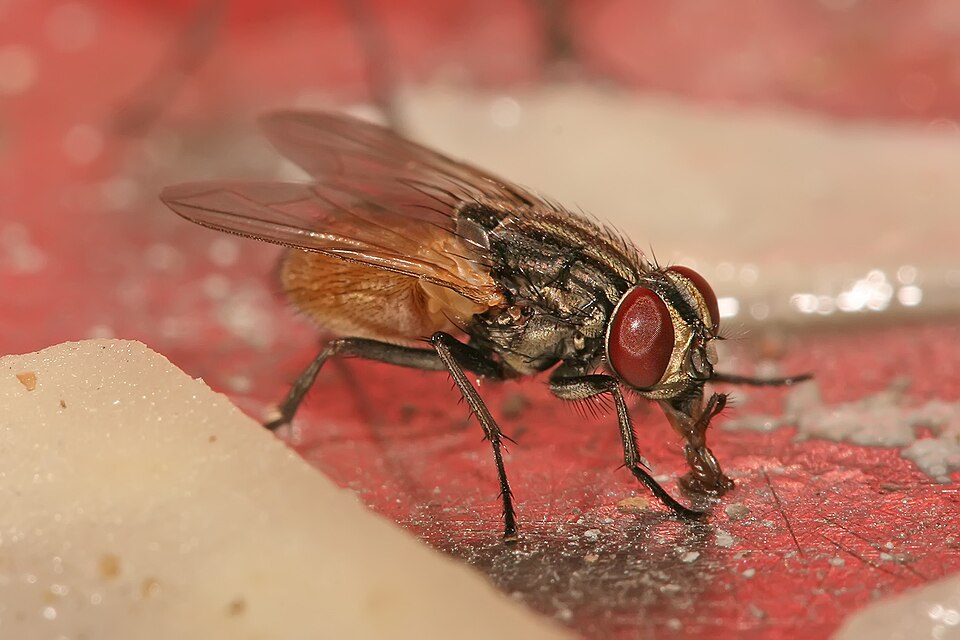
The house fly is a small flying insect found worldwide wherever humans live. It has a gray to black body, large reddish compound eyes, and a single pair of functional wings. This insect is one of the most common on Earth and lives in close association with human and animal activities. Its rapid life cycle and high reproductive capacity make it an omnipresent species. It plays an important sanitary role as it can carry many disease-causing agents. Although considered a pest, it is nonetheless a link in many food chains.
The body typically measures between 6 and 8 mm long and has four dark longitudinal bands on the thorax. The wings are transparent with fine veins, and the mouthparts are adapted for lapping up liquids. The legs have small sticky pads that allow the insect to move across vertical or smooth surfaces.
Characteristics
Indicative values: they vary by subspecies, sex and region.
Habitat and distribution
The house fly is found mainly in environments associated with humans: homes, farms, markets, and waste areas. It thrives particularly in warm, humid environments rich in organic matter.
CURRENT RANGE
This species is present on all inhabited continents, except for polar regions, thanks to its close association with human activities. It is particularly abundant in temperate and tropical zones.
Behaviour
This insect is active during the day and rests at night, often grouped in small swarms near food or heat sources. It has a fast and erratic flight that allows it to escape easily from predators and capture attempts. The house fly is attracted to strong odors, light, and heat sources.
Reproduction
The female lays several hundred eggs, usually on decomposing organic matter that will serve as food for the larvae. The eggs hatch in less than a day in warm conditions, giving rise to larvae called maggots. The complete cycle, from egg to adult, can be accomplished in one to two weeks depending on temperature.
Peculiarities
The house fly can taste food with its legs, which are equipped with sensory receptors. It beats its wings several hundred times per second, producing the characteristic buzzing sound of its flight.
Threats and conservation
The species is not threatened and enjoys no protected status, being considered a pest in most regions of the world. It is instead targeted by control methods such as insecticides and traps.
Numbers and trends vary across sources and regions. See the IUCN assessment for the latest reference data.
Gallery
1 documented photographs.
References
Profile updated 10 September 2026 · Reviewed by the TunisieVet editorial team.
Comments (0)
No comments yet.
CONSERVATION STATUS
Least concern (LC)
IUCN source, latest published assessment.
Species health
Documented diseases for this species.
Find a veterinarianThis information is provided for educational purposes only and is not a substitute for a veterinary consultation. If you have any concerns about your animal's health, consult a veterinarian.
To discover around: Fly
Videos, facts, stories and records linked to this species.
Similar animals
Other species documented in Animalpedia.