
Presentation
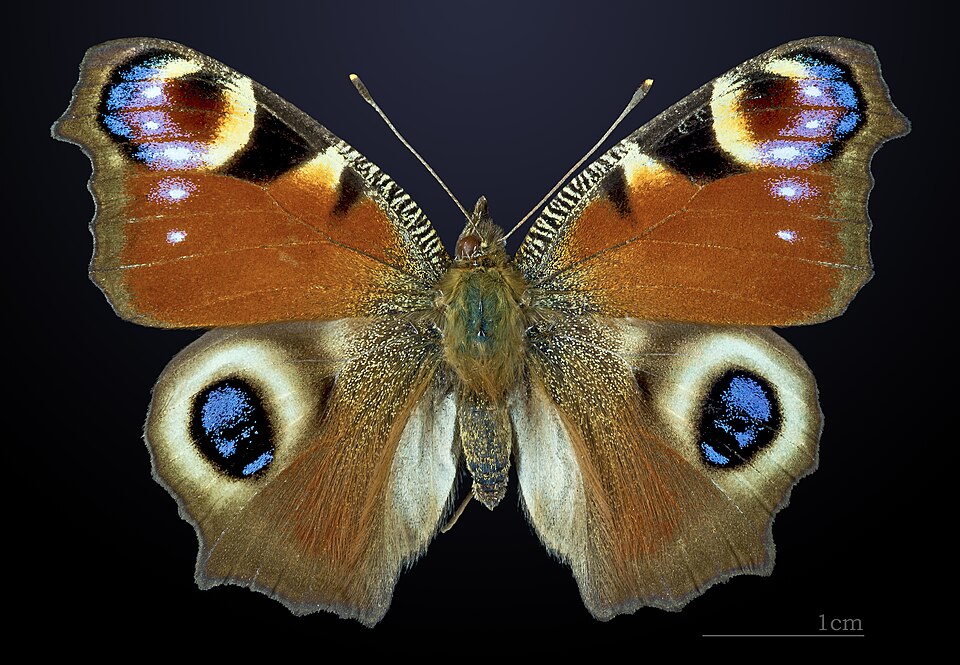
The peacock butterfly (Aglais io) is a day-flying butterfly widespread across Europe and temperate Asia, easily recognized by its large colored eyespots adorning each wing. It belongs to the family Nymphalidae and typically flies from spring through autumn, sometimes producing two generations per year. Its name comes from the four eyespots—blue, yellow, and black—that resemble the patterns on a peacock's tail. This species is found in gardens, flower-filled meadows, and forest edges. It overwinters as an adult, sheltering in places such as tree hollows, barns, or cellars.
The wings display a reddish-brown base decorated with four large multicolored eyespots, a warning pattern that deters predators. The underside of the wings is dark and streaked, providing excellent camouflage when the insect is at rest with wings closed. Wingspan typically ranges from 5 to 6 cm. The fine antennae end in a club characteristic of day-flying butterflies.
Characteristics
Indicative values: they vary by subspecies, sex and region.
Habitat and distribution
This species inhabits a wide variety of open and semi-open habitats: gardens, meadows, forest edges and wetland areas bordered with vegetation. It favours places rich in nectar-bearing flowers and nettles. It is found both in lowland areas and moderate mountains.
CURRENT RANGE
The Peacock butterfly is present across much of Europe and extends into temperate Asia, notably Japan. It is absent from North Africa and is not recorded in Tunisia. Its range covers temperate and continental climates.
Behaviour
The peacock butterfly is rather territorial; males actively patrol sunny areas to attract females. When threatened, it suddenly opens its wings to reveal its eyespots, mimicking the eyes of a large predator to startle insect-eating birds. It can also produce a faint rustling sound by rubbing its wings together. It overwinters as an adult during the cold months, unlike many other butterfly species.
Reproduction
Mating occurs in spring after the adults emerge from winter dormancy. The female lays her eggs in clusters beneath nettle leaves, where the caterpillars develop together initially. After several moults and the formation of a chrysalis, new adults emerge in summer. Depending on the region, a second generation may appear before winter.
Peculiarities
Its eyespots mimic the eyes of large predators such as owls, an effective defence mechanism against birds. It ranks among the most easily identified European butterflies due to this distinctive pattern. Its ability to overwinter as an adult is also remarkable among lepidopterans.
Threats and conservation
The species remains generally common and faces no major threats across its range. Loss of flower-rich meadows and pesticide use can, however, reduce its populations locally. Climate change also influences the timing of its life cycles.
Numbers and trends vary across sources and regions. See the IUCN assessment for the latest reference data.
Gallery
1 documented photographs.
References
Profile updated 08 September 2026 · Reviewed by the TunisieVet editorial team.
Comments (0)
No comments yet.
CONSERVATION STATUS
Least concern (LC)
IUCN source, latest published assessment.
Similar animals
Other species documented in Animalpedia.

TunisieVet in your pocket 📱🐾 Access your veterinary services wherever you are. [ Download the app ]
Learn more