
Presentation
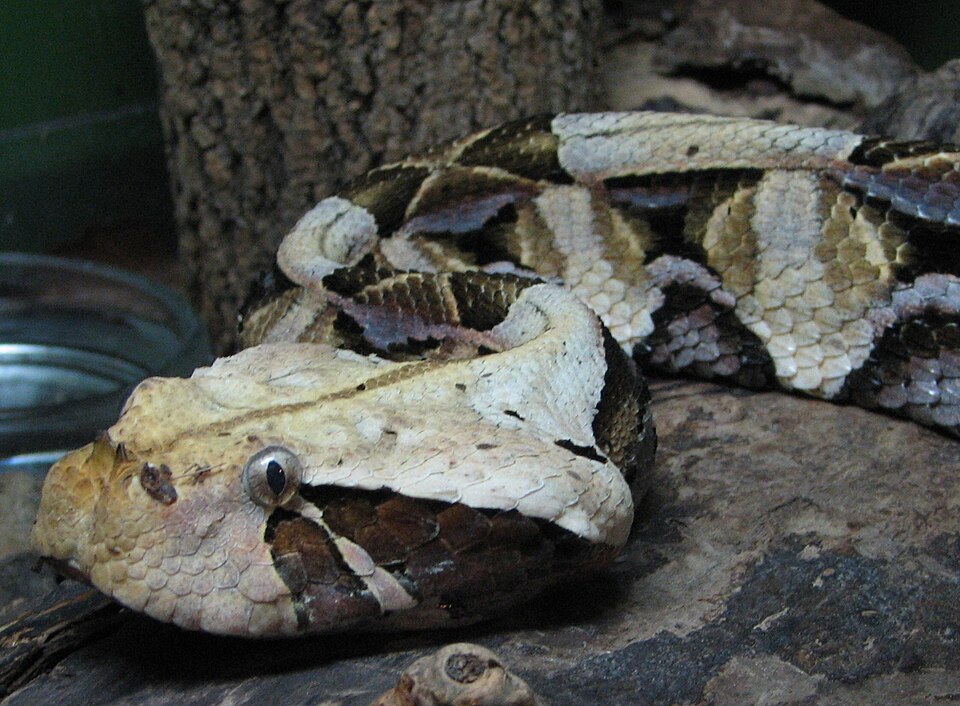
The Gaboon viper is the largest viperid snake in Africa, recognizable by its triangular head decorated with a brown and beige geometric pattern reminiscent of dead leaves. Its massive body has a pale diamond pattern edged with black, providing remarkable camouflage in forest litter. Despite its impressive size and extremely toxic venom, it is known to be slow and not very aggressive, only biting as a last resort. It has the longest venom fangs of all snakes, reaching over 2 cm in adults. It is a nocturnal and mainly terrestrial species, living hidden in the dense vegetation of Central and West Africa.
Stocky, heavy body covered with keeled scales, broad triangle-shaped head marked with a dark median line. The dress features brown, yellow and black geometric patterns forming effective camouflage on the ground. Venomous fangs, among the longest in the animal kingdom, can reach 2 to 5 cm depending on the individual.
Characteristics
Indicative values: they vary by subspecies, sex and region.
Habitat and distribution
It frequents humid tropical forests and wooded savannah areas of equatorial Africa. It is often found near forest edges and in dense ground vegetation, where it can camouflage itself effectively. It generally avoids areas that are too dry or lacking plant cover.
CURRENT RANGE
The species occurs in sub-Saharan Africa, mainly in Central and West Africa, from Cameroon to the Democratic Republic of Congo. It is also found in countries such as Nigeria, Gabon, Congo and Uganda. Its distribution generally follows the tropical forest belt of the continent.
Behaviour
A nocturnal and solitary snake, it spends the majority of its time motionless, hidden in dead leaves. Its temperament is generally calm and unreactive towards humans, unlike other African vipers. It only bites if directly threatened or surprised, preferring to flee or remain motionless.
Reproduction
Reproduction is viviparous, the female giving birth to young already formed after a gestation of several months. A litter can number from 20 to more than 60 young depending on the size of the mother. Newborns are autonomous from birth and already have functional venom.
Peculiarities
It holds the longest venom fangs known among snakes, a notable record in the animal kingdom. Its venom is produced in large quantities, although its bite toxicity is moderate compared to other viperids. The contrast between its potential danger and its placid behavior makes it a special case among venomous snakes.
Threats and conservation
Deforestation and conversion of forest habitats to agricultural land are gradually reducing its range. It is also captured for the exotic animal trade and sometimes killed out of fear during encounters with humans. No major specific international protection measures currently target this species.
Numbers and trends vary across sources and regions. See the IUCN assessment for the latest reference data.
Gallery
1 documented photographs.
References
Profile updated 19 August 2026 · Reviewed by the TunisieVet editorial team.
Comments (0)
No comments yet.
CONSERVATION STATUS
Least concern (LC)
IUCN source, latest published assessment.
Species health
Documented diseases for this species.
See the 8 diseases of this species Find a veterinarianThis information is provided for educational purposes only and is not a substitute for a veterinary consultation. If you have any concerns about your animal's health, consult a veterinarian.
To discover around: Gaboon viper
Videos, facts, stories and records linked to this species.
RECORD
up to approximately 5 cm
Longest venom fangs
Measurement carried out on adult specimens, hooks retracted in the upper jaw at rest.
Similar animals
Other species documented in Animalpedia.

TunisieVet in your pocket 📱🐾 Access your veterinary services wherever you are. [ Download the app ]
Learn more