
Presentation
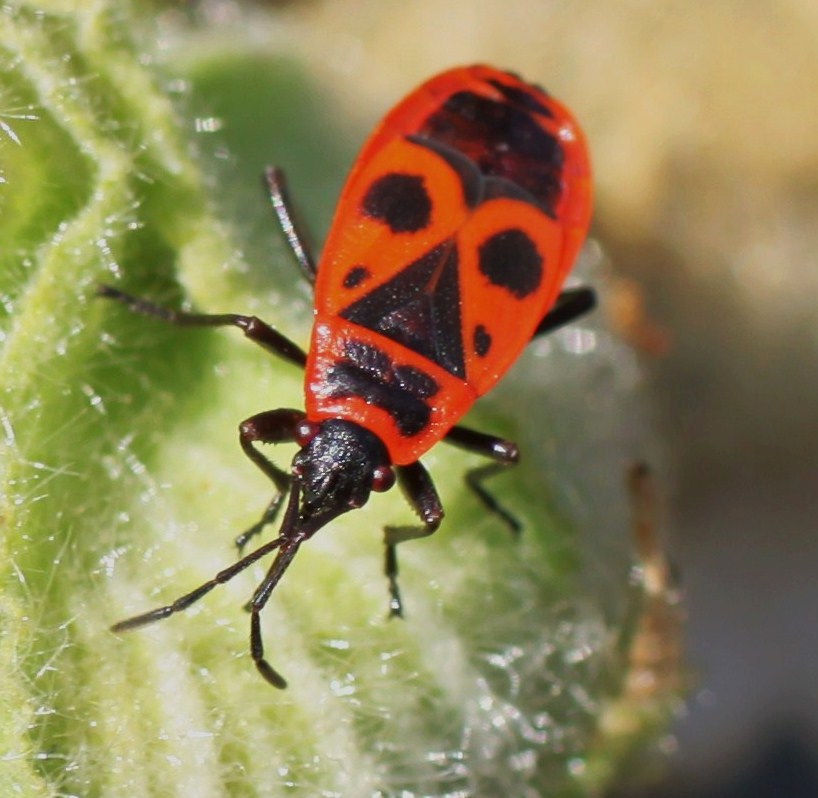
The red and black flea beetle is an easily recognized ground-dwelling bug distinguished by its bright red color marked with black patterns on its back. Small in size, this insect is very common in Europe and North Africa, where it often lives in large groups at the base of trees. Its common name comes from the red and black coloring that recalls the historical uniform of French gendarmes. Harmless to humans, it feeds mainly on seeds and plant debris that falls to the ground. It is frequently observed in spring and summer, clustered in colonies on tree trunks, warm stones, or at the base of lime and maple trees. Its great tolerance of cold allows it to survive winter hidden under bark or dead leaves.
The body measures between 8 and 12 mm in length, with a reddish-orange background marked by three black patches on the thorax and wing cases. The hind wings are often reduced, making flight rare in this species. The head is small, equipped with segmented antennae and a piercing-sucking mouthpart typical of true bugs.
Characteristics
Indicative values: they vary by subspecies, sex and region.
Habitat and distribution
The squash bug frequents temperate zones with seed-bearing trees such as lindens, maples, and mallows. It is found in both urban environments—parks and gardens—and in rural and forested areas. It favors warm, sunny spots at the base of trees or on sun-exposed walls.
CURRENT RANGE
The species is widely distributed across Europe, North Africa, and certain regions of western Asia. It is very common in Tunisia, particularly in urban and peri-urban areas of the country's north. Its broad distribution reflects its ability to adapt to various temperate and Mediterranean environments.
Behaviour
This bug is gregarious and forms aggregates of dozens to hundreds of individuals, especially during breeding and overwintering periods. It is diurnal and prefers warm, sunny surfaces such as stones or bark exposed to the south. The red and black flea beetle moves mainly by walking, as flight is uncommon due to its often-reduced wings.
Reproduction
Mating occurs in spring, often visible as pairs remaining together for several hours. The female lays her eggs in the soil or under plant debris, giving rise to larvae that resemble small wingless adults. Development proceeds through several successive molts until adulthood, generally completing one generation per year.
Peculiarities
The squash bug releases a foul-smelling defensive substance when handled, intended to repel predators. Its bright coloration serves as a warning signal (aposematism) although the species is not toxic. Its tendency to form large visible aggregations makes it a familiar insect frequently observed by the general public.
Threats and conservation
The species is not threatened and is not subject to any particular conservation measures. Pesticide use and intensive urbanization may locally reduce its populations, without affecting its overall distribution. It remains common in most of its natural and urban habitats.
Numbers and trends vary across sources and regions. See the IUCN assessment for the latest reference data.
Gallery
1 documented photographs.
References
Profile updated 26 August 2026 · Reviewed by the TunisieVet editorial team.
Comments (0)
No comments yet.
CONSERVATION STATUS
Least concern (LC)
IUCN source, latest published assessment.
To discover around: Red and Black Flea Beetle
Videos, facts, stories and records linked to this species.
Similar animals
Other species documented in Animalpedia.
