
Presentation
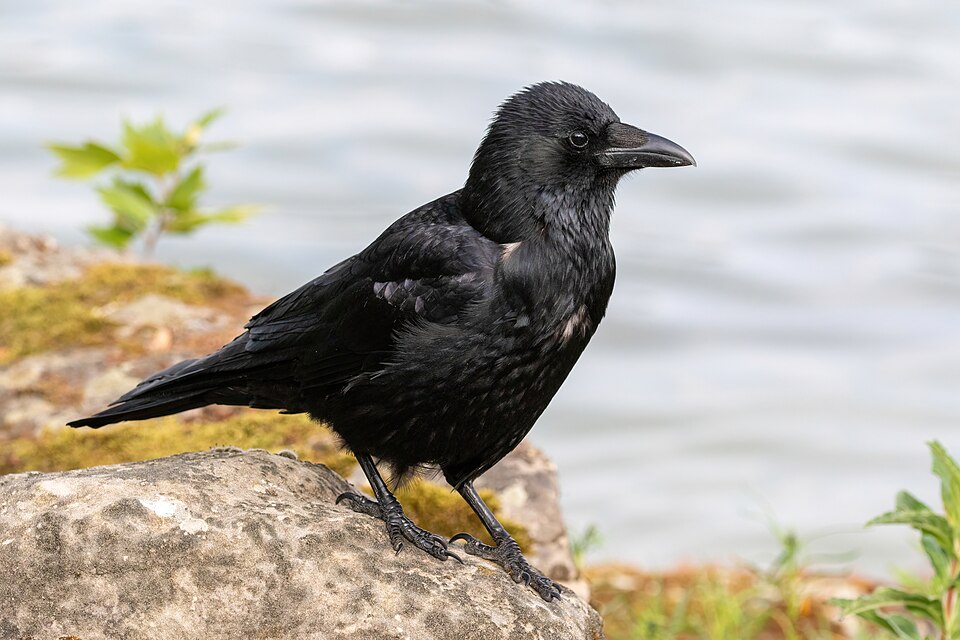
The Crow is a bird of the corvid family, recognizable by its entirely black plumage and its robust beak. Several closely related species bear this name, including the black Crow (Corvus corone) in Europe and the mantled Crow (Corvus cornix) in North Africa and Tunisia. It is an opportunistic and intelligent bird, capable of adapting to very varied environments, from the countryside to urban centers. She often lives in pairs or small groups and is particularly suspicious of humans. Its hoarse and repeated cry is easily recognizable. It plays an important ecological role as a scavenger and regulator of harmful insects.
The Crow measures approximately 45 to 47 cm in length with a wingspan of 84 to 100 cm. Its plumage is black, sometimes with an ash gray coat depending on the species, and its beak and legs are black and powerful. It has a stocky silhouette and direct flight, less graceful than that of the crow but efficient. Her cognitive abilities are remarkable: she knows how to use rudimentary tools and memorize human faces.
Characteristics
Indicative values: they vary by subspecies, sex and region.
Habitat and distribution
Crow frequents a wide diversity of environments: cultivated countryside, meadows, forest edges, wetlands and urban spaces. It easily adapts to human proximity, nesting in city parks and gardens. In Tunisia, it is present both in rural areas and in certain urban centers. Its ecological plasticity makes it a common species over a large part of its range.
CURRENT RANGE
Crow is widely distributed in Europe, North Africa and Asia. In North Africa, the mantled Crow occupies Morocco, Algeria and Tunisia. It is absent from the driest desert areas but present in coastal and agricultural regions. Its distribution area is stable, even expanding in certain urban areas.
Behaviour
The Crow is a social bird which forms stable pairs over several years and can gather in large dormitories outside the breeding season. She demonstrates great intelligence, capable of solving simple problems and learning through observation. It actively defends its territory, particularly against birds of prey and other corvids. Its cautious behavior and vigilance make it a difficult species to approach.
Reproduction
The breeding season begins in spring, with the female generally laying 3 to 5 eggs in a nest built in a tree. Incubation lasts approximately 18 to 20 days, mainly carried out by the female. The young leave the nest after 4 to 5 weeks but remain dependent on the parents for a few more weeks. The couple generally remains united over several successive seasons.
Peculiarities
Crow stands out for its exceptional intelligence among birds, comparable to that of some primates in certain cognitive tests. She is able to recognize human faces individually and remember them for several years. She sometimes uses simple tools to access food. Its complex social behavior includes forms of mutual assistance and cultural transmission between individuals.
Threats and conservation
The Crow does not face major threats and its populations are generally stable, even increasing in certain areas. It can nevertheless be persecuted locally because of the damage it causes to crops. The use of pesticides and the loss of natural habitats can locally affect its food resources. However, it benefits from its great capacity to adapt to environmental changes.
Numbers and trends vary across sources and regions. See the IUCN assessment for the latest reference data.
Gallery
1 documented photographs.
References
Profile updated 04 September 2026 · Reviewed by the TunisieVet editorial team.
Comments (0)
No comments yet.
CONSERVATION STATUS
Least concern (LC)
IUCN source, latest published assessment.
Species health
Documented diseases for this species.
Find a veterinarianThis information is provided for educational purposes only and is not a substitute for a veterinary consultation. If you have any concerns about your animal's health, consult a veterinarian.
Similar animals
Other species documented in Animalpedia.

TunisieVet in your pocket 📱🐾 Access your veterinary services wherever you are. [ Download the app ]
Learn more