
Presentation
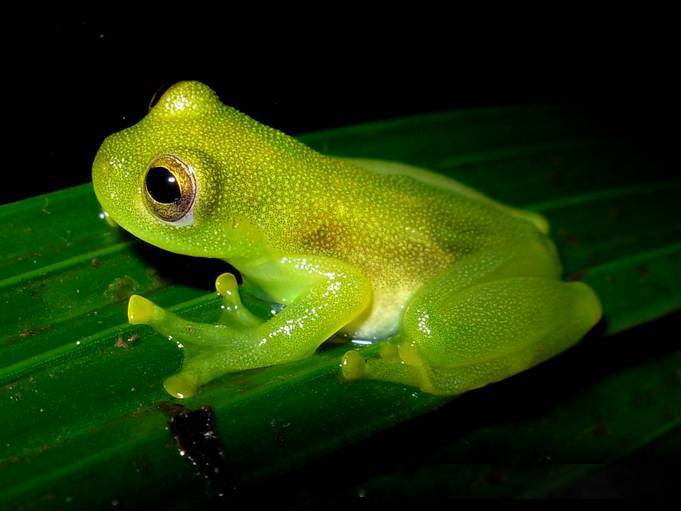
The glass frog is a small tree-dwelling amphibian from Central and South America, famous for the partial transparency of its belly skin, which reveals its internal organs, including its beating heart. This family includes several dozen species, usually translucent green on the back. It lives near streams in humid tropical rainforests, where it lays its eggs on leaves overhanging the water. Small in size, it is mainly active at night and is recognized more by its call than by sight. It is a valued subject of study for understanding adaptation to tree-dwelling life and tissue transparency in vertebrates.
The body is slender and elongated, covered with smooth skin ranging from green to yellow-green, often dotted with small markings. The belly skin is translucent, allowing the heart, liver, and digestive tract to be seen through it. The eyes are prominent and forward-facing, and the fingers are equipped with adhesive toe pads that aid in tree-dwelling life.
Characteristics
Indicative values: they vary by subspecies, sex and region.
Habitat and distribution
Glass frogs inhabit humid tropical forests, particularly areas close to streams and small rivers where they find both moisture and breeding sites. They live mainly in the lower and middle canopy, on vegetation overhanging water. Their presence is a good indicator of the health of forest and aquatic ecosystems.
CURRENT RANGE
This family is found throughout Central America and South America, from Mexico to northern Argentina. Species are particularly diverse in the tropical forests of the Andes and Amazon. They are completely absent from Africa, Europe, and Asia.
Behaviour
This species is primarily nocturnal and arboreal, moving with agility among leaves overhanging forest streams. Males produce a quiet call to attract females, and some actively defend a breeding territory. Parental care behavior is notable in several species, with the male remaining near the eggs to protect them from predators and drying out.
Reproduction
Breeding occurs near freshwater, with females laying their eggs in gelatinous clusters on the underside of leaves above streams. After hatching, tadpoles fall directly into the water where they continue their development. In many species, the male guards the clutch until hatching—a rare behavior among amphibians.
Peculiarities
The transparency of the ventral skin, which allows observation of the organs and sometimes even developing eggs in females, is the most striking feature of this family. Some species have a liver covered with reflective cells that mask the organs when the animal is at rest—a camouflage mechanism studied by scientists.
Threats and conservation
Deforestation and degradation of tropical waterways pose major threats to this family's habitats. Water pollution, particularly from agricultural pesticides, affects tadpole reproduction and survival. Some species are also collected for the exotic pet trade, increasing pressure on wild populations.
Numbers and trends vary across sources and regions. See the IUCN assessment for the latest reference data.
Gallery
1 documented photographs.
References
Profile updated 20 September 2026 · Reviewed by the TunisieVet editorial team.
Comments (0)
No comments yet.
CONSERVATION STATUS
Data deficient (DD)
IUCN source, latest published assessment.
Species health
Documented diseases for this species.
This information is provided for educational purposes only and is not a substitute for a veterinary consultation. If you have any concerns about your animal's health, consult a veterinarian.
To discover around: Glass Frog
Videos, facts, stories and records linked to this species.
Similar animals
Other species documented in Animalpedia.
