
Presentation
Western gorilla is the largest living primate, an impressive anthropoid ape characterized by its massive stature, exceptional strength, and remarkable intelligence. This herbivorous animal lives in structured social groups in the tropical forests of West and Central Africa.
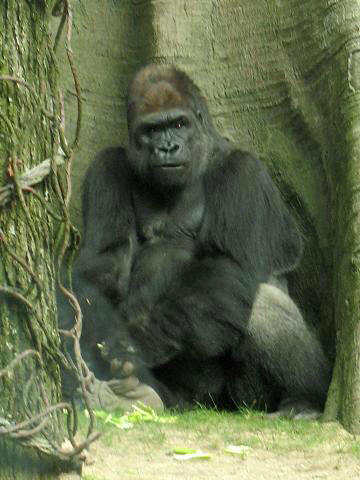
The Western gorilla has a sturdy body covered in short, thick black hair, with very long, muscular arms. The adult male (silverback) is distinguished by a grayish tint on the back and hips. The face is bare, with small ears, expressive eyes and a broad nose with flattened nostrils.
Characteristics
Indicative values: they vary by subspecies, sex and region.
Habitat and distribution
The Western gorilla inhabits dense, humid tropical forests, mainly primary and secondary forests. It also frequents mountain forests at medium altitude. These environments offer an abundance of food and a dense plant cover essential to its survival.
CURRENT RANGE
Western gorilla is endemic to West and Central Africa. Its range extends over several countries including Equatorial Guinea, Gabon, Cameroon, the Republic of Congo and the Central African Republic. Residual populations are isolated and fragmented.
Behaviour
The Western gorilla lives in hierarchical family groups led by a dominant male (silverback) who protects and organizes the group. Individuals are generally calm and peaceful, spending most of their time feeding and resting. They communicate through vocalizations, gestures and facial expressions.
Reproduction
The female gorilla reaches sexual maturity around 8-9 years old and the male around 12-13 years old. Gestation lasts about 8.5 months, and the female usually gives birth to a single young. The young remain dependent on their mother for 3-4 years.
Peculiarities
Western gorilla possesses remarkable intelligence and learning ability, comparable to that of human children. Each individual has a distinct personality and can create and use tools. The very cohesive family structure and the strong emotional bonds between individuals constitute remarkable social particularities.
Threats and conservation
The Western gorilla faces serious and multiple threats: massive destruction of its forest habitat due to deforestation, poaching for bushmeat, illegal trade, and emerging diseases such as Ebola. Habitat fragmentation also limits the possibilities for reproduction and population expansion.
Numbers and trends vary across sources and regions. See the IUCN assessment for the latest reference data.
Gallery
1 documented photographs.
References
UICN — Liste rouge des espèces menacées
Profile updated 30 August 2026 · Reviewed by the TunisieVet editorial team.
Comments (0)
No comments yet.
CONSERVATION STATUS
Critically endangered (CR)
IUCN source, latest published assessment.
Species health
Documented diseases for this species.
See the 4 diseases of this species Find a veterinarianThis information is provided for educational purposes only and is not a substitute for a veterinary consultation. If you have any concerns about your animal's health, consult a veterinarian.
To discover around: Western gorilla
Videos, facts, stories and records linked to this species.
Similar animals
Other species documented in Animalpedia.

TunisieVet in your pocket 📱🐾 Access your veterinary services wherever you are. [ Download the app ]
Learn more