
Presentation
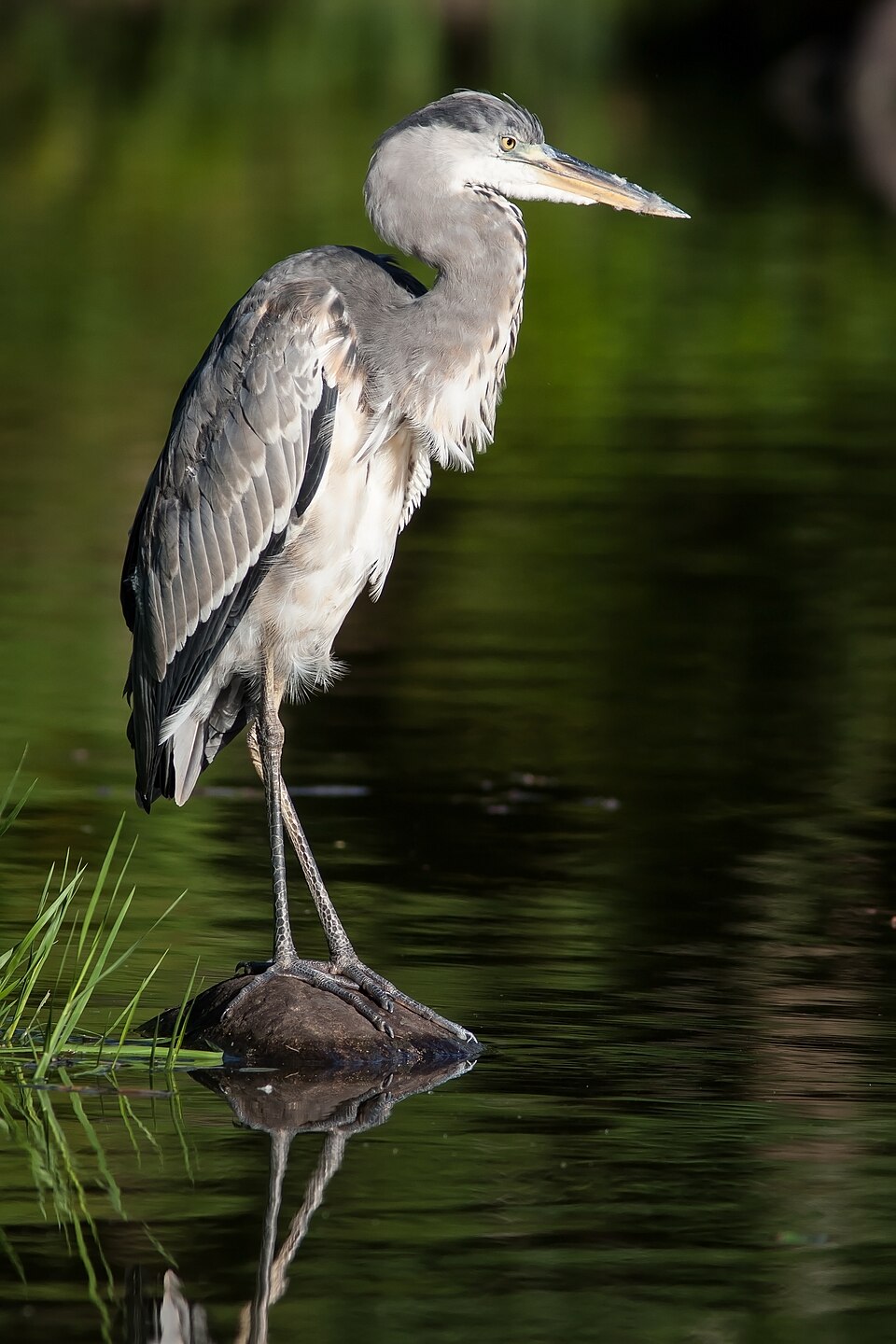
The grey heron is a large wading bird recognised by its long neck, long legs, and grey-ash plumage streaked with black and white. It often stands motionless at the water's edge, watching for prey with patience before striking with a quick thrust of its beak. Present in Tunisia in wetlands and coastal areas, it frequents both natural habitats and water bodies near human settlements. It is a widely distributed bird across Europe, Africa and Asia, appreciated for its elegant appearance and slow flight with broad wings. It typically nests in colonies called heronries, built in large trees close to water. Its longevity and adaptability make it a common species despite some sensitivity to wetland degradation.
The grey heron has a long neck folded in an S-shape when at rest and in flight, and a powerful yellowish, dagger-shaped beak. Its plumage is mostly pale grey on the back and wings, with a white head marked by a black stripe extended as a crest. The legs are long and slender, adapted for walking in shallow water.
Characteristics
Indicative values: they vary by subspecies, sex and region.
Habitat and distribution
The grey heron frequents wetland areas such as lakes, ponds, marshes, and rivers, as well as calm coastal shores. It may also be observed near artificial bodies of water in agricultural or urban settings. The presence of shallow water rich in prey is essential to its habitat.
CURRENT RANGE
The species is widely distributed throughout Europe, Africa, and Asia, with resident and migratory populations depending on the region. In Tunisia, it is observed in wetlands in the north and in certain coastal lagoons. European populations often migrate to North Africa and sub-Saharan Africa during winter.
Behaviour
It is generally a solitary bird when hunting, but gregarious for breeding, forming noisy colonies. It is active mainly at dawn and dusk, though it may hunt at any time. Its flight is slow, with broad wing beats and the neck folded against the body.
Reproduction
Breeding occurs in spring, with the construction or repair of large, bulky nests made of branches, located high in trees. The female typically lays 3 to 5 eggs, which are incubated by both parents for approximately one month. The young remain in the nest for several weeks before fledging.
Peculiarities
The grey heron can remain motionless for long periods, a posture that sometimes causes it to be mistaken for a statue at the water's edge. It possesses powder down on its plumage, a feature that helps it clean its feathers of the oily substances from fish.
Threats and conservation
Degradation and drying of wetland areas constitute the main threat to the species. Water pollution and human disturbance at breeding sites can also affect local populations. Overall, the species remains common and not threatened on a global scale.
Numbers and trends vary across sources and regions. See the IUCN assessment for the latest reference data.
Gallery
1 documented photographs.
References
Profile updated 07 September 2026 · Reviewed by the TunisieVet editorial team.
Comments (0)
No comments yet.
CONSERVATION STATUS
Least concern (LC)
IUCN source, latest published assessment.
Species health
Documented diseases for this species.
See the 4 diseases of this species Find a veterinarianThis information is provided for educational purposes only and is not a substitute for a veterinary consultation. If you have any concerns about your animal's health, consult a veterinarian.
To discover around: Grey Heron
Videos, facts, stories and records linked to this species.
Similar animals
Other species documented in Animalpedia.

TunisieVet in your pocket 📱🐾 Access your veterinary services wherever you are. [ Download the app ]
Learn more