
Presentation
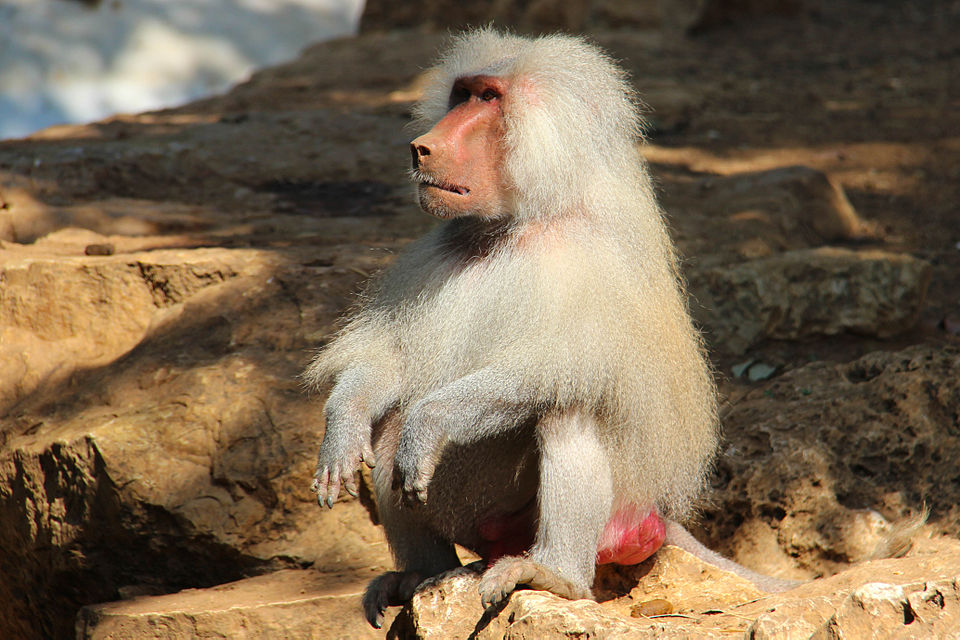
The Hamadryas, or Hamadryas baboon, is an Old World monkey native to the Horn of Africa and the Arabian Peninsula. It is distinguished by the silvery coat and long mane of adult males, contrasting with the olive-brown coat of females. This species was revered by the ancient Egyptians, who associated it with the god Thoth. They live in complex social groups organized into family units called “harems”. The Hamadryas is well adapted to arid and rocky environments where it finds shelter and food.
The adult male has a thick silvery mane framing the head and shoulders, while the smaller female has a dull brown coat without a mane. The face and buttock calluses are bright pink to red, particularly marked in males. The tail is long and drooping, and the body is robust with powerful limbs adapted for walking on the ground.
Characteristics
Indicative values: they vary by subspecies, sex and region.
Habitat and distribution
The Hamadryas frequents arid, semi-desert and mountainous areas, often near rocky cliffs serving as protective nocturnal roosts. It also ventures into the surrounding dry savannahs and steppes in search of food. The presence of water points, even temporary, is essential to its survival.
CURRENT RANGE
The species is present in the Horn of Africa, notably in Ethiopia, Eritrea, Djibouti and Somalia. A population also exists in the southwest of the Arabian Peninsula, Yemen and Saudi Arabia. It is not native to North Africa or Tunisia.
Behaviour
The species lives according to a social organization on several levels: a dominant male controls a small group of females forming a “harem”, several harems group together into clans, then into bands, and finally into large troops that can bring together several hundred individuals during the nighttime rest on the cliffs. The dominant male closely monitors the females in his harem and intervenes in the event of an attempt to escape. Communication relies on vocalizations, facial expressions and extensive social grooming. The species is diurnal and terrestrial, moving on the ground to forage.
Reproduction
Females reach sexual maturity around 4 to 5 years old and males a little later. Gestation lasts about 6 months and usually results in the birth of a single young. The young remain closely dependent on their mother during the first year, during which they are carried and then gradually weaned.
Peculiarities
Hamadryas was sacred in ancient Egypt, where it featured in religious iconography alongside the god Thoth and was sometimes mummified. Its social structure in several hierarchical levels is considered one of the most complex among non-human primates. Marked sexual dimorphism between males and females is particularly pronounced in this species.
Threats and conservation
Habitat loss linked to agricultural expansion and desertification threatens certain local populations. Conflicts with human activities, including poaching and retaliation for crop damage, also constitute pressure. Overall, however, the species remains relatively widespread in its range.
Numbers and trends vary across sources and regions. See the IUCN assessment for the latest reference data.
Gallery
1 documented photographs.
References
Profile updated 26 August 2026 · Reviewed by the TunisieVet editorial team.
Comments (0)
No comments yet.
CONSERVATION STATUS
Least concern (LC)
IUCN source, latest published assessment.
Species health
Documented diseases for this species.
This information is provided for educational purposes only and is not a substitute for a veterinary consultation. If you have any concerns about your animal's health, consult a veterinarian.
Similar animals
Other species documented in Animalpedia.

TunisieVet in your pocket 📱🐾 Access your veterinary services wherever you are. [ Download the app ]
Learn more