
Presentation
The hornet is a social insect of the wasp family, recognized by its large size and brown-reddish and yellow coloring. It lives in organized colonies centered around a queen, built in tree cavities, attics, or wall cavities. An active predator, it hunts other insects to feed its larvae while also consuming sugary substances. Although its sting is painful, the hornet is only aggressive toward humans if it feels directly threatened. It plays a notable ecological role in regulating insect populations. In Tunisia, it is present in several wooded and periurban regions.
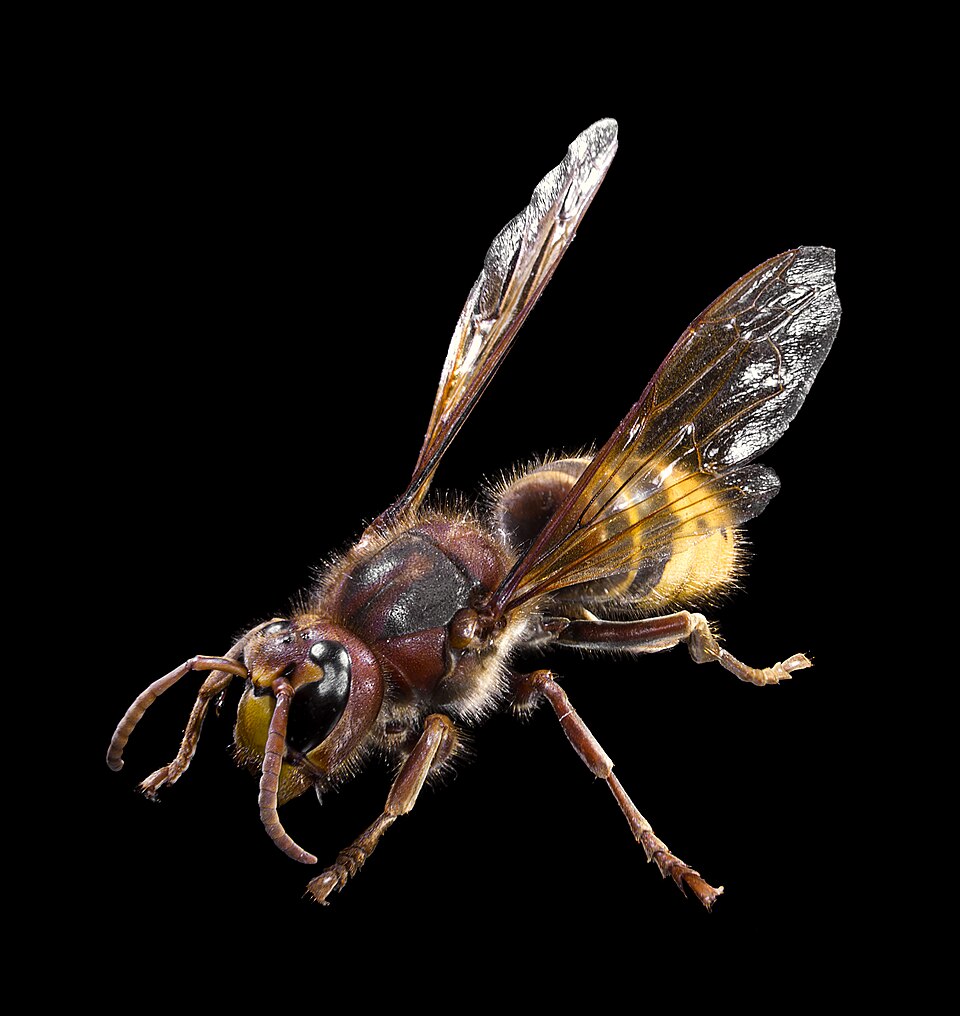
The hornet measures between 2.5 and 3.5 cm depending on the caste, with a broad head and powerful jaws. Its body displays brown-reddish and yellow bands, darker than those of the common wasp. The wings are brownish and folded along the body at rest. Females possess a smooth stinger allowing multiple successive stings.
Characteristics
Indicative values: they vary by subspecies, sex and region.
Habitat and distribution
The hornet inhabits forests, wooded areas, gardens, and periurban environments that offer nesting cavities. It readily settles in hollow tree trunks, attics, roofing, or wall cavities. Its capacity for adaptation allows it to colonise both rural areas and areas inhabited by humans.
CURRENT RANGE
The hornet is widely distributed throughout Europe, temperate Asia, and North Africa. It has also been accidentally introduced to North America. In Tunisia, it is found in the forest zones of the north and in certain periurban regions.
Behaviour
The hornet is a social insect living in annual colonies led by a founding queen. Communication within the nest relies on chemical and tactile signals between workers. It is active mainly during the day, though it can also fly at night attracted by lights. Its nest defense is vigorous but it generally avoids confrontation away from the nest.
Reproduction
Only the mated queen survives the winter and establishes a new colony in spring. She lays the first eggs, which produce workers that enlarge the nest and feed the subsequent larvae. Late in the season, the colony produces males and future queens that mate before dispersal. The nest is abandoned in autumn, and only the young mated queens overwinter.
Peculiarities
The hornet is able to fly at night, unlike most other social wasps, and is often attracted to light sources. Its sting, though painful, is no more dangerous than a wasp sting for a non-allergic person. It possesses vision adapted to low light conditions, a rare characteristic among social hymenoptera.
Threats and conservation
The hornet is not listed among threatened species and its populations are generally stable. It may nevertheless be destroyed locally due to the fear it provokes or its proximity to human dwellings. Pesticide use and nest destruction constitute the main local pressures.
Numbers and trends vary across sources and regions. See the IUCN assessment for the latest reference data.
Gallery
1 documented photographs.
References
Profile updated 10 September 2026 · Reviewed by the TunisieVet editorial team.
Comments (0)
No comments yet.
CONSERVATION STATUS
Least concern (LC)
IUCN source, latest published assessment.
Species health
Documented diseases for this species.
Find a veterinarianThis information is provided for educational purposes only and is not a substitute for a veterinary consultation. If you have any concerns about your animal's health, consult a veterinarian.
To discover around: Hornet
Videos, facts, stories and records linked to this species.
Similar animals
Other species documented in Animalpedia.
