
Presentation
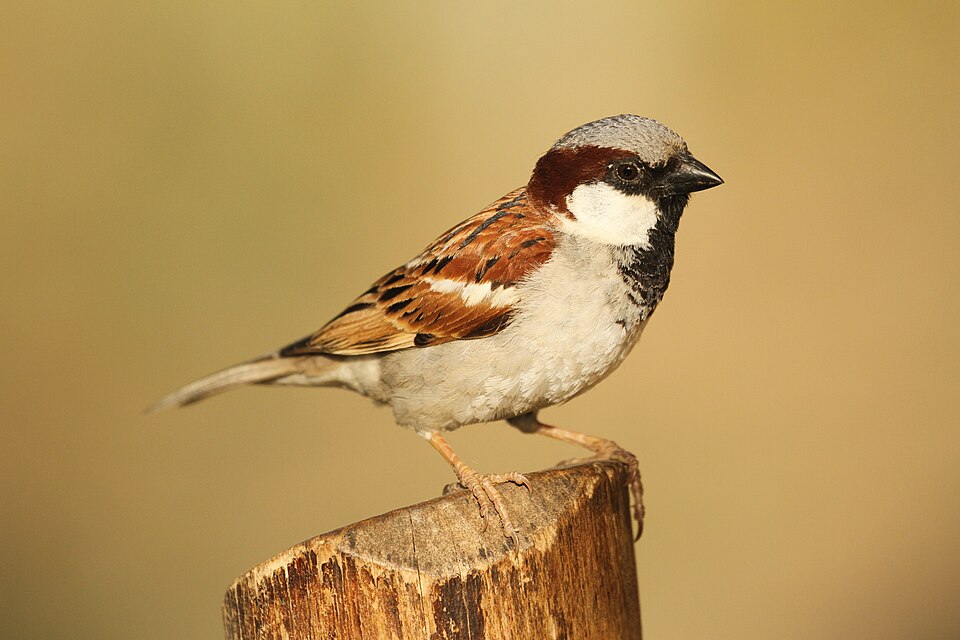
The house sparrow is a small, stocky songbird found around human habitations worldwide. It measures about 15 centimetres and displays brown streaked plumage, with clear differences between males, which have a black throat and bib, and females, which are duller and more uniformly coloured. Highly social and vocal, it lives in flocks and has adapted well to urban and agricultural settings. In Tunisia, it ranks among the most common birds, seen in both traditional medinas and the countryside. Its opportunistic diet and remarkable adaptability explain its success on almost every continent. Nevertheless, it remains affected by the decline of insect populations and the loss of nesting cavities in some modern urban areas.
The house sparrow has a round body, a short conical beak suited to seed-eating, and rounded wings. Sexual dimorphism is clear: the male displays a grey crown, white cheeks, and a black bib, while the female shows discrete brown-beige plumage. Size typically ranges from 14 to 16 cm, with weight between 24 and 40 grams.
Characteristics
Indicative values: they vary by subspecies, sex and region.
Habitat and distribution
The house sparrow frequents urban and suburban environments primarily, as well as agricultural areas and farms. It avoids dense forests and natural habitats with no human presence. Its dependence on structures for nesting makes it a species closely tied to human activity.
CURRENT RANGE
Originally from Europe, North Africa, and Asia, the house sparrow was introduced intentionally or accidentally to nearly every continent. Today it is one of the most widespread birds in the world, found in the Americas, Oceania, and sub-Saharan Africa. In Tunisia, it is present everywhere, from major cities to rural villages.
Behaviour
It is a social species that lives in flocks year-round, sometimes gathering in hundreds around food sources or roosting sites. The house sparrow is sedentary and territorial around its nesting site, which it actively defends against other individuals. It communicates through characteristic chirping and frequently takes dust or water baths to maintain its plumage.
Reproduction
The female lays 3 to 6 eggs per clutch, usually several times a year between spring and summer. Incubation lasts about 11 to 14 days, and both parents feed the chicks. House sparrows readily nest in crevices in buildings, under roofs, or in dense hedges.
Peculiarities
The house sparrow is one of the birds most closely associated with humans, colonizing cities for thousands of years. Some urban populations have developed specific behaviors, such as incorporating cigarette butts into nests, which may help reduce parasites.
Threats and conservation
Although the species remains very common, some major European cities have observed marked decline since the 2000s, attributed to decreasing insect populations, pollution, and modernization of buildings that reduces nesting sites. In Tunisia, the population remains globally stable and abundant.
Numbers and trends vary across sources and regions. See the IUCN assessment for the latest reference data.
Gallery
1 documented photographs.
References
Profile updated 05 September 2026 · Reviewed by the TunisieVet editorial team.
Comments (0)
No comments yet.
CONSERVATION STATUS
Least concern (LC)
IUCN source, latest published assessment.
Species health
Documented diseases for this species.
See the 4 diseases of this species Find a veterinarianThis information is provided for educational purposes only and is not a substitute for a veterinary consultation. If you have any concerns about your animal's health, consult a veterinarian.
To discover around: House Sparrow
Videos, facts, stories and records linked to this species.
Similar animals
Other species documented in Animalpedia.

TunisieVet in your pocket 📱🐾 Access your veterinary services wherever you are. [ Download the app ]
Learn more