
Presentation
The giant isopod is a marine crustacean living in the abyssal depths, mainly in the Gulf of Mexico and the western Atlantic. It belongs to the isopod group, related to terrestrial woodlice, but reaches a much larger size than its shallow-water cousins—a phenomenon known as abyssal gigantism. Its segmented body, protected by a rigid calcareous shell, allows it to roll into a ball for defense. An opportunistic scavenger, it feeds on the carcasses of marine animals that fall to the ocean floor. Little studied due to its difficult-to-access habitat, it has sparked growing public interest since appearing in aquariums and on the internet.
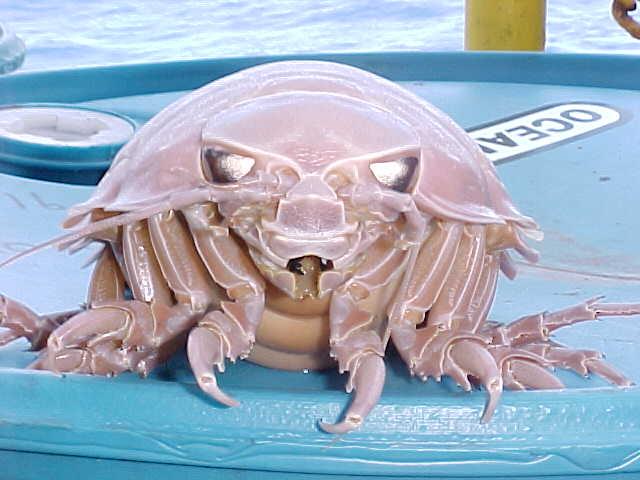
Its oval, segmented body can measure up to 40–50 cm long, making it one of the largest known isopods. It has fourteen jointed legs, two pairs of antennae, and large compound eyes adapted to the dim light of the seafloor. Its grayish-lilac calcified shell provides good protection against predators. It can curl into a ball, like a woodlouse, to protect itself.
Characteristics
Indicative values: they vary by subspecies, sex and region.
Habitat and distribution
The giant isopod lives exclusively in deep marine environments, typically between 300 and 2000 meters deep. It favors muddy or sandy seabeds where it can partially bury itself. These abyssal zones are characterized by complete darkness, high pressure, and temperatures around 4°C. It does not occur in shallow coastal waters.
CURRENT RANGE
The species is mainly recorded in the Gulf of Mexico and the deep waters of the western Atlantic. Related isopods of the genus Bathynomus are also found in other oceans, particularly in the Indo-Pacific. Its exact range remains poorly known due to the difficulty of exploring the deep sea. It is not present in Tunisian or Mediterranean waters.
Behaviour
It is a solitary and mainly nocturnal animal, active especially when foraging for food. It moves slowly across the seafloor or remains buried in sediments while waiting for a food source. When threatened, it adopts defensive behavior by curling up on itself. Its activity and metabolism are greatly slowed by the cold temperatures and scarcity of food in the abyss.
Reproduction
The female carries her eggs in a ventral pouch called a marsupium until they are fully developed. The juveniles, called manca, are born fully formed without passing through a free-living larval stage. Reproduction remains poorly documented due to the difficulties of observing these animals in the deep sea. The reproductive cycle is thought to be slow, consistent with the species' overall metabolism.
Peculiarities
Its gigantism, compared with terrestrial isopods measuring just a few centimeters, illustrates the phenomenon of abyssal gigantism observed in several deep-sea invertebrates. Its ability to fast for several years without apparent harm is particularly remarkable. It is sometimes called a "giant sea cockroach" because of its morphological resemblance to terrestrial woodlice and cockroaches.
Threats and conservation
The species is not directly threatened by human activity due to its remote deep-sea habitat. It is occasionally captured incidentally during deep-sea fishing or collected for the exotic aquarium trade. No data suggest a significant decline in its populations. Long-term environmental changes related to climate change could eventually affect its habitat.
Numbers and trends vary across sources and regions. See the IUCN assessment for the latest reference data.
Gallery
1 documented photographs.
References
Profile updated 07 September 2026 · Reviewed by the TunisieVet editorial team.
Comments (0)
No comments yet.
CONSERVATION STATUS
Data deficient (DD)
IUCN source, latest published assessment.
To discover around: Giant Isopod
Videos, facts, stories and records linked to this species.
RECORD
up to 50 cm
The largest known isopod
Maximum size recorded in an adult Bathynomus giganteus specimen in the abyssal environment...
Similar animals
Other species documented in Animalpedia.

TunisieVet in your pocket 📱🐾 Access your veterinary services wherever you are. [ Download the app ]
Learn more