
Presentation
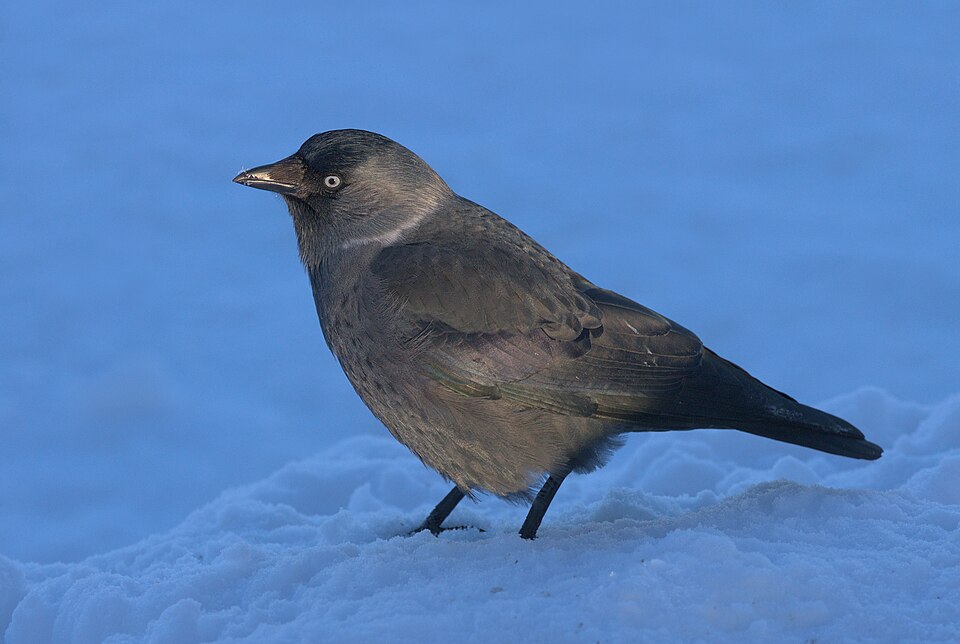
The Jackdaw is a small corvid recognizable by its black plumage contrasted by an ash gray nape and cheeks, as well as its light, almost white eyes. Small in size compared to other crows, it often travels in noisy and gregarious groups. Its characteristic cry, a dry and repeated “tchak”, earned it its name. Very sociable, it readily nests near humans, in cavities of buildings, cliffs or old trees. It is an intelligent bird, capable of solving simple problems and recognizing human faces.
The Jackdaw measures approximately 33 to 39 cm long with a wingspan of 65 to 75 cm. Its plumage is glossy black on the body with a darker crown and distinctive gray nape. Its light eyes, almost white in adults, contrast sharply with its dark plumage and distinguish it from other corvids.
Characteristics
Indicative values: they vary by subspecies, sex and region.
Habitat and distribution
The Jackdaw frequents both rural and urban environments, nesting in the cavities of old buildings, bell towers, cliffs and old hollow trees. It particularly appreciates cultivated areas and meadows for feeding. Its capacity for adaptation allows it to colonize both the countryside and city centers.
CURRENT RANGE
The species is widely distributed across Europe, North Africa and much of temperate Asia. In North Africa, it is present in particular in Tunisia, Algeria and Morocco. Its populations are generally stable and well established throughout its range.
Behaviour
The Jackdaw is an extremely social bird that lives in colonies that can number several hundred individuals. It forms loyal, lifelong pairs and communicates through a wide range of vocalizations. It is known for its high cognitive abilities, including its spatial memory and ability to follow human gaze. Groups often travel in the company of other corvids such as crows.
Reproduction
The female generally lays 4 to 6 eggs per clutch, once a year in spring. Incubation lasts approximately 17 to 18 days, mainly carried out by the female. The young leave the nest after 4 to 5 weeks but remain dependent on the parents for a few more weeks.
Peculiarities
The light eyes of the adult Jackdaw are a unique feature among European corvids, absent in the juvenile which has brown eyes. The species is renowned for its fidelity to nesting sites, often reused over several generations. It is one of the rare birds capable of following the direction of human gaze to locate food.
Threats and conservation
The Jackdaw does not face major threats and its populations are considered stable or even slightly increasing in certain regions. The destruction of old buildings and the renovation of roofs can locally reduce the available nesting sites. The use of agricultural pesticides can also affect food resources.
Numbers and trends vary across sources and regions. See the IUCN assessment for the latest reference data.
Gallery
1 documented photographs.
References
Profile updated 04 September 2026 · Reviewed by the TunisieVet editorial team.
Comments (0)
No comments yet.
CONSERVATION STATUS
Least concern (LC)
IUCN source, latest published assessment.
Species health
Documented diseases for this species.
Find a veterinarianThis information is provided for educational purposes only and is not a substitute for a veterinary consultation. If you have any concerns about your animal's health, consult a veterinarian.
Similar animals
Other species documented in Animalpedia.

TunisieVet in your pocket 📱🐾 Access your veterinary services wherever you are. [ Download the app ]
Learn more