
Presentation
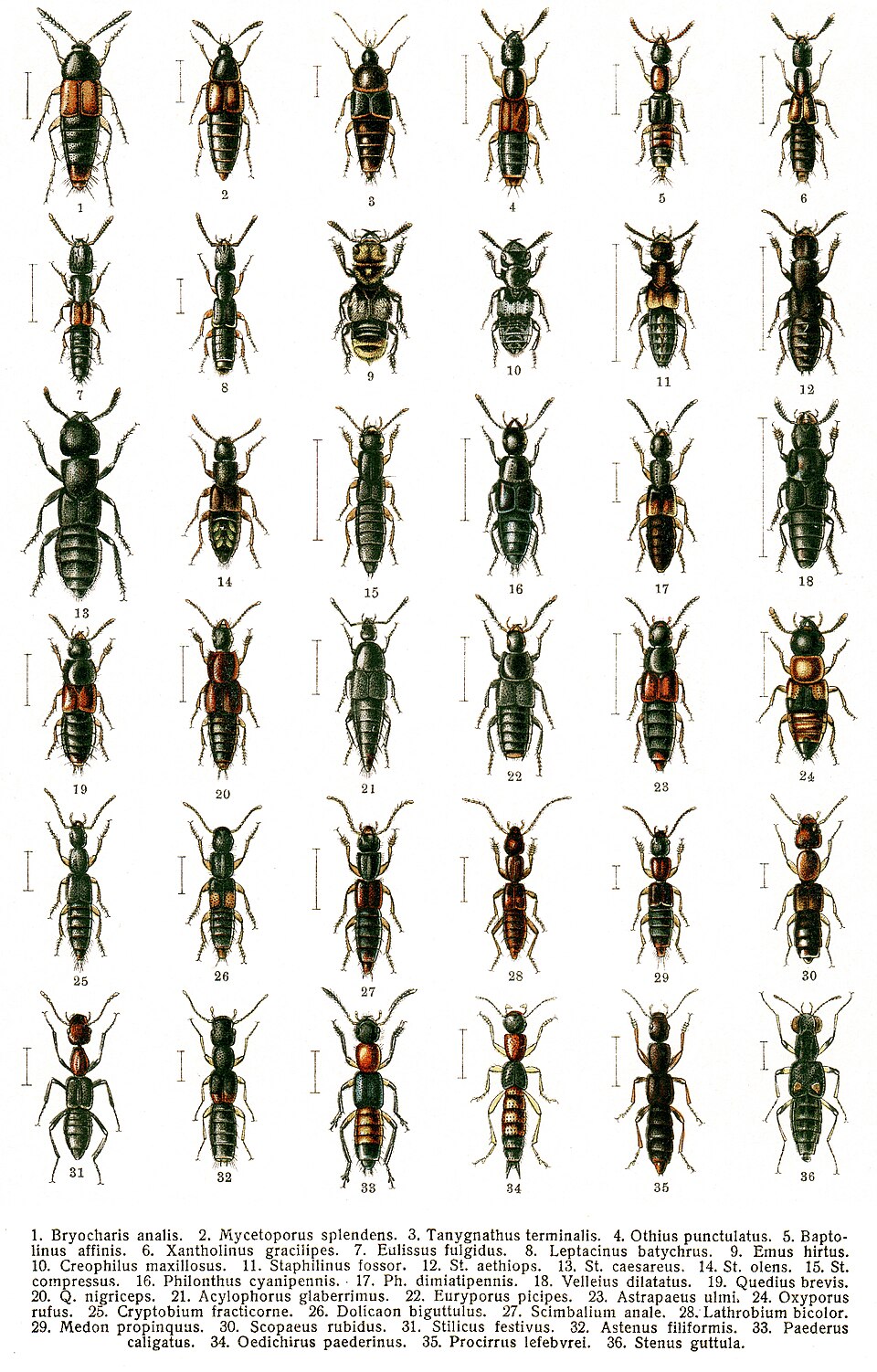
The rove beetle is a coleopteran characterized by short elytra that leave much of its abdomen exposed. This family, Staphylinidae, comprises tens of thousands of species distributed worldwide. The most well-known species in Europe and North Africa, the devil's coach horse, is a black, elongated insect capable of curling its abdomen into a defensive posture that resembles a scorpion. It lives in soil, beneath stones, or in leaf litter, where it hunts small prey. Despite its striking appearance, it is completely harmless to humans except for a defensive odorous secretion.
Elongated and narrow body, usually black or brown, measuring from a few millimetres to about 3 cm depending on the species. The elytra, very short, cover only a small part of the abdomen, which remains flexible and mobile. The insect can raise its abdomen into a threatening position when it feels threatened, imitating a scorpion's stance, although it has no sting.
Characteristics
Indicative values: they vary by subspecies, sex and region.
Habitat and distribution
Rove beetles inhabit gardens, cultivated areas, meadows, woodlands and wetlands—wherever they find moisture and decomposing organic matter. They are commonly found under stones, dead leaves or compost heaps.
CURRENT RANGE
Staphylinidae form one of the largest families of beetles and are present on all continents except Antarctica. The devil's coach-horse is widely distributed throughout Europe, North Africa and Western Asia, including Tunisia.
Behaviour
Active mainly at night, it moves quickly across soil and can fly thanks to membranous wings folded beneath its short elytra. When disturbed, it adopts a defensive posture by curling its abdomen forward. It also releases a foul-smelling secretion intended to deter its predators.
Reproduction
The female lays her eggs in soil or under moist plant debris. The larvae, predatory like the adults, develop in the litter before pupating. The complete cycle, from egg to adult, typically takes anywhere from a few weeks to several months depending on climate conditions.
Peculiarities
Its defensive posture mimicking a scorpion, despite being completely lacking venom or a stinger, is its most striking characteristic. This family of beetles is among the most diverse in the animal kingdom in terms of described species.
Threats and conservation
Common rove beetles face no major global threats and remain abundant. Intensive pesticide use in agricultural areas can, however, reduce their populations locally.
Numbers and trends vary across sources and regions. See the IUCN assessment for the latest reference data.
Gallery
1 documented photographs.
References
Profile updated 27 August 2026 · Reviewed by the TunisieVet editorial team.
Comments (0)
No comments yet.
CONSERVATION STATUS
Least concern (LC)
IUCN source, latest published assessment.
Similar animals
Other species documented in Animalpedia.

🚀 SWConsulting — Turning Your Ideas into Digital Solutions Do you have an idea, a project, or a business process that needs to be digitalized? SWConsulting supports businesses from concept to deployment, delivering custom, reliable, and scalable digital solutions tailored to their real needs. 💻 Web & Mobile Development ⚙️ Business Applications & SaaS 🤖 Artificial Intelligence & Automation 📊 Custom CRM & Management Tools 🛒 E-commerce & Marketplaces 🔗 APIs & System Integrations Our goal is simple: turn your business needs into practical digital solutions that help you improve efficiency, automate processes, and grow your business. Have a project in mind? Let’s talk. 🚀 SWConsulting — Digital Solutions, Real Impact.
WhatsApp