
Presentation
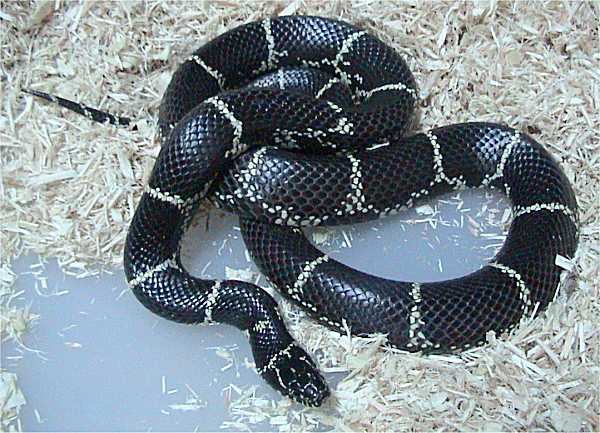
The kingsnake is a nonvenomous colubrid native to North America, prized for its robust constitution and striking patterns. Its name reflects its ability to feed on other snakes, including venomous species such as rattlesnakes, against whose venom it possesses strong resistance. The body is smooth and cylindrical, typically displaying bands or chains of white to yellow on a black or brown ground color depending on the subspecies. It kills prey by constriction before swallowing them whole. Widely kept in the reptile hobby because of its generally calm temperament and ease of care, numerous color varieties selected in captivity now exist. It does not occur in the wild in Tunisia.
Muscled and smooth body, head only slightly distinct from the neck, glossy scales arranged in regular rows. Coloration varies widely according to subspecies and population, ranging from solid black to banded or chain patterns in white, yellow, or cream. Eyes are round, without vertical pupils, which distinguishes it from vipers.
Characteristics
Indicative values: they vary by subspecies, sex and region.
Habitat and distribution
The species inhabits a wide range of environments: forests, grasslands, rocky areas, marshes, and areas near water bodies. It often shelters under logs, rocks, or in abandoned burrows.
CURRENT RANGE
The kingsnake is found across much of the United States and northern Mexico. Several geographic subspecies share this range, with notable color variations depending on the region.
Behaviour
Primarily terrestrial and secretive animal, active mainly at dusk and night depending on season. It becomes defensive when threatened, and may vibrate its tail and hiss, but rarely bites with severity. Solitary outside the breeding season, it hibernates in regions with cool winters.
Reproduction
Reproduction is oviparous. The female lays an average of 10 to 20 eggs following spring mating. Incubation lasts about two months, with no parental care after laying. Young are independent from the moment of hatching and reach sexual maturity in two to three years.
Peculiarities
Its natural resistance to rattlesnake venom allows it to prey on venomous snakes without serious risk. This trait makes it an appreciated natural regulator in its native ecosystem.
Threats and conservation
The species faces relatively few threats in the wild, although certain local populations suffer from habitat destruction and wildlife trafficking for the exotic pet trade. Road mortality also causes local population declines.
Numbers and trends vary across sources and regions. See the IUCN assessment for the latest reference data.
Gallery
1 documented photographs.
References
Profile updated 09 September 2026 · Reviewed by the TunisieVet editorial team.
Comments (0)
No comments yet.
CONSERVATION STATUS
Least concern (LC)
IUCN source, latest published assessment.
Species health
Documented diseases for this species.
See the 4 diseases of this species Find a veterinarianThis information is provided for educational purposes only and is not a substitute for a veterinary consultation. If you have any concerns about your animal's health, consult a veterinarian.
Similar animals
Other species documented in Animalpedia.

TunisieVet in your pocket 📱🐾 Access your veterinary services wherever you are. [ Download the app ]
Learn more