Presentation
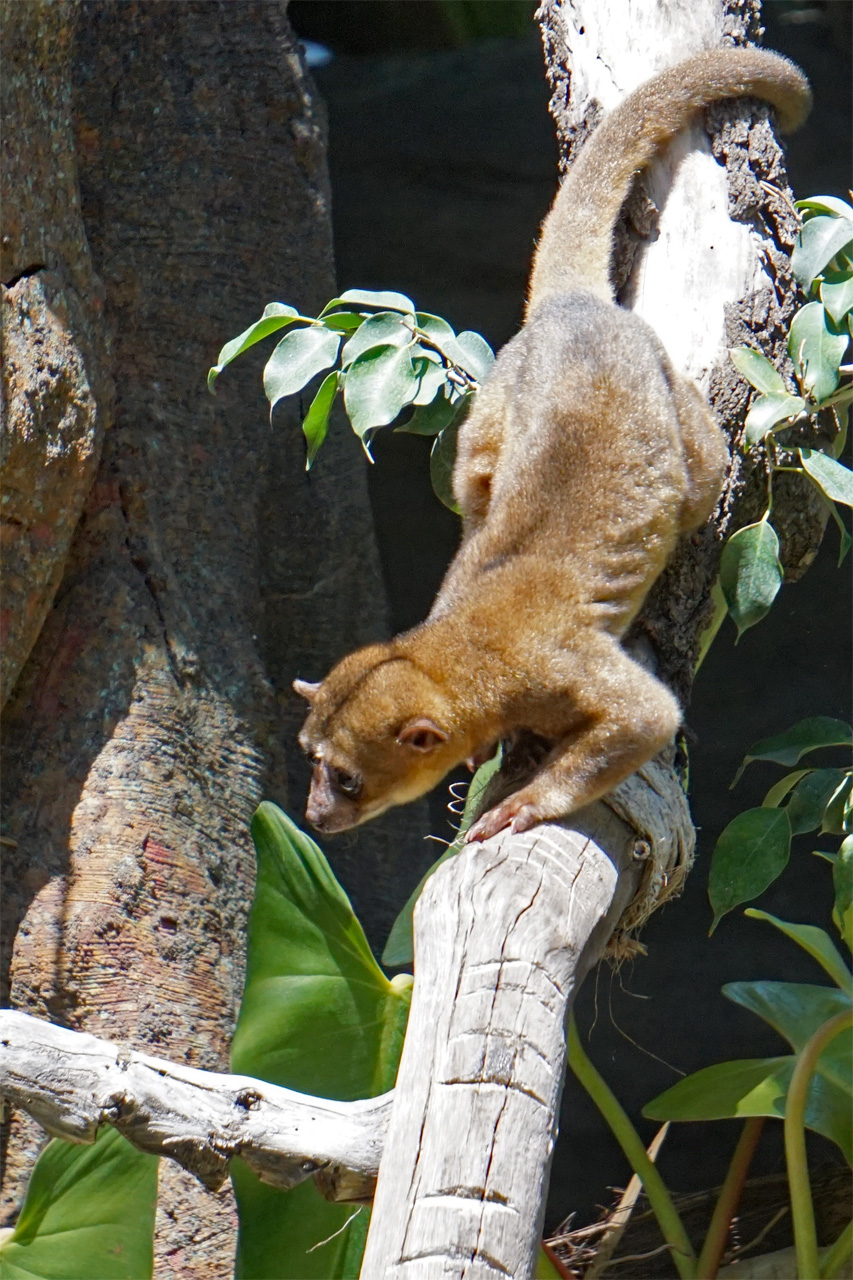
The kinkajou is a small arboreal mammal living in tropical forests of Central and South America. Often mistaken for primates because of its tree-dwelling lifestyle, it actually belongs to the Procyonidae family, related to raccoons. Its elongated body, golden to reddish-brown fur, and long prehensile tail allow it to move with agility through the canopy. Nocturnal and shy, it feeds mainly on fruit and nectar. Its long slender tongue serves to extract nectar from flowers and honey from wild hives, which is why it is called the "honey bear". It is sometimes kept as an exotic pet despite the constraints this involves.
The kinkajou has a flexible body, a round head with large eyes adapted for night vision, and a prehensile tail as long as its body. Its fur is short, dense, and golden to golden-brown in color. Its short sharp claws, combined with highly mobile paws, allow it to climb and hang easily from branches.
Characteristics
Indicative values: they vary by subspecies, sex and region.
Habitat and distribution
The kinkajou lives in humid tropical forests, in both primary and secondary forest. It occupies mainly the canopy, rarely descending to the ground. It is found from sea level to moderate altitudes in dense forested areas.
CURRENT RANGE
The species is found from southern Mexico to Brazil, throughout Central America and the Amazon Basin. It occupies a large portion of the tropical forests of the American continent. Its distribution remains linked to the availability of continuous forest cover.
Behaviour
The kinkajou is a solitary and strictly nocturnal animal, spending the day sleeping in tree hollows. It is highly agile in trees thanks to its prehensile tail which serves as a fifth limb. Although generally solitary, it may gather in small groups to feed or groom one another. It communicates through various vocalizations including sharp cries and grunts.
Reproduction
The female kinkajou typically gives birth to a single offspring after a gestation period of approximately 112 to 118 days. The young is born blind and dependent, remaining with its mother for several months before becoming independent. Sexual maturity is reached at around two to three years of age.
Peculiarities
The kinkajou is sometimes called the 'honey bear' because of its pronounced preference for wild honey. Its prehensile tail, unique among American carnivores, enables arboreal locomotion comparable to that of some primates. Its extensible tongue, similar to that of nectar-feeding animals, is a remarkable adaptation for a carnivore.
Threats and conservation
Deforestation and fragmentation of its forest habitat are the main threats to the species. It is also captured for the exotic pet trade, despite its temperament potentially becoming unpredictable in adulthood. Local hunting for its fur or meat occurs in some regions but remains limited.
Numbers and trends vary across sources and regions. See the IUCN assessment for the latest reference data.
Gallery
1 documented photographs.
References
Profile updated 16 September 2026 · Reviewed by the TunisieVet editorial team.
Comments (0)
No comments yet.
CONSERVATION STATUS
Least concern (LC)
IUCN source, latest published assessment.
Species health
Documented diseases for this species.
This information is provided for educational purposes only and is not a substitute for a veterinary consultation. If you have any concerns about your animal's health, consult a veterinarian.
Similar animals
Other species documented in Animalpedia.