
Presentation
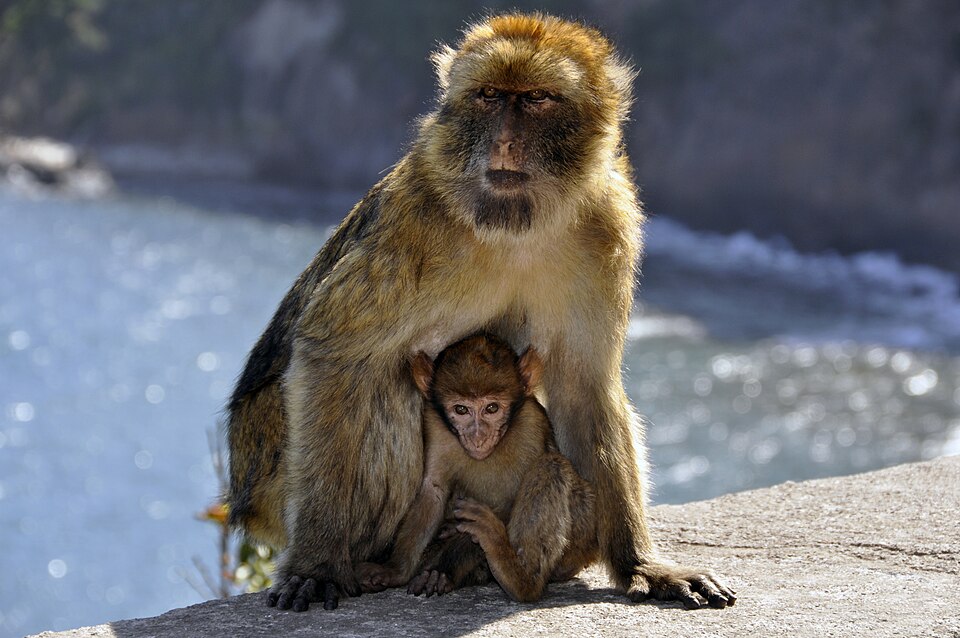
The Barbary macaque is a sturdy, stocky primate with thick gray-brown fur that thickens in winter to protect it from alpine temperatures. Unlike most macaques, it has a vestigial tail reduced to a simple protuberance, which makes it easily recognizable. Its furless face, pinkish to reddish in color, and its prominent cheeks give it a characteristic appearance.
The Barbary macaque has developed musculature, powerful limbs adapted to arboreal and terrestrial locomotion, and hands with prehensile fingers. Its cheeks have mouth pockets allowing it to store food. Its dense, waterproof coat is a major adaptation to the wet and cold mountain conditions of the Moroccan Middle Atlas.
Characteristics
Indicative values: they vary by subspecies, sex and region.
Habitat and distribution
The Barbary macaque inhabits the cedar and fir forests of the Moroccan Middle Atlas, between 1400 and 2600 meters above sea level. It prefers dense forest areas offering thick plant cover, crucial for its protection and nutrition. These mountain forests experience harsh winters and snowfall, extreme conditions to which the species has remarkably adapted.
CURRENT RANGE
Barbary macaque is endemic to the Moroccan Middle Atlas, where its population remains in two main fragmented areas. The species is completely absent from Tunisia and the rest of North Africa. Historically, it occupied a wider range in North Africa, but it gradually retreated towards the heights of Morocco over the centuries.
Behaviour
A highly social species, the Barbary macaque lives in hierarchical matriarchal groups of 10 to 60 individuals. Social interactions are intense: mutual delousing, games and frequent emotional contacts. Unlike most primates, males actively participate in raising the young. The species is diurnal, terrestrial and arboreal, roaming its territory in search of food.
Reproduction
The female reaches sexual maturity around 4-5 years old, the male around 5-6 years old. Mating takes place mainly in autumn and early winter. After a gestation of approximately 5.5 to 6 months, a female gives birth to a single young, rarely two. Young people benefit from a long period of maternal dependence and group support. The interval between births is usually 2 years.
Peculiarities
Barbary macaque is the only macaque living outside of Asia, making it a fascinating testimony to prehistoric primate migrations. Its almost total absence of a tail clearly distinguishes it from other macaques. Remarkably, males actively participate in raising the young—an exception in the macaque world—devotedly carrying and protecting the hatchlings.
Threats and conservation
The Barbary macaque faces serious and multiple threats: loss and fragmentation of its forest habitat due to deforestation and logging, poaching for illegal pet trafficking, and conflicts with local populations. The small size of its population—estimated at less than 8,000 individuals—makes it extremely vulnerable to disease and demographic fluctuations.
Numbers and trends vary across sources and regions. See the IUCN assessment for the latest reference data.
Gallery
1 documented photographs.
References
UICN — Liste rouge des espèces menacées
Profile updated 29 August 2026 · Reviewed by the TunisieVet editorial team.
Comments (0)
No comments yet.
CONSERVATION STATUS
Endangered (EN)
IUCN source, latest published assessment.
Species health
Documented diseases for this species.
This information is provided for educational purposes only and is not a substitute for a veterinary consultation. If you have any concerns about your animal's health, consult a veterinarian.
To discover around: Barbary macaque
Videos, facts, stories and records linked to this species.
Similar animals
Other species documented in Animalpedia.

TunisieVet in your pocket 📱🐾 Access your veterinary services wherever you are. [ Download the app ]
Learn more