Presentation
The Krait is a venomous snake belonging to the genus Bungarus, bringing together several species distributed in South and Southeast Asia. It is distinguished by an elongated body, often decorated with alternating black and white or yellowish bands, and by hexagonal dorsal scales arranged in a row along the spine. Active mainly at night, it is renowned for its extremely powerful neurotoxic venom, among the most dangerous in the snake world. The Krait readily frequents rural areas and the surroundings of homes, which increases the risk of encountering humans. Several species are recognized, including the common Krait (Bungarus caeruleus) and the banded Krait (Bungarus fasciatus). It plays an important ecological role by regulating populations of rodents and other snakes.
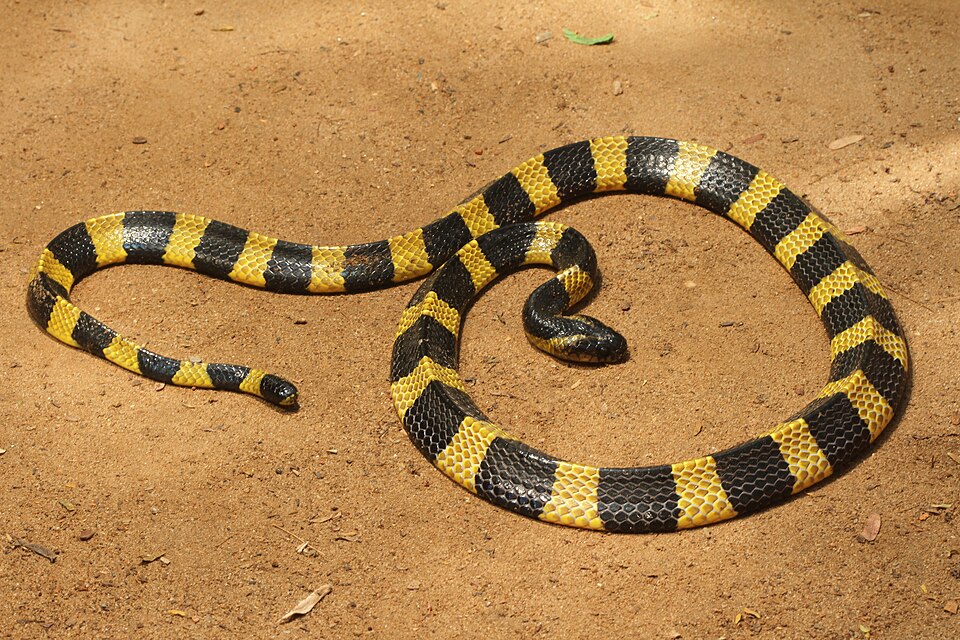
The Krait has a cylindrical and elongated body, a head indistinguishable from the neck and enlarged and hexagonal dorsal vertebral scales. Its typical coloring alternates black or blue-black bands with white, cream or yellowish bands, although some species are more uniformly dark. Its tail is short and slender, and its eyes have round pupils. It has short fixed hooks in the front of the jaw, typical of elapids.
Characteristics
Indicative values: they vary by subspecies, sex and region.
Habitat and distribution
The Krait occupies a wide variety of environments, from agricultural plains to forests to scrub areas. It particularly likes environments close to water, such as rice fields, irrigation canals and wetlands. It is also frequently encountered near human habitations and villages, attracted by the abundance of rodents. It can take refuge in abandoned burrows, piles of wood or piles of stones.
CURRENT RANGE
Krait is found in the Indian subcontinent, Southeast Asia, and parts of southern China. The different species of the Bungarus genus are distributed in particular in India, Pakistan, Bangladesh, Sri Lanka, Burma, Thailand, Vietnam and Indonesia. Its presence is closely linked to the rural and agricultural areas of these regions. It is not found in North Africa or Tunisia.
Behaviour
The Krait is a nocturnal and rather timid snake, seeking to flee rather than attack when it encounters humans. During the day, it remains hidden in burrows, under stones or in piles of debris, moving little. Its bite, although not painful at the time, can be extremely dangerous due to its neurotoxic venom acting on the nervous system. Many accidents happen at night, when people sleeping on the ground are bitten without even immediately realizing it.
Reproduction
The Krait is oviparous and generally lays between 6 and 15 eggs depending on species and conditions. The female lays her eggs in a sheltered location, such as a burrow or a pile of decaying vegetation, and may demonstrate partial guarding of the nest. Incubation lasts about two months before the young hatch, which are independent from birth. Juveniles already have functional venom upon hatching.
Peculiarities
The venom of Krait is considered one of the most toxic among terrestrial snakes, acting by neuromuscular blockade which can lead to respiratory paralysis. Notably, the bite of Krait is often not very painful and does not always cause visible swelling, which sometimes delays awareness of the severity of the envenomation. The common Krait is responsible for a significant number of envenomation deaths in South Asia, particularly during nocturnal bites.
Threats and conservation
The Krait is suffering the destruction of its natural habitat linked to agricultural and urban expansion. It is also killed by local populations for fear of its dangerousness, often during accidental encounters near homes. Some species of the genus are poorly known and their conservation status remains uncertain due to lack of sufficient data.
Numbers and trends vary across sources and regions. See the IUCN assessment for the latest reference data.
Gallery
1 documented photographs.
References
Profile updated 02 September 2026 · Reviewed by the TunisieVet editorial team.
Comments (0)
No comments yet.
CONSERVATION STATUS
Least concern (LC)
IUCN source, latest published assessment.
Species health
Documented diseases for this species.
See the 7 diseases of this species Find a veterinarianThis information is provided for educational purposes only and is not a substitute for a veterinary consultation. If you have any concerns about your animal's health, consult a veterinarian.
To discover around: Krait
Videos, facts, stories and records linked to this species.
Similar animals
Other species documented in Animalpedia.