
Presentation
The Loris designates a group of nocturnal primates belonging to the family Lorisidae, distributed in South and Southeast Asia as well as in sub-Saharan Africa depending on the genera. These animals are characterized by large, round eyes adapted to night vision and slow, precise movements. The slow Loris (genus Nycticebus) is the species best known to the general public, in particular because of its presence in the illegal exotic animal trade. Unlike the majority of venomous mammals, the slow Loris has a brachial gland secreting a toxic substance which it mixes with its saliva. It lives mainly in dense tropical forests where it moves cautiously along branches. Its discreet morphology and furtive behavior make it a difficult animal to observe in its natural environment.
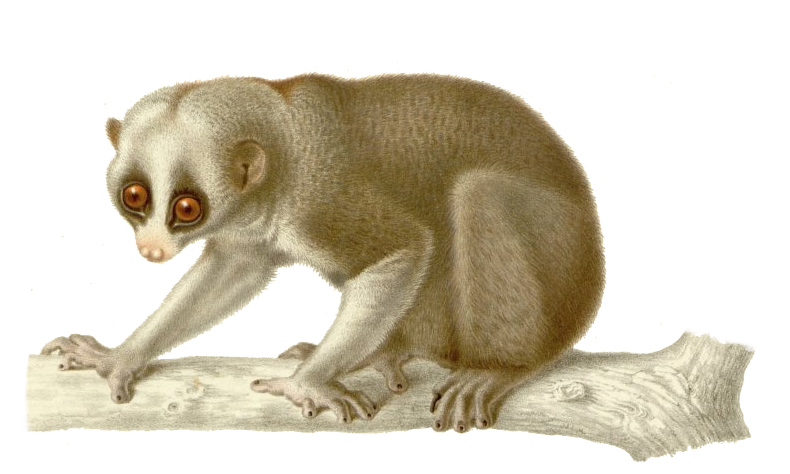
The Loris has a stocky body, a very short or absent tail, and limbs of similar length adapted for slow and sure locomotion. Its large orbicular eyes, rimmed in dark, give it excellent night vision. Its hands and feet with strong gripping ability allow it to hold firmly on branches for long periods of time. The coat is dense, generally reddish-brown to gray, often decorated with a darker dorsal line.
Characteristics
Indicative values: they vary by subspecies, sex and region.
Habitat and distribution
The Loris lives in tropical rainforests, secondary forests and sometimes areas of bamboo or forest edge plantations. It seeks a dense canopy offering continuity and cover for its nocturnal movements. Some African species also occupy gallery forests and dense scrub.
CURRENT RANGE
Slow Loris (genus Nycticebus) are found in South and Southeast Asia, notably in India, Indonesia, Malaysia, the Philippines and the Indochinese peninsula. Related African genera, such as potto and angwantibos, occur in central and west Africa. No wild populations exist outside of these natural areas.
Behaviour
The Loris is a strictly nocturnal and arboreal animal, spending almost all of its existence in the canopy. It moves extremely slowly and avoids sudden movements, a strategy that limits its detection by predators. Solitary most of the time, it can nevertheless share its territory with other individuals in a tolerant manner. When faced with a threat, it adopts a characteristic defensive posture by raising its arms to release the toxic secretion from its brachial glands.
Reproduction
The Loris female generally gives birth to a single young after a gestation of several months, which varies depending on the species. The young remain clinging to its mother's belly for the first few weeks before sometimes being left hidden on a branch while she feeds. Weaning occurs after several months and sexual maturity is reached around the age of one to two years depending on the species.
Peculiarities
The slow Loris is the only known primate to possess a venomous bite, the result of a glandular secretion mixed with saliva. This particularity makes it an important subject of scientific study on the evolution of venom in mammals. Its popularity on social networks has paradoxically increased the pressure on poaching for the illegal pet trade.
Threats and conservation
Loss of forest habitat linked to deforestation poses a major threat to several Loris species. Poaching for the illegal trade, fueled by demand for exotic pets and traditional medicine, is exacerbating population declines. Several species of slow-moving Loris are today classified as threatened by the IUCN.
Numbers and trends vary across sources and regions. See the IUCN assessment for the latest reference data.
Gallery
1 documented photographs.
References
Profile updated 26 August 2026 · Reviewed by the TunisieVet editorial team.
Comments (0)
No comments yet.
CONSERVATION STATUS
Vulnerable (VU)
IUCN source, latest published assessment.
Species health
Documented diseases for this species.
This information is provided for educational purposes only and is not a substitute for a veterinary consultation. If you have any concerns about your animal's health, consult a veterinarian.
To discover around: Loris
Videos, facts, stories and records linked to this species.
RECORD
Toxic brachial glands
Single venomous primate
The slow loris mixes a secretion from its brachial glands with its saliva to produce a tox...
Similar animals
Other species documented in Animalpedia.

TunisieVet in your pocket 📱🐾 Access your veterinary services wherever you are. [ Download the app ]
Learn more