
Presentation
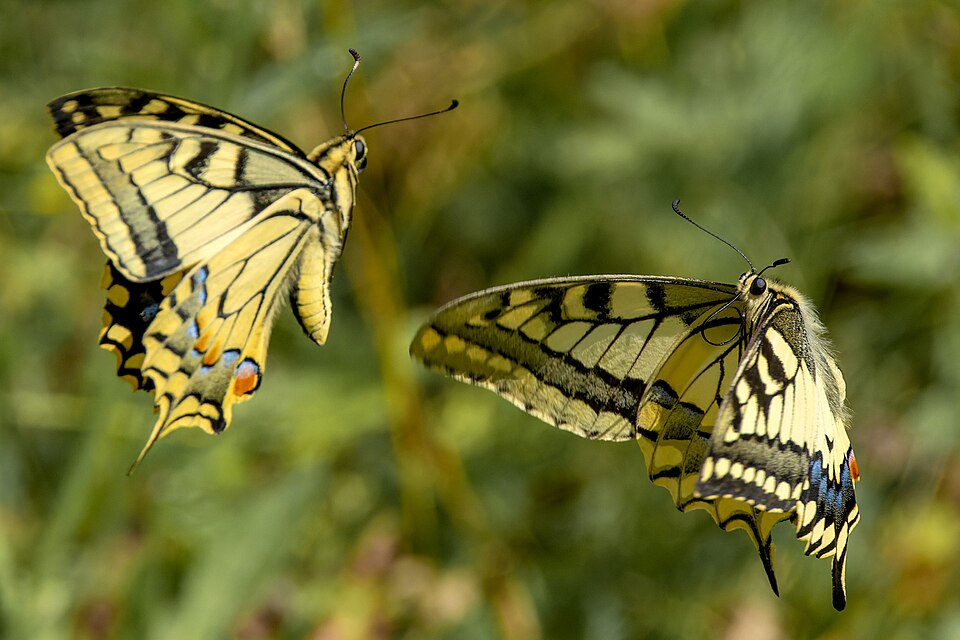
The Old World Swallowtail is a large butterfly recognizable by its pale yellow wings marked with black veins and tail-like extensions on the hind wings. It belongs to the family Papilionidae, which includes some of the world's largest butterflies. Widespread across Europe, North Africa, and much of Asia, it inhabits open flowering habitats. Its caterpillar, green with black stripes and orange spots, feeds on plants in the carrot family such as fennel and wild carrot. The adult is a strong flier, traveling long distances in search of flower nectar. In Tunisia, it ranks among the most common and easiest butterflies to observe.
The wings display a pale yellow ground color streaked with bands and black veins, with blue spots and an orange-red patch near the tail of each hind wing. Wingspan typically ranges from 65 to 90 mm. The body is slender and black, covered in fine scales, and the antennae are club-shaped, as in all Papilionidae.
Characteristics
Indicative values: they vary by subspecies, sex and region.
Habitat and distribution
The swallowtail is found in flower-rich meadows, uncultivated land, gardens, scrubland, and agricultural areas where its host plants grow. It favors open, sunny habitats, from sea level to moderate elevations in the mountains. It adapts readily to cultivated areas and the surroundings of human settlements.
CURRENT RANGE
The species is widely distributed across Europe, North Africa, the Middle East, and much of temperate Asia as far as Japan. It is also present in North America in closely related forms. In Tunisia, it is found throughout the country, from coastal areas to mountainous regions.
Behaviour
The Old World Swallowtail is an active daytime butterfly, flying vigorously and capable of gliding over long distances. Males often display territorial behavior, patrolling high points to spot females. When threatened, the caterpillar deploys a scented orange organ, the osmeterium, located behind the head to deter predators. The species can produce multiple generations per year depending on climate.
Reproduction
The female lays her eggs singly on the leaves of host plants. The caterpillar passes through several larval stages before transforming into a chrysalis, hung vertically from a support by a silk thread. Depending on the region and season, the chrysalis may produce an adult in a few weeks or enter winter dormancy. The complete life cycle allows two to three generations per year in warm temperate regions such as Tunisia.
Peculiarities
The caterpillar possesses a retractable defensive organ called the osmeterium, which releases a foul smell to deter predators. The name "swallowtail" refers to a character from Greek mythology. It is one of the emblematic species used for studying butterfly biology in Europe.
Threats and conservation
The species remains globally common and does not face major threats on a worldwide scale. Locally, intensive pesticide use and the loss of flower-rich uncultivated land may reduce its populations. Certain isolated subpopulations, particularly in Great Britain, are more vulnerable and benefit from local protection measures.
Numbers and trends vary across sources and regions. See the IUCN assessment for the latest reference data.
Gallery
1 documented photographs.
References
Profile updated 08 September 2026 · Reviewed by the TunisieVet editorial team.
Comments (0)
No comments yet.
CONSERVATION STATUS
Least concern (LC)
IUCN source, latest published assessment.
Similar animals
Other species documented in Animalpedia.

TunisieVet in your pocket 📱🐾 Access your veterinary services wherever you are. [ Download the app ]
Learn more