
Presentation
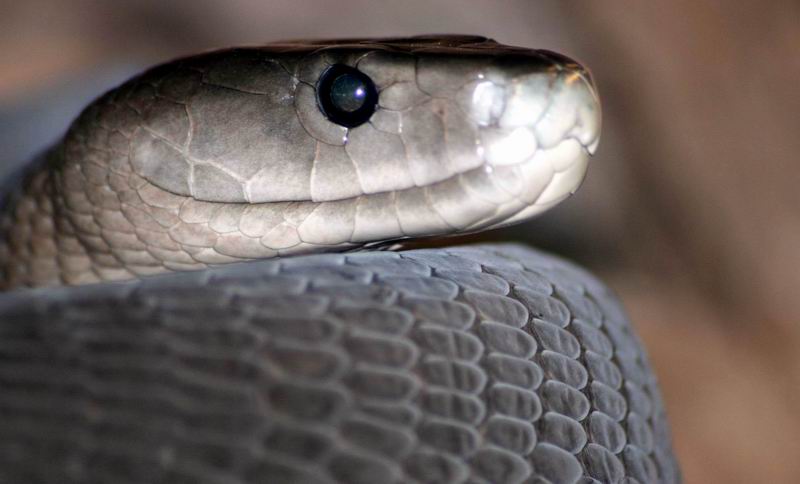
Mamba designates several species of venomous snakes of the Dendroaspis genus, including the famous black Mamba (Dendroaspis polylepis) and the green Mamba (Dendroaspis viridis in particular). These African reptiles are among the most feared snakes due to the power of their neurotoxic venom and their liveliness. The black Mamba, the most famous, is also one of the fastest snakes in the world over short distances. The green Mambas, more arboreal, are discreet and less aggressive than their terrestrial cousin. They occupy various environments in sub-Saharan Africa, from savannahs to forests. No Mamba species are present in Tunisia.
Long and slender body, which can exceed 3 meters for the black Mamba, with a narrow coffin-shaped head. Coloration varies from olive-gray to dark brown for the black Mamba (whose name comes from the black inside of its mouth), to bright green for arboreal species. The scales are smooth and shiny, and the eyes have a round pupil characteristic of venomous colubrids with fixed fangs.
Characteristics
Indicative values: they vary by subspecies, sex and region.
Habitat and distribution
The black Mamba frequents savannahs, rocky areas and light forests, while the green Mambas favor tropical forests and dense wooded areas. These snakes seek out shelters such as termite mounds, rock crevices or tree cavities. They generally avoid areas that are too humid or desert.
CURRENT RANGE
Mambas are endemic to sub-Saharan Africa, with variable distributions depending on the species. The black Mamba is found in East and Southern Africa, while the green Mambas are found in West and East Africa. No species of Mamba lives naturally in North Africa.
Behaviour
The Mamba is a diurnal, active and fast snake, capable of fleeing quickly in case of danger rather than attacking directly. It becomes defensive when it feels cornered, raising the front of its body and opening its mouth as a sign of warning. The black Mamba is mainly terrestrial while the green Mambas are mainly arboreal. It is a solitary animal that does not form social groups.
Reproduction
Reproduction is oviparous, the female laying between 6 and 17 eggs depending on the species, generally in the warm season. Incubation lasts about 80 to 90 days, after which the young are completely autonomous and already venomous upon hatching. No parental care is provided after egg-laying.
Peculiarities
The black Mamba gets its name from the black color of the inside of its mouth, visible when it feels threatened, and not from the color of its skin. Its neurotoxic venom acts very quickly on the nervous system, causing paralysis which can be fatal without rapid antivenom treatment. Despite its reputation, the black Mamba generally avoids contact with humans.
Threats and conservation
The Mambas are threatened by the destruction of their natural habitat due to deforestation and agricultural expansion. They are also persecuted by local people out of fear, which leads to their direct destruction. Habitat fragmentation limits their movements and hunting areas.
Numbers and trends vary across sources and regions. See the IUCN assessment for the latest reference data.
Gallery
1 documented photographs.
References
Profile updated 02 September 2026 · Reviewed by the TunisieVet editorial team.
Comments (0)
No comments yet.
CONSERVATION STATUS
Least concern (LC)
IUCN source, latest published assessment.
Species health
Documented diseases for this species.
See the 4 diseases of this species Find a veterinarianThis information is provided for educational purposes only and is not a substitute for a veterinary consultation. If you have any concerns about your animal's health, consult a veterinarian.
To discover around: Mamba
Videos, facts, stories and records linked to this species.
RECORD
up to 11-19 km/h
One of the fastest snakes in the world
Maximum speed measured for a black mamba moving on flat, open ground.
Similar animals
Other species documented in Animalpedia.

TunisieVet in your pocket 📱🐾 Access your veterinary services wherever you are. [ Download the app ]
Learn more