
Presentation
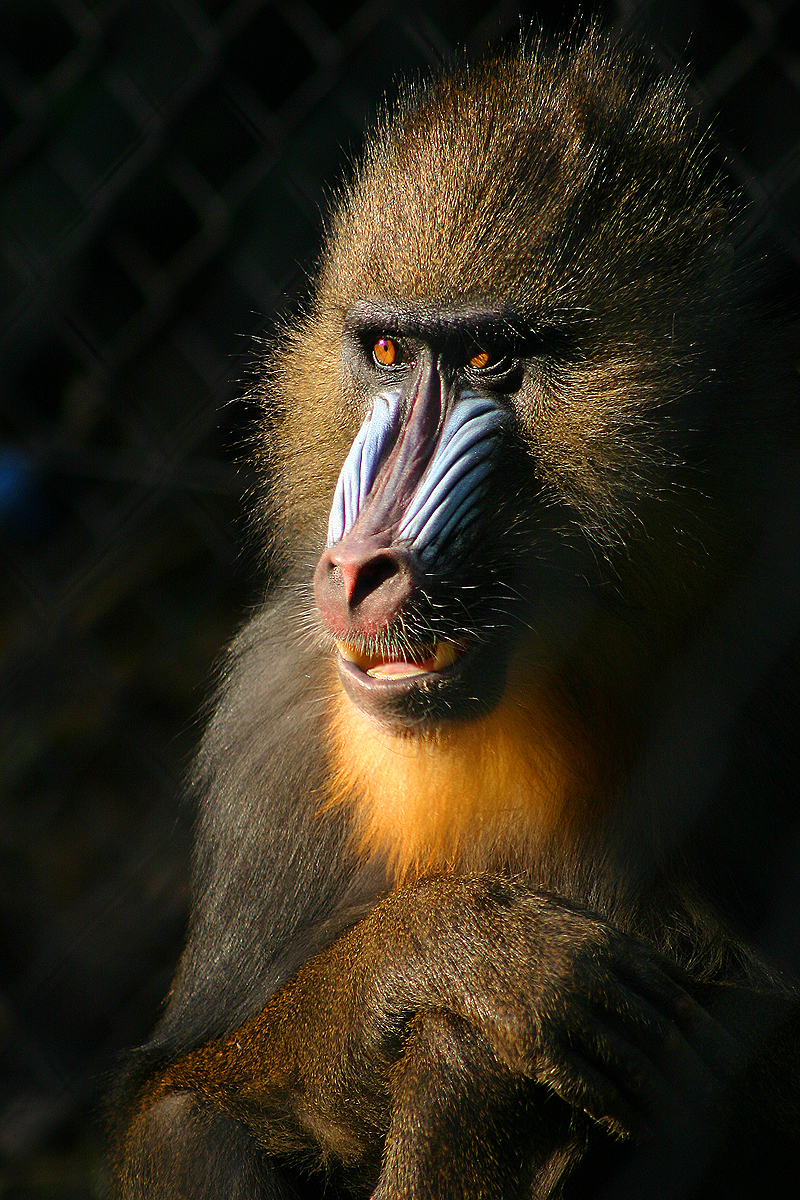
The Mandrill (Mandrillus sphinx) is a large monkey native to the forests of central Africa. It is distinguished by its colorful face, red and blue, particularly marked in dominant males. A social species, it lives in groups that can bring together several dozen or even hundreds of individuals. It is the largest ape in the world after the great apes proper (gorilla, orangutan, chimpanzee, bonobo). It spends most of its time on the ground, although it can climb trees for food or shelter. The species is today threatened by deforestation and hunting.
The Mandrill has an olive-brown coat and an elongated snout streaked with bright red and blue colors, more pronounced in males. It exhibits strong sexual dimorphism: males are significantly larger and more colorful than females. Its powerful limbs and jaw with long canines make it a physically impressive animal.
Characteristics
Indicative values: they vary by subspecies, sex and region.
Habitat and distribution
The Mandrill lives mainly in the dense, humid tropical forests of central Africa. It also frequents forest edges and certain areas of wooded savannah near forest massifs.
CURRENT RANGE
The species is present in Gabon, Cameroon, Equatorial Guinea and Congo. Its distribution remains limited to this region of central Africa, with no natural presence elsewhere on the continent.
Behaviour
Mandrill live in matriarchal groups called "hordes", which can temporarily gather in supergroups of several hundred individuals. The social hierarchy is marked, particularly among males whose rank is reflected by the intensity of facial colors. Communication occurs through vocalizations, facial expressions and body postures.
Reproduction
Reproduction is not strictly seasonal, although peaks in births are observed in the dry season. Gestation lasts about six months and usually results in the birth of a single young. The youngster remains dependent on his mother for several months before gaining independence.
Peculiarities
The Mandrill is renowned for its bright facial and buttock colors, unique among primates. The intensity of these colors reflects the social and hormonal status of the male. It holds the title of largest non-anthropoid ape in the world.
Threats and conservation
Deforestation linked to logging and agriculture is reducing its natural habitat. Hunting for bushmeat poses a significant threat in many parts of its range. The illegal exotic pet trade also affects the species.
Numbers and trends vary across sources and regions. See the IUCN assessment for the latest reference data.
Gallery
1 documented photographs.
References
Profile updated 26 August 2026 · Reviewed by the TunisieVet editorial team.
Comments (0)
No comments yet.
CONSERVATION STATUS
Vulnerable (VU)
IUCN source, latest published assessment.
Species health
Documented diseases for this species.
See the 7 diseases of this species Find a veterinarianThis information is provided for educational purposes only and is not a substitute for a veterinary consultation. If you have any concerns about your animal's health, consult a veterinarian.
To discover around: Mandrill
Videos, facts, stories and records linked to this species.
RECORD
up to 95 cm head-body length
Largest ape (non-anthropoid)
Measurement carried out in adult males, larger than females.
Similar animals
Other species documented in Animalpedia.

TunisieVet in your pocket 📱🐾 Access your veterinary services wherever you are. [ Download the app ]
Learn more