Presentation
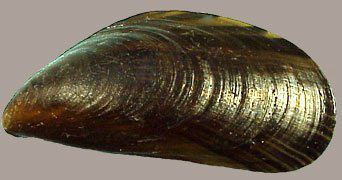
The mussel is a marine bivalve mollusk that lives anchored to rocks, piers, and submerged structures by means of filaments called a byssus. It has an elongated shell ranging in color from blue-black to dark brown, formed of two symmetric valves joined by a hinge. An active filter-feeder, the animal sustains itself by drawing in seawater to extract plankton and organic particles. Very common on rocky coasts and in intertidal zones, it is also widely farmed for human consumption. Several closely related species are grouped under this common name, the most well-known being the common mussel (Mytilus edulis) and the Mediterranean mussel (Mytilus galloprovincialis).
The shell, composed of calcium carbonate, has an oval and elongated shape, narrower at the front than at the rear. Its external color ranges from blue-black to violet-brown, while the interior is pearlescent and whitish. The animal's soft body is protected by the two valves, which close hermetically in case of danger or exposure to air. The byssus, a bundle of proteinaceous filaments secreted by a gland, allows it to anchor firmly to hard substrates.
Characteristics
Indicative values: they vary by subspecies, sex and region.
Habitat and distribution
Mussels colonize the intertidal and subtidal zones of rocky shores, as well as artificial substrates such as docks, pilings, and mussel farms. They tolerate significant variations in salinity and temperature, allowing them to thrive in open ocean and estuarine environments alike. Mussel farming, known as mussel culture, is practiced in sea or lagoon settings on ropes, poles, or suspended lines.
CURRENT RANGE
Various mussel species are found in most temperate and cold seas worldwide, notably in the North Atlantic, the Mediterranean Sea, and along the Pacific coasts. The Mediterranean mussel is found particularly along Tunisian shores, where it has been subject to traditional and aquacultural harvesting, especially in Lake Bizerte and the lagoons in the northern part of the country.
Behaviour
A sessile animal in adulthood, the mussel remains fixed in the same location throughout its life by means of its byssus. It typically lives in dense colonies, forming beds that can contain thousands of individuals on a single substrate. It closes its valves during low tide or when a predator is present, which limits drying out and injury.
Reproduction
Reproduction occurs through external fertilization, with males and females typically separate. Adults release male and female gametes directly into the water, often in response to environmental signals such as temperature. The fertilized egg develops into a planktonic larva called a veliger, which drifts for several weeks before settling on a substrate and metamorphosing into a juvenile mussel.
Peculiarities
The mussel's byssus, which is highly resistant, has inspired research in biomaterials for developing high-performance adhesives for use in wet environments. The species' filtration capacity—several liters of water per day per individual—makes it a good indicator of coastal water quality.
Threats and conservation
Coastal water pollution, particularly from heavy metals and toxic algal blooms, can affect mussel survival and food safety. Warming waters and ocean acidification weaken the formation of the calcium shell. Wild populations are also subject to overharvesting in certain areas, though mussel farming largely meets commercial demand.
Numbers and trends vary across sources and regions. See the IUCN assessment for the latest reference data.
Gallery
1 documented photographs.
References
Profile updated 30 August 2026 · Reviewed by the TunisieVet editorial team.
Comments (0)
No comments yet.
CONSERVATION STATUS
Least concern (LC)
IUCN source, latest published assessment.
Species health
Documented diseases for this species.
Find a veterinarianThis information is provided for educational purposes only and is not a substitute for a veterinary consultation. If you have any concerns about your animal's health, consult a veterinarian.

Be among the first to use our app. Sign up and get early Google Play access.
Discover