
Presentation
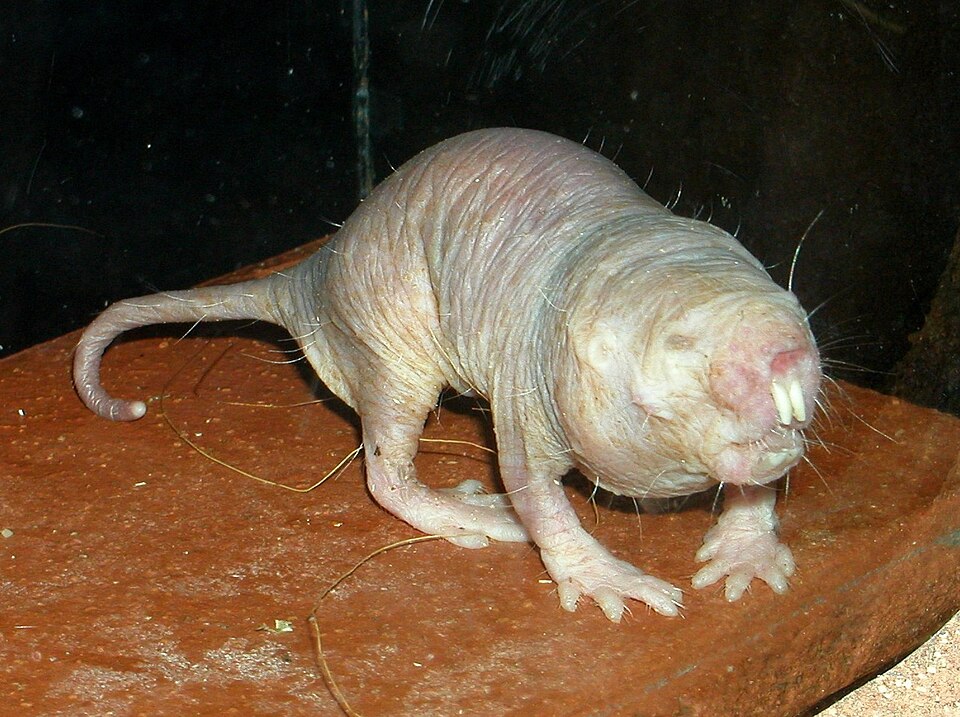
The naked mole-rat (Heterocephalus glaber) is a small burrowing rodent from the Horn of Africa, famous for its unique eusocial organization among mammals. Hairless, it lives in colonies structured around a reproductive queen, much like social insects. Its wrinkled, pinkish skin, long incisors, and almost complete absence of hair give it a singular appearance. It attracts major scientific interest for its exceptional cancer resistance, tolerance to low oxygen levels, and remarkable longevity for a rodent of its size.
The naked mole-rat measures about 3 to 4 inches long and weighs 1 to 1.25 ounces. Its hairless, wrinkled skin is pale pink to beige in color, suited to underground life in total darkness. Its prominent incisors, which move independently of the jaw, serve to dig tunnels. It has an unusual temperature regulation system, behaving almost like a poikilothermic animal (variable-blooded).
Characteristics
Indicative values: they vary by subspecies, sex and region.
Habitat and distribution
The naked mole-rat lives exclusively in complex underground tunnel networks beneath the arid and semi-desert savannas of the Horn of Africa. These tunnels can extend several kilometres and maintain an atmosphere poor in oxygen, which the species tolerates remarkably well. It avoids prolonged exposure to open air and daylight. This underground lifestyle offers some protection from surface predators.
CURRENT RANGE
The species is endemic to the Horn of Africa, particularly Ethiopia, Kenya, and Somalia. It occupies arid and semi-arid areas where the soil permits digging stable tunnel systems. Its range remains restricted to these regions of East Africa. It does not occur naturally elsewhere in the world.
Behaviour
It is the only truly eusocial mammal known, living in colonies that can number up to 300 individuals organized into castes. A single female, the queen, reproduces with a few males, while other colony members dig tunnels, defend the colony, and maintain the underground network. Individuals communicate through various vocalizations and cooperate closely to maintain the tunnel system. This social organization resembles that of insect colonies such as bees or termites.
Reproduction
Only the queen of the colony reproduces; other females remain sterile as long as she maintains social dominance. Gestation lasts approximately 70 days and produces litters of up to a dozen young. The queen can breed multiple times per year throughout her life, which is considerably longer than that of other colony members. Young are fed and protected collectively by non-breeding members.
Peculiarities
The naked mole-rat is studied for its exceptional resistance to cancer, which is virtually never observed in this species. It tolerates extremely low oxygen levels and can survive several minutes in near-total anoxia. Its longevity, which can exceed 30 years, is exceptional compared to that of similarly sized rodents. It experiences virtually no pain from certain chemical stimuli such as acid.
Threats and conservation
The species is not considered threatened throughout its natural range. It is partly protected by its underground lifestyle, which limits exposure to predators and human activities. Some local populations may be affected by habitat degradation or agricultural expansion. It is in high demand for scientific and biomedical research, with no significant impact on wild populations.
Numbers and trends vary across sources and regions. See the IUCN assessment for the latest reference data.
Gallery
1 documented photographs.
References
Profile updated 18 September 2026 · Reviewed by the TunisieVet editorial team.
Comments (0)
No comments yet.
CONSERVATION STATUS
Least concern (LC)
IUCN source, latest published assessment.
Species health
Documented diseases for this species.
This information is provided for educational purposes only and is not a substitute for a veterinary consultation. If you have any concerns about your animal's health, consult a veterinarian.
To discover around: Naked Mole-rat
Videos, facts, stories and records linked to this species.
RECORD
Virtually no incidence of tumors
The rodent most resistant to cancer
Finding documented in laboratory colonies studied over several decades.
Similar animals
Other species documented in Animalpedia.

TunisieVet in your pocket 📱🐾 Access your veterinary services wherever you are. [ Download the app ]
Learn more