Presentation
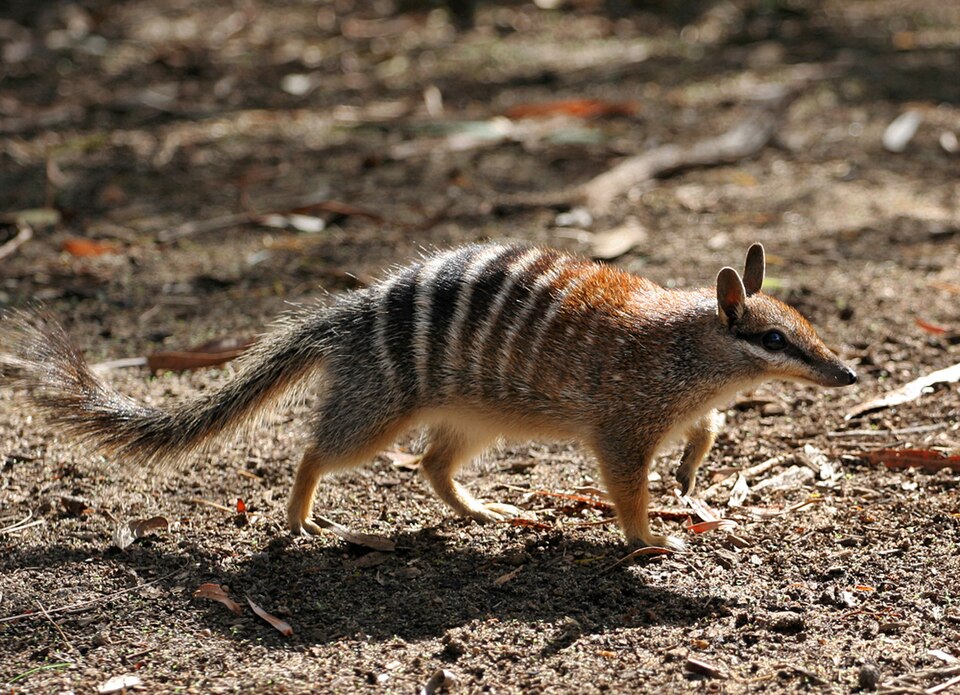
The numbat is a small Australian marsupial recognizable by its reddish-brown fur striped with white bands on the hindquarters. Unlike most marsupials, it is active during the day, which makes it easy to observe as it searches for termites. Its long, sticky tongue and pointed snout are adapted for a diet consisting almost exclusively of termites. Once widespread across much of southern Australia, it experienced a drastic decline and now survives only in a few isolated populations in Western Australia. It is one of the rare diurnal marsupials and is the faunal emblem of this Australian state.
The numbat measures approximately 35 to 45 cm in length, including its bushy tail, and weighs 300 to 700 grams. Its fur ranges from reddish to greyish-brown, adorned with four to eleven white transverse bands on the back and a black stripe running through the eye. It has up to 52 teeth, a high number for mammals, although most are small and not very functional. Its tail is long, bushy, and often held upright, resembling that of a squirrel.
Characteristics
Indicative values: they vary by subspecies, sex and region.
Habitat and distribution
The numbat inhabits dry eucalyptus forests, particularly those with Wandoo trees, and wooded areas where fallen timber supports the presence of termite mounds. The presence of hollow logs and dead wood on the ground is essential, as these serve as day and night shelters. Its habitat has been greatly reduced by agricultural clearing, limiting its presence to a few protected reserves.
CURRENT RANGE
The species is endemic to Australia and once ranged across a wide band in the continent's south, from desert to coast. Today, wild populations survive only in a few forests of Western Australia, notably the Dryandra and Perup reserves. Reintroduction programs have established small populations in protected wildlife sanctuaries in other states.
Behaviour
The numbat is a solitary and territorial animal, active only during the day—a rare trait among Australian marsupials. At night it shelters in burrows or hollow logs to escape predators and temperature fluctuations. It moves on the ground with quick, jerky movements, stopping frequently to sniff the ground in search of termite galleries. Shy and inconspicuous, it quickly flees to shelter at the first sign of danger.
Reproduction
The female numbat gives birth to a litter of two to four young per year, typically in early Australian summer. Lacking a true marsupial pouch, she carries her young attached to her teats in a protected furry area on her belly. The young are then left in a burrow while the mother goes foraging, becoming independent by around nine months of age. Sexual maturity is reached in the first year.
Peculiarities
The numbat is one of the few marsupial mammals to be exclusively diurnal, an adaptation linked to the activity patterns of its termite prey. It lacks a functional marsupial pouch, a rarity among Australian marsupials. It is also the official animal emblem of Western Australia.
Threats and conservation
The introduction of exotic predators such as the red fox and domestic cat has dramatically reduced numbat populations. Destruction of its forest habitat through agriculture and fire poses an additional threat. Its low genetic diversity, resulting from past population bottlenecks, further undermines its long-term survival.
Numbers and trends vary across sources and regions. See the IUCN assessment for the latest reference data.
Gallery
1 documented photographs.
References
Profile updated 02 September 2026 · Reviewed by the TunisieVet editorial team.
Comments (0)
No comments yet.
CONSERVATION STATUS
Endangered (EN)
IUCN source, latest published assessment.
Species health
Documented diseases for this species.
This information is provided for educational purposes only and is not a substitute for a veterinary consultation. If you have any concerns about your animal's health, consult a veterinarian.
Similar animals
Other species documented in Animalpedia.

Be among the first to use our app. Sign up and get early Google Play access.
Discover