
Presentation
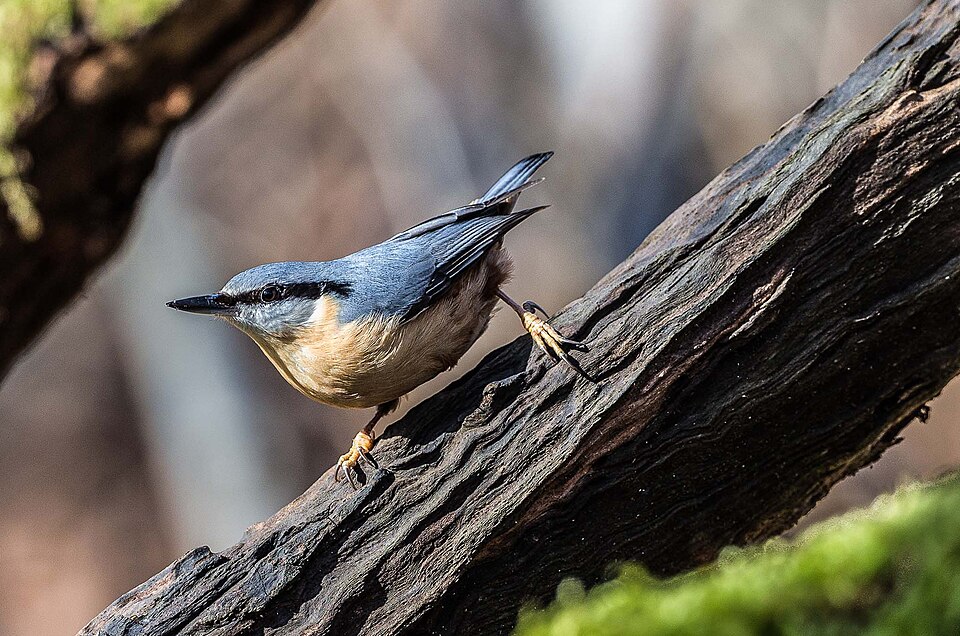
The Eurasian nuthatch (Sitta europaea) is a small woodland songbird with blue-grey plumage on the back and rust-orange on the flanks. It is recognizable by its unique ability to descend tree trunks head-first, unlike woodpeckers. Its powerful, pointed bill allows it to probe bark and crack seeds wedged in crevices. Found throughout the temperate forests of Europe and Asia, it is a year-round resident and remains territorial throughout the year. In Tunisia, a local subspecies inhabits cork oak forests in the northwestern part of the country.
The nuthatch measures approximately 12 to 14 cm in length with a wingspan of 22 to 27 cm. Its blue-grey plumage contrasts with a black mask crossing the eye and a whitish throat. The flanks and belly are rust to orange-toned, more pronounced in males. The compact body, short tail, and robust feet with powerful claws are all adapted to life in the trees.
Characteristics
Indicative values: they vary by subspecies, sex and region.
Habitat and distribution
This species favors mature deciduous and mixed forests with plenty of old trees offering nesting cavities. It is also found in wooded parks, tree-lined gardens and old orchards. In Tunisia, it is associated with cork oak and Algerian oak forests in the Kroumirie and Mogods massifs.
CURRENT RANGE
The Eurasian nuthatch is widely distributed across Europe, temperate Asia and the Maghreb. It is present from the British Isles to Japan, with numerous regional subspecies. In North Africa, it occupies isolated populations in the forest massifs of northern Tunisia, Algeria and Morocco.
Behaviour
The nuthatch is a lively and agile bird, able to move in all directions on trunks and branches, including head downwards. It defends a territory year-round and typically lives in a stable pair bond. Its call is loud and resonant, often heard before the bird itself is seen. It has the distinctive habit of plastering the entrance to its nesting cavity with mud to reduce the opening and protect itself from predators.
Reproduction
The nuthatch nests in natural cavities in trees or abandoned woodpecker holes, which it lines with fine bark. The female typically lays 6 to 9 white eggs spotted with reddish-brown, once a year in spring. Incubation lasts about 15 days and is carried out mainly by the female. The young leave the nest after roughly three weeks but remain dependent on their parents for a few more days.
Peculiarities
The nuthatch is the only European bird capable of descending tree trunks head-first thanks to a special articulation of its hind leg. It seals the entrance of its nest with dried mud to adjust the hole diameter. It also caches its food reserves in multiple hiding places that it memorizes with precision.
Threats and conservation
Deforestation and the loss of cavity-bearing old trees reduce available nesting sites. Fragmentation of forest massifs isolates certain populations, particularly in North Africa. It remains however a species that is globally little threatened on a worldwide scale.
Numbers and trends vary across sources and regions. See the IUCN assessment for the latest reference data.
Gallery
1 documented photographs.
References
Profile updated 05 September 2026 · Reviewed by the TunisieVet editorial team.
Comments (0)
No comments yet.
CONSERVATION STATUS
Least concern (LC)
IUCN source, latest published assessment.
Species health
Documented diseases for this species.
This information is provided for educational purposes only and is not a substitute for a veterinary consultation. If you have any concerns about your animal's health, consult a veterinarian.
Similar animals
Other species documented in Animalpedia.

TunisieVet in your pocket 📱🐾 Access your veterinary services wherever you are. [ Download the app ]
Learn more