
Presentation
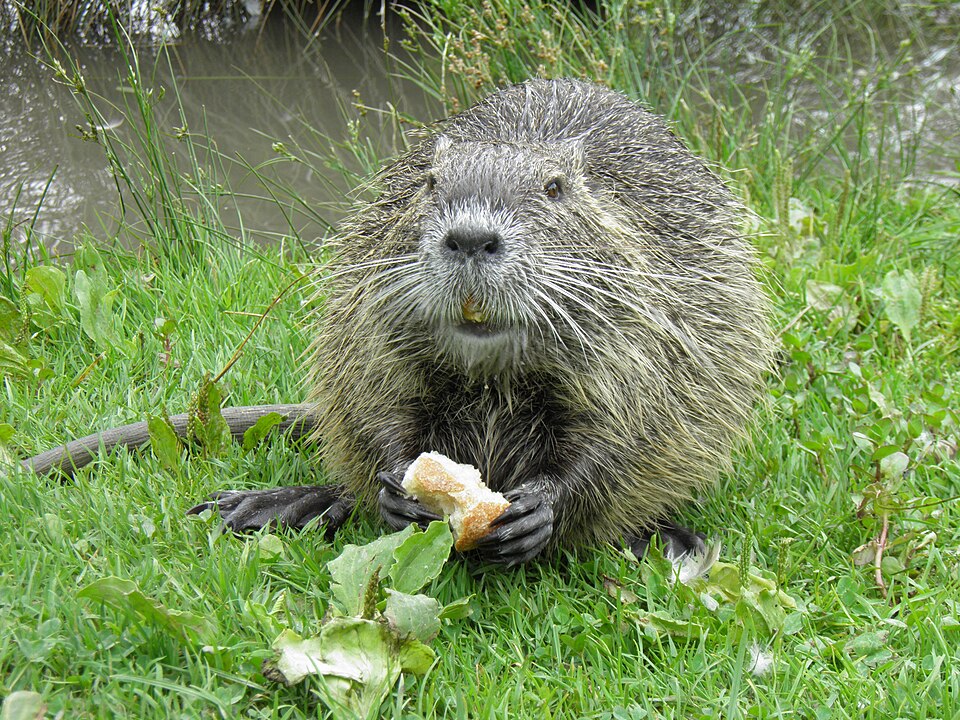
The Nutria (Myocastor coypus) is a large semi-aquatic rodent native to South America, introduced to other continents for fur farming and then largely escaped into the wild. Recognizable by its brown fur, its round tail and its long orange incisors, it resembles a modest-sized beaver but belongs to a different family. It lives in wetlands, marshes, ponds and streams with abundant vegetation. Considered an invasive species in many regions where it has been introduced, it causes damage to banks and aquatic vegetation. Its rapid reproduction and its absence of natural predators in certain environments favor its expansion. In Tunisia, its presence remains anecdotal and linked to occasional introductions or to detention in captivity.
The Nutria is distinguished by its dense, waterproof reddish-brown fur, its webbed hind legs, and its long, cylindrical tail covered with scales. Its incisors, large and orange in color, are visible even with the mouth closed and grow continuously. Its stocky body and massive head, equipped with developed vibrissae, give it a recognizable silhouette close to that of a large muskrat.
Characteristics
Indicative values: they vary by subspecies, sex and region.
Habitat and distribution
The Nutria frequents wetlands, marshes, ponds, rivers and canals lined with dense vegetation. It appreciates soft banks where it can dig burrows and areas with abundant aquatic vegetation serving as food and shelter. It can also colonize water points near agricultural or urban areas.
CURRENT RANGE
Native to South America, particularly the Amazon basin and temperate regions of Argentina, Chile and Uruguay, Nutria has been introduced to Europe, North America, Asia and Africa for breeding. Wild populations have established themselves permanently in several of these regions after escapes or voluntary releases. Its presence in North Africa, including Tunisia, remains limited and localized.
Behaviour
The Nutria is a semi-aquatic rodent, mainly crepuscular and nocturnal, which spends much of its time in water or in the immediate vicinity of banks. It digs burrows in slopes and sometimes builds platforms of floating vegetation to rest or feed its young. It is a rather gregarious animal, living in small family groups, but it can also be observed in isolation. A good swimmer and diver, it uses its webbed hind legs to move efficiently in an aquatic environment.
Reproduction
The female can reproduce from the age of 4 to 6 months and give birth to several litters per year after a gestation of around 130 days. Each litter has an average of 4 to 6 young, capable of swimming a few hours after birth. This strong reproductive potential explains the rapid colonization of favorable environments.
Peculiarities
The female's teats are located on the sides rather than on the stomach, which allows the young to suckle while the mother swims. Its orange incisors, due to iron-rich enamel, remain permanently visible. The Nutria is often confused with the beaver or muskrat due to its silhouette and aquatic lifestyle.
Threats and conservation
In its native range, the Nutria is hunted for its fur and meat, but it is not subject to major threats to its natural populations. In the regions where it has been introduced, it is on the contrary considered harmful and is the subject of regulation or eradication programs because of the damage it causes to banks and crops.
Numbers and trends vary across sources and regions. See the IUCN assessment for the latest reference data.
Gallery
1 documented photographs.
References
Profile updated 21 August 2026 · Reviewed by the TunisieVet editorial team.
Comments (0)
No comments yet.
CONSERVATION STATUS
Least concern (LC)
IUCN source, latest published assessment.
Species health
Documented diseases for this species.
See the 8 diseases of this species Find a veterinarianThis information is provided for educational purposes only and is not a substitute for a veterinary consultation. If you have any concerns about your animal's health, consult a veterinarian.
Similar animals
Other species documented in Animalpedia.

TunisieVet in your pocket 📱🐾 Access your veterinary services wherever you are. [ Download the app ]
Learn more