Presentation
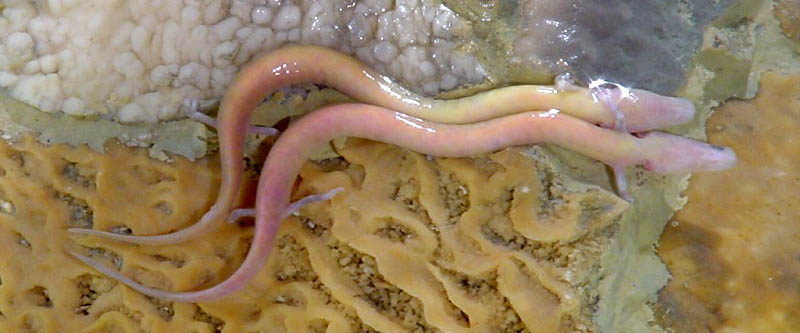
The olm is an aquatic tailed amphibian and a cave-dwelling species found naturally in the karst caves of southeastern Europe. Its elongated, eel-like body lacks pigmentation, giving it a pinkish to whitish appearance that reveals blood vessels beneath the skin. It has feathery external gills that persist throughout its life, an example of permanent neoteny. Its eyes are atrophied and covered by skin, making the species completely blind and relying instead on well-developed chemical and electromagnetic senses for orientation. It lives exclusively in the dark underground waters of the Dinaric limestone massifs. Its exceptional longevity and extremely slow metabolism make it an emblematic animal of biospeleology.
Cylindrical, elongated body reaching up to 30 cm, with short slender limbs bearing few digits. Depigmented and translucent skin, absence of functional eyes, bright red external gills. Extremely reduced metabolism allowing it to survive without food for several years.
Characteristics
Indicative values: they vary by subspecies, sex and region.
Habitat and distribution
It lives exclusively in underground waters of limestone caves, subterranean rivers and lakes where total darkness and stable, cool temperatures prevail. This confined environment, poor in nutrients, has shaped its extreme troglobiotic adaptations.
CURRENT RANGE
The species is endemic to the Dinaric Alps, found mainly in Slovenia, Croatia, Bosnia-Herzegovina and northeastern Italy. Its range is fragmented and strictly linked to the underground karst systems of this region.
Behaviour
A solitary and largely sedentary animal, it spends most of its time hidden under stones or in crevices within caves. Its activity level is low, with slow and infrequent movements to conserve energy. It communicates and perceives its environment through electrical, chemical, and mechanical signals rather than visual cues.
Reproduction
Reproduction is either oviparous or sometimes ovoviviparous depending on the population and environmental conditions. The female may lay around fifteen eggs which she actively protects, or in some cases give birth to a small number of already-developed larvae. Sexual maturity is attained late, typically between 10 and 15 years of age, and intervals between breeding events can span several years.
Peculiarities
The proteus can survive several years without food thanks to an extreme slowing of its metabolism. It is capable of detecting magnetic and electrical fields, an ability rare among vertebrates. Its longevity can exceed 70 years, a record among amphibians.
Threats and conservation
Pollution of underground waters and degradation of karst systems threaten its fragile habitats. Uncontrolled speleological tourism and illegal collection for sale to collectors pose additional pressures. Fragmentation of populations due to the geographical isolation of caves limits genetic exchange.
Numbers and trends vary across sources and regions. See the IUCN assessment for the latest reference data.
Gallery
1 documented photographs.
References
Profile updated 02 September 2026 · Reviewed by the TunisieVet editorial team.
Comments (0)
No comments yet.
CONSERVATION STATUS
Vulnerable (VU)
IUCN source, latest published assessment.
Species health
Documented diseases for this species.
Find a veterinarianThis information is provided for educational purposes only and is not a substitute for a veterinary consultation. If you have any concerns about your animal's health, consult a veterinarian.
To discover around: Olm
Videos, facts, stories and records linked to this species.
RECORD
over 70 years
The longest-lived amphibian
Estimate based on monitoring of captive and wild populations in Slovenia.
Similar animals
Other species documented in Animalpedia.

Be among the first to use our app. Sign up and get early Google Play access.
Discover