
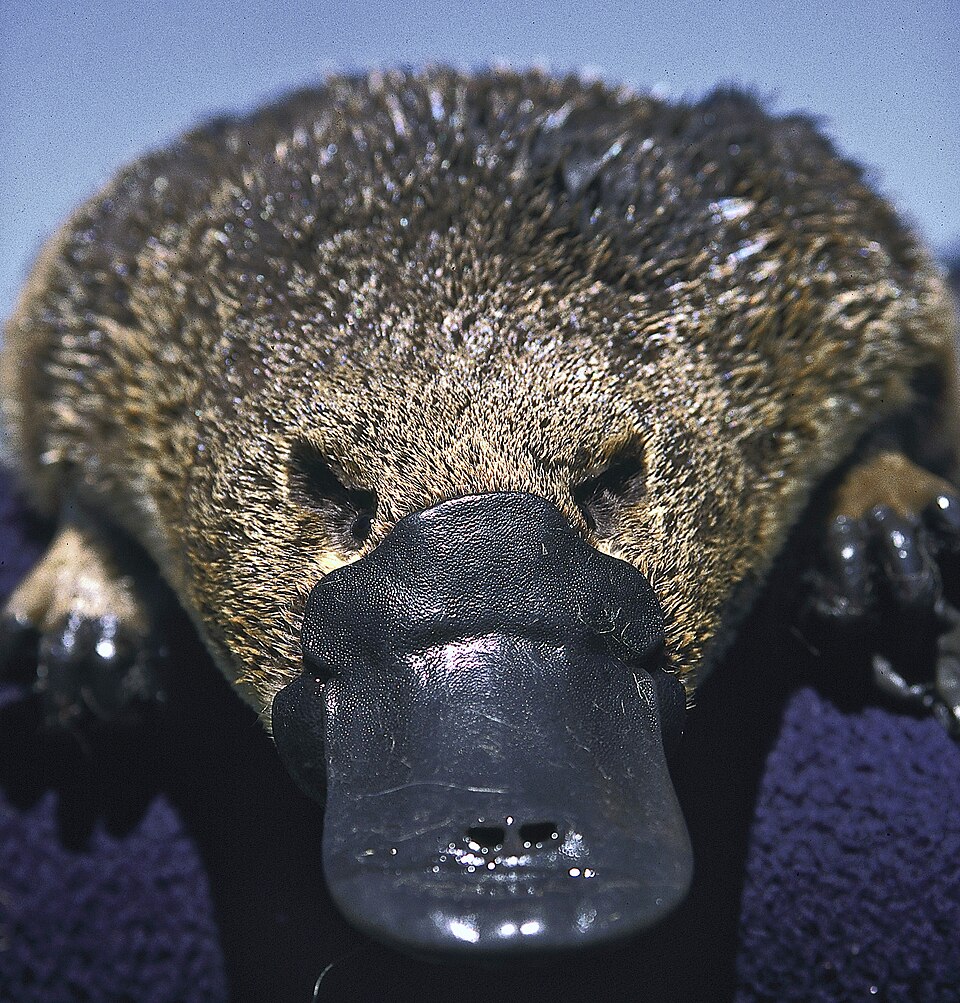
Presentation
The Platypus is a monotreme mammal endemic to eastern Australia, famous for its hybrid appearance combining a duck bill, a beaver tail and an otter body. Discovered by European naturalists at the end of the 18th century, it was long considered a curiosity or even a scientific hoax as its anatomy seemed improbable. It is one of the only living mammals to lay eggs and one of the few to be venomous. It lives in rivers and freshwater streams, where it hunts small invertebrates using an extremely sensitive beak. Discreet and mainly nocturnal, it is rarely observed despite its notoriety. Its unique biology makes it a major subject of study for understanding the evolution of mammals.
The Platypus is a semi-aquatic mammal recognizable by its soft horny beak, waterproof brown fur, and clawed webbed feet. Males have a venomous dewclaw on their hind legs, used in territorial fights. It is one of the rare oviparous mammals, laying eggs like other monotremes. Its beak is equipped with very sensitive electroreceptors and mechanoreceptors which allow it to detect its prey in murky water.
Characteristics
Indicative values: they vary by subspecies, sex and region.
Habitat and distribution
The species lives in slow-moving freshwater rivers, streams and lakes, lined with vegetation allowing burrows to be dug in the banks. It frequents both cool mountain streams and more temperate low altitude zones. Water quality and the presence of invertebrate prey are determining factors for its establishment. It avoids heavily polluted or artificial environments.
CURRENT RANGE
Platypus is endemic to eastern and southeastern Australia, including Tasmania. It is found from Queensland to Victoria and Tasmania, along freshwater courses. Its distribution has declined in certain urbanized or agricultural areas since European colonization. However, it remains present in many protected watersheds.
Behaviour
The Platypus is a solitary, primarily crepuscular and nocturnal animal that spends much of its time swimming and digging burrows in riverbanks. An excellent diver, it closes its eyes, ears and nostrils underwater and locates its prey using electroreceptors located in its beak. It can remain submerged for about one to two minutes before coming up to breathe. Apart from reproduction, it avoids its conspecifics and defends an aquatic territory.
Reproduction
Breeding takes place once a year, generally between winter and austral spring. After mating, the female digs a special burrow where she lays one to three eggs which she incubates while holding them close to her body. The young are born blind and hairless, and feed on mother's milk secreted directly through the skin, the Platypus not having nipples. Weaning occurs after about four months, during which the young remain in the burrow.
Peculiarities
Platypus is one of only five extant monotreme mammals, a group that lays eggs instead of giving birth to live young. The male has a venomous dewclaw capable of inflicting intense pain on humans, although not fatal. Its beak functions as a sixth sense thanks to electroreception, a rare ability among mammals. Its discovery revolutionized the zoological classification of the 19th century.
Threats and conservation
The main threats are river degradation, drought, habitat fragmentation and dams that disrupt river connectivity. Water pollution and the introduction of predators or competitors also affect local populations. Climate change, particularly the increasing frequency of droughts in Australia, is a growing concern for experts.
Numbers and trends vary across sources and regions. See the IUCN assessment for the latest reference data.
Gallery
1 documented photographs.
References
Profile updated 18 August 2026 · Reviewed by the TunisieVet editorial team.
Comments (0)
No comments yet.
CONSERVATION STATUS
Near threatened (NT)
IUCN source, latest published assessment.
Species health
Documented diseases for this species.
See the 8 diseases of this species Find a veterinarianThis information is provided for educational purposes only and is not a substitute for a veterinary consultation. If you have any concerns about your animal's health, consult a veterinarian.
To discover around: Platypus
Videos, facts, stories and records linked to this species.
RECORD
Venom delivered by a femoral spur in males
Only known venomous dewclaw mammal of this type
Measured in adult males during territorial behaviors and intraspecific fights.
Similar animals
Other species documented in Animalpedia.

TunisieVet in your pocket 📱🐾 Access your veterinary services wherever you are. [ Download the app ]
Learn more