
Presentation
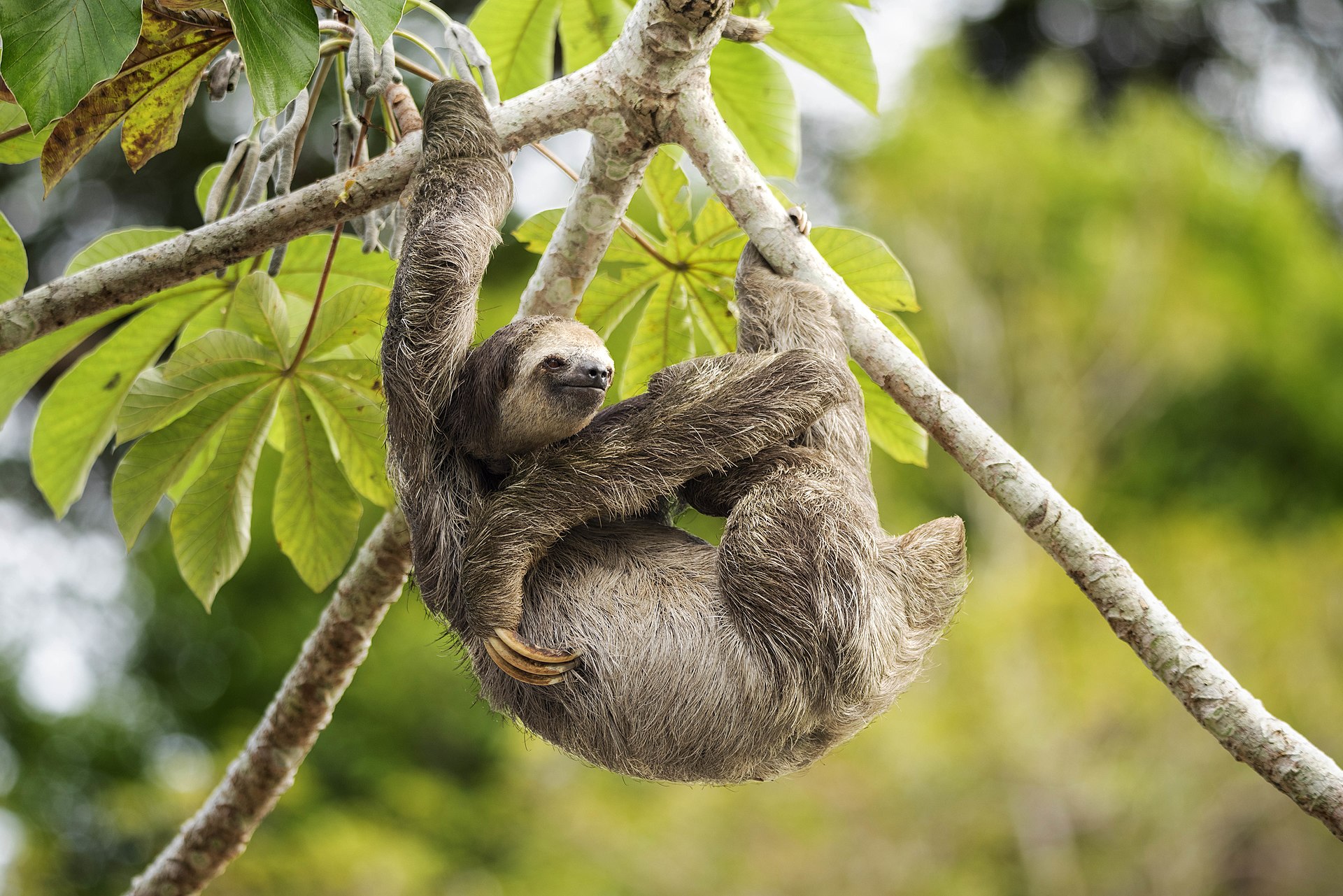
The Three-toed sloth (Bradypus tridactylus) is an arboreal mammal from South America, famous for its extreme slowness. It spends almost its entire life hanging from the branches of trees in the canopy, where it moves, eats and sleeps. Its grayish to brownish coat often harbors symbiotic algae which give it a greenish tint, aiding its camouflage. This species has developed a very low metabolism adapted to a low-energy diet. She only goes down to the ground about once a week to defecate.
The Three-toed sloth has long clawed limbs suitable for hanging under branches. Its head is round with a small snout and dark eyes, and it has three fingers with hooked claws on each paw. Its particularly mobile neck allows it to turn its head almost 180°. Its rough coat harbors microorganisms, including algae, which contribute to its coloring.
Characteristics
Indicative values: they vary by subspecies, sex and region.
Habitat and distribution
The Three-toed sloth lives in the tropical rainforests of South America, mainly in the canopy. It frequents both primary forest and certain areas of secondary forest close to watercourses. Its life is almost entirely arboreal, which limits its presence to areas with dense forest cover.
CURRENT RANGE
The species occurs in northern South America, including Brazil, Venezuela, Guyana, Suriname and French Guiana. It mainly occupies the Amazon basin and adjacent tropical forests. Its distribution remains largely linked to the extent of intact tropical forest cover.
Behaviour
This animal is solitary and mainly nocturnal or crepuscular, although it can also be active during the day. It moves very slowly in trees and remains motionless much of the time to conserve energy. Its slowness constitutes an anti-predator strategy, making it difficult to spot by birds of prey and big cats. He communicates little and avoids social contact outside the breeding season.
Reproduction
The female gives birth to a single young after a gestation of approximately six months. The newborn immediately clings to its mother's womb and remains there for several months before becoming independent. Sexual maturity is reached around three years of age. Breeding is not seasonal and can occur at any time of the year.
Peculiarities
The Three-toed sloth comes down from its tree about once a week to defecate on the ground, a risky behavior that exposes it to predators. Its coat is home to a complex ecosystem of algae, fungi and insects. Its movement speed on the ground barely exceeds a few meters per minute, much lower than that observed in trees.
Threats and conservation
Deforestation of the Amazon and neighboring tropical forests poses the main threat to this species, reducing its natural habitat. Forest fragmentation isolates populations and complicates their movement between trees. Hunting remains occasional but locally present. The illegal trade as exotic pets represents additional pressure.
Numbers and trends vary across sources and regions. See the IUCN assessment for the latest reference data.
Gallery
1 documented photographs.
References
Profile updated 18 August 2026 · Reviewed by the TunisieVet editorial team.
Comments (0)
No comments yet.
CONSERVATION STATUS
Least concern (LC)
IUCN source, latest published assessment.
Species health
Documented diseases for this species.
See the 8 diseases of this species Find a veterinarianThis information is provided for educational purposes only and is not a substitute for a veterinary consultation. If you have any concerns about your animal's health, consult a veterinarian.
To discover around: Three-toed sloth
Videos, facts, stories and records linked to this species.
Similar animals
Other species documented in Animalpedia.

TunisieVet in your pocket 📱🐾 Access your veterinary services wherever you are. [ Download the app ]
Learn more