
Presentation
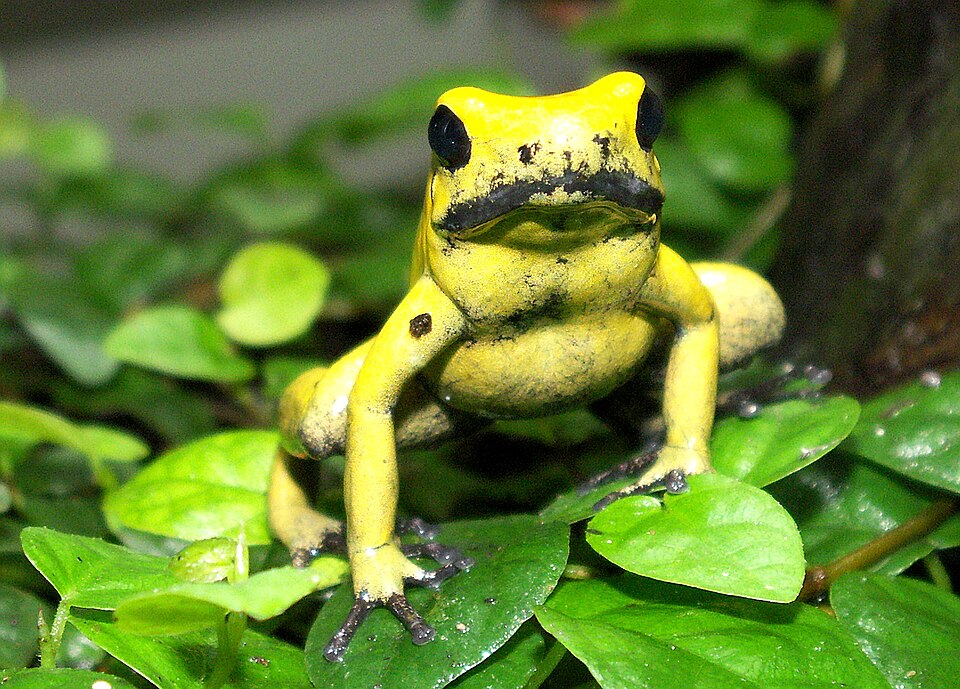
The golden poison frog (Phyllobates terribilis) is a small frog belonging to the Dendrobatidae family, native to the rainforests along Colombia's Pacific coast. It is renowned for its extraordinarily potent skin venom—the most toxic ever measured in a vertebrate. Its skin displays a bright coloration in yellow, orange, or green, depending on the population, which serves as a warning to predators. Diurnal and reclusive, it lives on the ground in moist forest leaf litter. Today it faces threats from deforestation and collection for the exotic pet trade.
A small sturdy frog measuring on average 4 to 5 cm long, with smooth, glossy skin. Its aposematic coloration, most commonly a vivid yellow, warns predators of its toxicity. Its skin glands secrete batrachotoxin, an extremely powerful neurotoxic alkaloid. It has long slender fingers tipped with small adhesive discs that aid in movement.
Characteristics
Indicative values: they vary by subspecies, sex and region.
Habitat and distribution
This frog lives exclusively in humid tropical lowland forests on the ground, among the leaf litter. It favors areas with high rainfall and constant humidity, often near small streams. This very specific habitat accounts for its extremely limited geographical range.
CURRENT RANGE
The species is endemic to a small region on the Pacific coast of Colombia, in the department of Cauca. Its natural range is very small and fragmented. It exists in the wild nowhere else in the world.
Behaviour
A diurnal species, most active during the coolest parts of the day. Males emit soft calls to establish territory and attract females. It typically lives in loose small groups within the forest leaf litter. Unlike many amphibians, it does not attempt to flee when threatened; its toxicity serves as its primary defense.
Reproduction
The female lays small clutches of a few dozen eggs on leaves or on the ground in humid habitats. The male often guards and keeps the eggs moist until they hatch. Once hatched, the larvae are carried on an adult's back to a water source where they continue their development as tadpoles. Complete metamorphosis occurs after several weeks.
Peculiarities
The golden poison frog is considered the most toxic animal known to date relative to its size. Indigenous Emberá peoples traditionally used its venom to poison the tips of their hunting blowguns. A single wild individual can contain enough toxin to kill several adult humans. Notably, specimens raised in captivity and fed differently from their natural diet lose their toxicity entirely over generations.
Threats and conservation
Deforestation from agriculture and logging reduces its already limited natural habitat. Illegal collection of individuals for the international exotic pet trade is an additional threat. Pollution of surrounding waterways also degrades conditions necessary for its reproduction.
Numbers and trends vary across sources and regions. See the IUCN assessment for the latest reference data.
Gallery
1 documented photographs.
References
Profile updated 08 September 2026 · Reviewed by the TunisieVet editorial team.
Comments (0)
No comments yet.
CONSERVATION STATUS
Endangered (EN)
IUCN source, latest published assessment.
Species health
Documented diseases for this species.
Find a veterinarianThis information is provided for educational purposes only and is not a substitute for a veterinary consultation. If you have any concerns about your animal's health, consult a veterinarian.
To discover around: Golden Poison Frog
Videos, facts, stories and records linked to this species.
RECORD
About 1 mg of batrachotoxin is enough to kill an adult human
The world's most toxic animal
Measurement based on the amount of skin toxin secreted by an adult wild individual.
Similar animals
Other species documented in Animalpedia.

TunisieVet in your pocket 📱🐾 Access your veterinary services wherever you are. [ Download the app ]
Learn more