
Presentation
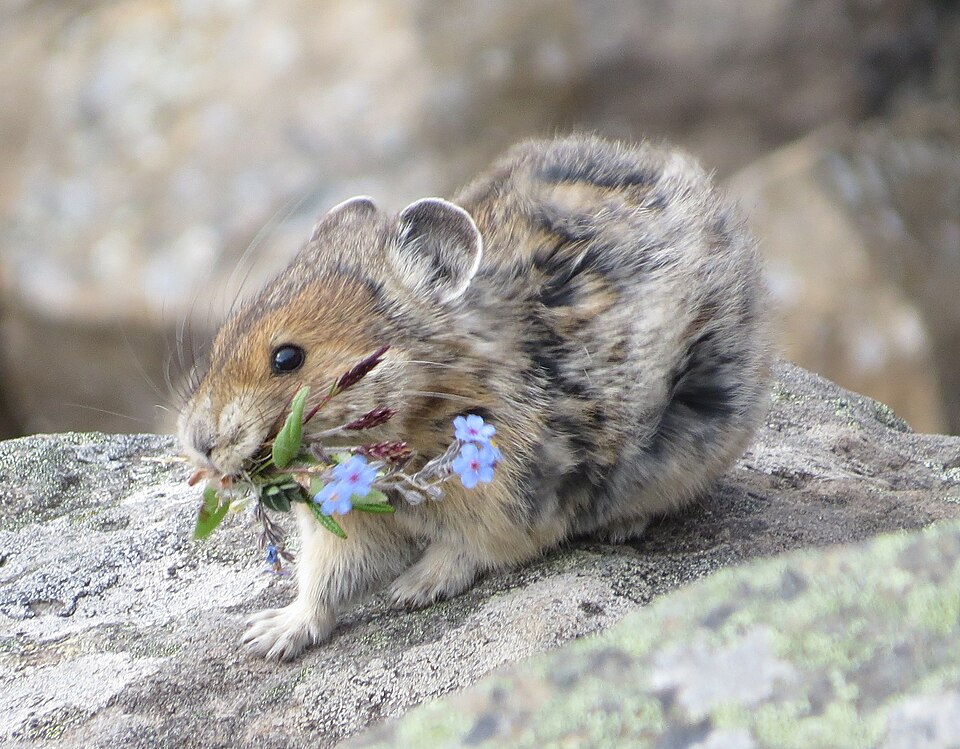
The Pika is a small lagomorph mammal related to rabbits and hares, but with a stockier morphology and without a long visible tail. It generally measures between 15 and 20 cm long and weighs 100 to 300 g depending on the species. Its ears are round and short, its sturdy legs and its dense coat help it cope with cold mountain climates. There are around thirty species distributed mainly in Central Asia and North America. The Pika is active during the day, lives in colonies and emits high-pitched cries to signal danger, hence its nickname “hissing hare”.
Stocky body, short and rounded ears, absence of visible tail. Thick brown-gray coat, adapted to seasonal temperature variations at altitude. Short legs with furry pads that facilitate grip on rocks.
Characteristics
Indicative values: they vary by subspecies, sex and region.
Habitat and distribution
The Pika mainly inhabits high altitude rocky areas, scree and alpine meadows of the mountains. Some species also occupy the arid steppes and plateaus of Central Asia. The altitude and the coolness of the climate are determining factors for its presence.
CURRENT RANGE
Pika is found in Central Asia, the Himalayas, Siberia and parts of China, as well as in North America in the Rocky Mountains. No species of Pika are native to Africa, Western Europe, or the Middle East. There is no wild population of Pika in Tunisia.
Behaviour
The Pika is diurnal, territorial and gregarious, often living in small colonies organized around burrows or rocky scree. It communicates by high-pitched whistles to alert its peers in the event of a predator. Unlike many lagomorphs, it does not always dig its own burrow and happily occupies natural cavities between stones. It remains active all year round, without a hibernation period.
Reproduction
The female gives birth to one or more litters per year, generally numbering 2 to 5 young. Gestation lasts approximately three to four weeks. The young are weaned quickly and reach sexual maturity before a year, which allows for fairly rapid demographic renewal despite high juvenile mortality.
Peculiarities
The Pika is sensitive to global warming because it does not tolerate extreme heat, with certain high-altitude populations being threatened by rising temperatures. Its winter haying technique is unique among small, non-hibernating mountain mammals. Its characteristic whistling call earned it its nickname “the hissing hare.”
Threats and conservation
Climate change poses the main threat to many populations of Pikas, reducing their cool high altitude habitat. Some species are also affected by intensive grazing and steppe degradation. The majority of species, however, remain classified as not globally threatened.
Numbers and trends vary across sources and regions. See the IUCN assessment for the latest reference data.
Gallery
1 documented photographs.
References
Profile updated 27 August 2026 · Reviewed by the TunisieVet editorial team.
Comments (0)
No comments yet.
CONSERVATION STATUS
Least concern (LC)
IUCN source, latest published assessment.
Species health
Documented diseases for this species.
Find a veterinarianThis information is provided for educational purposes only and is not a substitute for a veterinary consultation. If you have any concerns about your animal's health, consult a veterinarian.
To discover around: Pika
Videos, facts, stories and records linked to this species.
Similar animals
Other species documented in Animalpedia.

TunisieVet in your pocket 📱🐾 Access your veterinary services wherever you are. [ Download the app ]
Learn more