
Presentation
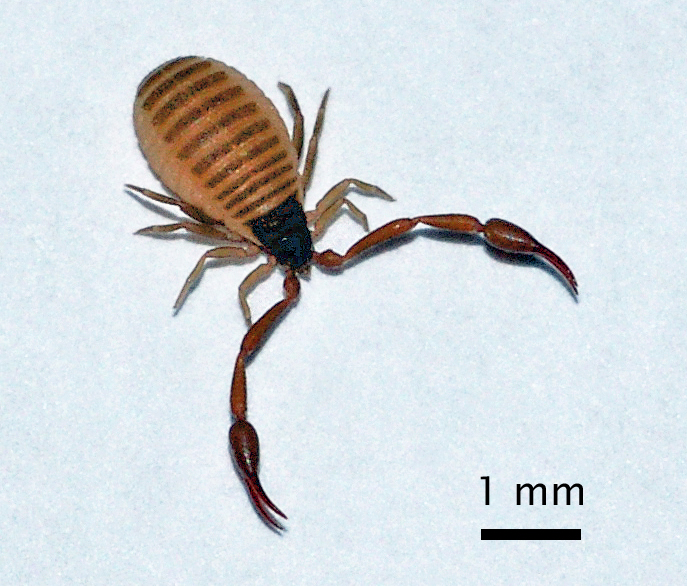
The pseudoscorpion is a tiny arachnid that resembles a scorpion without a tail or stinger. Its flattened body typically measures 2 to 8 mm long and ends in a pair of disproportionately large pincers (pedipalps). It is found hidden under bark, stones, leaf litter, or in household dust, often going unnoticed. More than 3,000 described species exist worldwide, distributed across all continents except Antarctica. Despite its appearance, it is completely harmless to humans and plays a useful role as a predator of tiny pests.
Oval and flattened body, brown to blackish, lacking a tail and stinger unlike true scorpions. The pedipalps end in pincers equipped with venom glands used to immobilize very small prey. It has eight legs and can produce silk through glands located in its chelicerae, which it uses to weave a protective cocoon.
Characteristics
Indicative values: they vary by subspecies, sex and region.
Habitat and distribution
The pseudoscorpion prefers damp, sheltered habitats away from direct sunlight: forest leaf litter, under bark, in soil, caves, and bird nests. Some commensal species settle in homes, particularly among old books, dust, or undisturbed corners. It avoids areas that are too dry or too exposed.
CURRENT RANGE
Pseudoscorpions are found on all continents except Antarctica, with great species diversity adapted to various climates. In North Africa, including Tunisia, several species are found in forested areas and under stones. Their worldwide dispersal is facilitated by phoresy on other insects.
Behaviour
Discreet and mainly nocturnal, it moves slowly but can retreat rapidly when threatened. It is known for phoresy behavior, which involves clinging to the legs of flying insects such as flies to disperse to new habitats. It is solitary for most of the year, though it can be territorial toward other pseudoscorpions.
Reproduction
Reproduction occurs through indirect transfer of a spermatophore deposited by the male and collected by the female, often following a courtship display. The female then carries her eggs and young in a ventral pouch until they reach their first stage of independent development. Juveniles resemble miniature adults and undergo several molts before reaching maturity.
Peculiarities
Despite its name, it has neither a tail nor a venomous terminal sting; its venom is located only in its pincers. It can produce silk, an ability rare among arachnids outside of spiders. Its phoretic behavior allows it to travel long distances without wings.
Threats and conservation
The species is not generally threatened because of its wide distribution and ability to adapt to various habitats. Destruction of its natural habitat, particularly forest leaf litter and old stones, can reduce populations locally. It is not subject to any significant commercial exploitation.
Numbers and trends vary across sources and regions. See the IUCN assessment for the latest reference data.
Gallery
1 documented photographs.
References
Profile updated 28 August 2026 · Reviewed by the TunisieVet editorial team.
Comments (0)
No comments yet.
CONSERVATION STATUS
Least concern (LC)
IUCN source, latest published assessment.
Similar animals
Other species documented in Animalpedia.

📱 عندك صفحة على فايسبوك؟ باهي… أما وين موقعك؟ الصفحة وحدها ما تكفيش. موقعك يخلي الناس تلقاك، يعرفوك أكثر ويثقو في خدمتك. 🌐 موقع باسم مشروعك 📲 يخدم أربعة وعشرين ساعة 🤝 يعطي ثقة واحترافية .📈 يعاونك تكبّر خدمتك خلّيه موجود وين الناس تلوّج عليه 🚀نعملولك موقع يشرّف مشروعك
WhatsApp