
Presentation
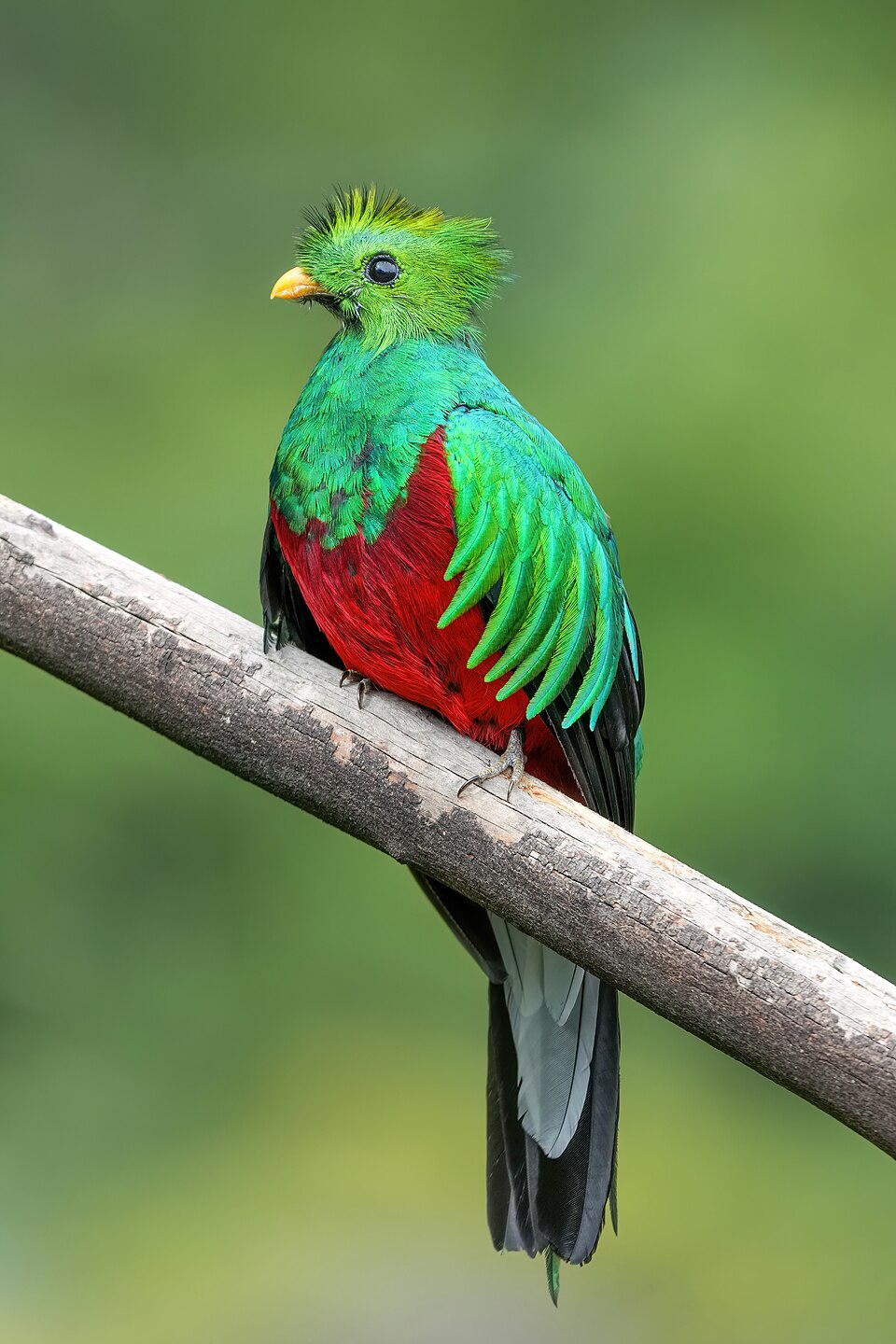
The resplendent quetzal is an emblematic bird of the mountain forests of Central America, renowned for its brilliant plumage. The male displays iridescent emerald-green feathers and a long tail of coverts that can exceed the length of the tail itself. His bright red chest contrasts with the metallic green of the back and head. This bird holds an important symbolic place in pre-Columbian cultures, particularly among the Mayas and Aztecs. Despite its colors, it remains elusive and typically lives within the canopy of humid forests. Its presence today is threatened by deforestation.
The male is distinguished by his spectacular tail coverts, which are absent in the female whose plumage is duller. His short beak is yellow-orange in the adult male. The head bears a small distinctive crest characteristic of the genus Pharomachrus. His short legs and limited flight endurance reflect an adaptation to arboreal life rather than long-distance travel.
Characteristics
Indicative values: they vary by subspecies, sex and region.
Habitat and distribution
The species inhabits humid mountain tropical forests, generally between 1,200 and 3,000 meters in elevation. It favors cloud forests rich in epiphytes and fruit-bearing trees, particularly laurels. Seasonal elevational movements follow fruit availability. Destruction of these forests poses the primary threat to its habitat.
CURRENT RANGE
The resplendent quetzal is found from southern Mexico through Guatemala, Honduras, Costa Rica, and Nicaragua to Panama. The largest populations occur in cloud forest reserves of Costa Rica and Guatemala. Its distribution is fragmented due to forest habitat loss.
Behaviour
A rather solitary bird or one living in pairs during breeding season. It spends most of its time perched motionless in the canopy, which makes it difficult to spot despite its bright colors. The male performs spectacular courtship flights to attract the female, displaying his tail coverts. Its song, a series of fluted notes, is heard mainly at dawn and dusk.
Reproduction
The female typically lays two eggs in a tree cavity, either excavated or reused by both parents. Both parents take turns incubating the eggs for approximately 18 days. The male, despite his long cumbersome tail, actively participates in incubation and feeding the chicks. The young leave the nest after about one month but remain dependent on adults for some time.
Peculiarities
The resplendent quetzal was revered by the Mayan and Aztec civilizations, which associated its feathers with royalty and the deity Quetzalcóatl. It appears on Guatemala's flag and currency as the national bird of the country. The Maya harvested its feathers without killing the bird, as it was considered sacred.
Threats and conservation
Deforestation driven by agriculture and urbanization severely reduces its natural habitat. Poaching for its feathers and capture for illegal wildlife trade pose additional threats. Climate change, by altering the elevation of cloud forests, further complicates its long-term survival.
Numbers and trends vary across sources and regions. See the IUCN assessment for the latest reference data.
Gallery
1 documented photographs.
References
Profile updated 17 September 2026 · Reviewed by the TunisieVet editorial team.
Comments (0)
No comments yet.
CONSERVATION STATUS
Near threatened (NT)
IUCN source, latest published assessment.
Species health
Documented diseases for this species.
See the 4 diseases of this species Find a veterinarianThis information is provided for educational purposes only and is not a substitute for a veterinary consultation. If you have any concerns about your animal's health, consult a veterinarian.
Similar animals
Other species documented in Animalpedia.

TunisieVet in your pocket 📱🐾 Access your veterinary services wherever you are. [ Download the app ]
Learn more