Presentation
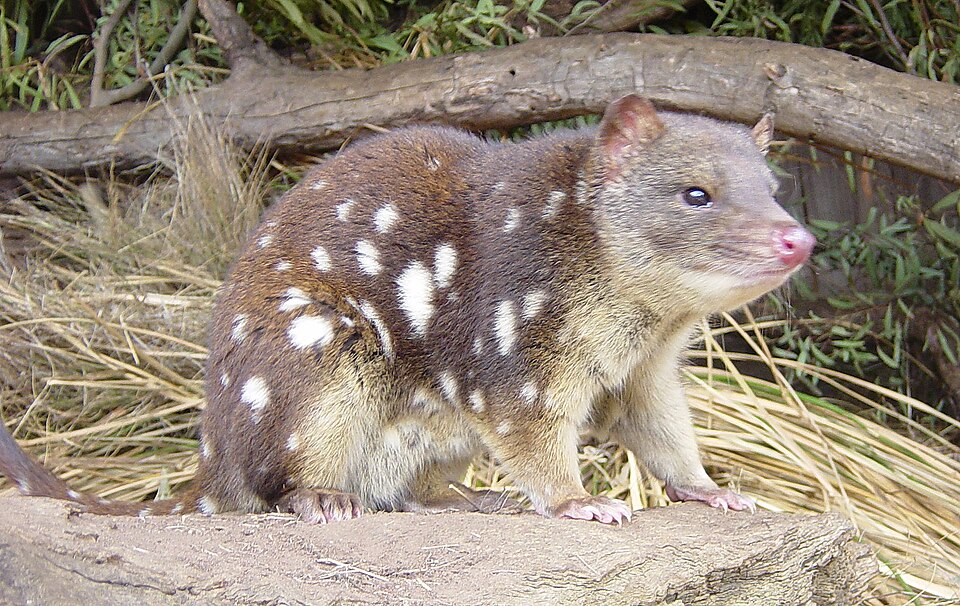
The spotted-tailed quoll is a carnivorous marsupial native to eastern Australia and Tasmania. It is the largest of the quolls and one of the largest carnivorous marsupials still found on the Australian continent. Its reddish-brown coat is scattered with white spots that extend onto the tail, distinguishing it from other quoll species. It has an elongated snout, small rounded ears, and long sensory whiskers. Primarily active at night, it hunts both on the ground and in the trees thanks to its excellent agility. It occupies dense forest habitats where it finds both food and resting sites.
The body is compact and muscular, adapted for both ground running and climbing. The reddish-brown to dark brown fur bears irregular white spots unique to each individual. The tail is long and bushy and is also spotted, unlike that of other quolls. The paws have sharp claws and pads suited for climbing.
Characteristics
Indicative values: they vary by subspecies, sex and region.
Habitat and distribution
The spotted-tailed quoll lives mainly in humid sclerophyll forests and highland tropical rainforests. It also frequents certain dry forest areas near watercourses. The presence of cavities in trees or rocks for resting is essential to its habitat.
CURRENT RANGE
The species is endemic to eastern Australia, found notably in Queensland, New South Wales, Victoria and Tasmania. Its range is now fragmented due to habitat loss. No populations exist outside Australia.
Behaviour
Solitary and territorial, this animal marks its territory with droppings deposited in visible locations called latrines. It is essentially nocturnal but may be active at dusk. A skilled climber, it moves easily through the canopy to hunt or escape predators. Individuals communicate through vocalizations and scent marking, particularly during the breeding season.
Reproduction
Breeding occurs once a year, typically during southern winter. After a very short gestation characteristic of marsupials, the female gives birth to multiple young that she carries in a rudimentary pouch before nursing them in a nest. The young leave the pouch after a few weeks and remain dependent on the mother for several months. Sexual maturity is reached at about one year of age.
Peculiarities
It is the only quoll whose tail bears white spots, a distinctive feature used to identify it in the field. It ranks among the largest carnivorous marsupials still living after the extinction of the thylacine.
Threats and conservation
The species is threatened by deforestation, habitat fragmentation and predation by introduced foxes and feral cats. Accidental poisoning through baits intended for other pests also poses a threat. Road collisions and disease affect local populations as well.
Numbers and trends vary across sources and regions. See the IUCN assessment for the latest reference data.
Gallery
1 documented photographs.
References
Profile updated 02 September 2026 · Reviewed by the TunisieVet editorial team.
Comments (0)
No comments yet.
CONSERVATION STATUS
Near threatened (NT)
IUCN source, latest published assessment.
Species health
Documented diseases for this species.
This information is provided for educational purposes only and is not a substitute for a veterinary consultation. If you have any concerns about your animal's health, consult a veterinarian.
To discover around: Spotted-tailed Quoll
Videos, facts, stories and records linked to this species.
RECORD
up to 75 cm of body length excluding the tail
Australia's largest carnivorous marsupial
Measurement taken in the largest adult males since the thylacine disappeared in the wild.
Similar animals
Other species documented in Animalpedia.

Be among the first to use our app. Sign up and get early Google Play access.
Discover