
Presentation
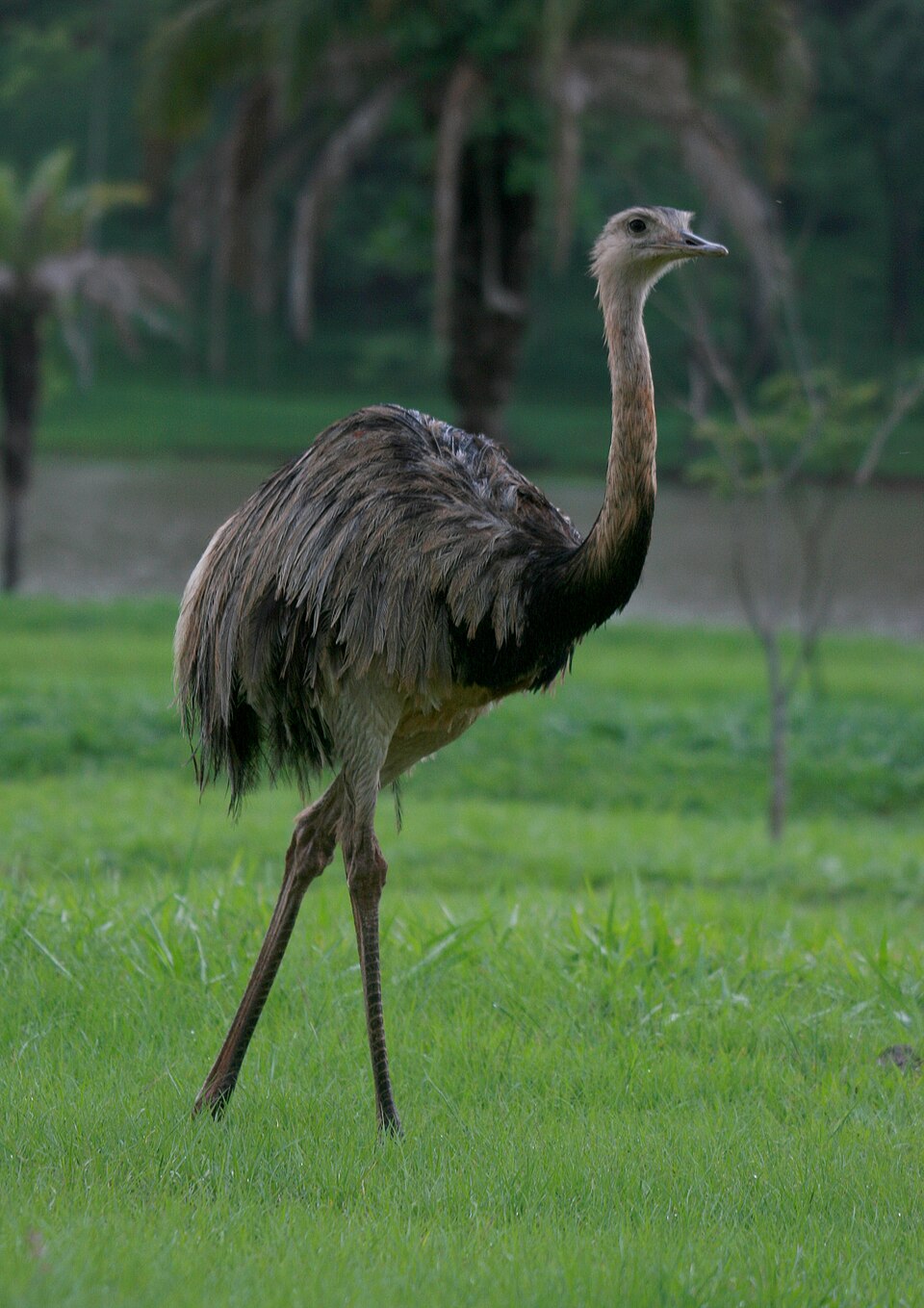
The rhea (Rhea americana) is a large flightless running bird native to the grasslands of South America. It belongs to the ratite family, like the ostrich and emu, though it is taxonomically distinct from them. Recognizable by its long neck and sturdy long legs, it moves in groups across open savannas and steppes. It is the largest bird in the Americas and an excellent runner capable of quickly escaping its predators. It is sometimes raised in captivity for its meat, feathers, and leather.
The rhea has grey-brown plumage, a long partially bare neck, and reduced wings that it uses for balance and display. Its long powerful legs end in three toes, adapted for fast running. It lacks a developed keel, which prevents it from flying like all ratites.
Characteristics
Indicative values: they vary by subspecies, sex and region.
Habitat and distribution
The rhea inhabits open savannas, grasslands, and grassy steppes of South America. It avoids heavily wooded or mountainous areas, preferring open terrain that facilitates running and surveillance for predators. It is also found at the edge of farmland and cultivated pastures.
CURRENT RANGE
The species is native to South America, where it is found notably in Brazil, Argentina, Paraguay, Uruguay, and Bolivia. Introduced populations also exist in Europe, particularly in Germany, as a result of escapes from farms. It remains absent in the wild from North Africa and Tunisia.
Behaviour
The rhea lives in groups called flocks, ranging from a few individuals to several dozen outside the breeding season. It is generally a calm animal but capable of delivering powerful kicks in self-defense. Males become territorial and polygamous during the breeding period, gathering several females.
Reproduction
The male rhea builds a simple ground nest and incubates alone the eggs laid by several females in the same nest. Incubation lasts approximately 35 to 40 days. The male then cares for the chicks on his own, displaying marked paternal behavior uncommon among birds.
Peculiarities
The rhea is often compared to the ostrich because of its shape, although it is smaller and belongs to a different family. The exclusive paternal behavior of the male, who incubates and raises the young alone, is a notable characteristic of the species. It can reach high speeds thanks to its long muscular legs.
Threats and conservation
The species is threatened by habitat loss linked to agricultural expansion and urbanization of South American plains. Hunting for meat, feathers, and eggs also puts pressure on certain local populations. Overall, the species remains widely distributed.
Numbers and trends vary across sources and regions. See the IUCN assessment for the latest reference data.
Gallery
1 documented photographs.
References
Profile updated 07 September 2026 · Reviewed by the TunisieVet editorial team.
Comments (0)
No comments yet.
CONSERVATION STATUS
Near threatened (NT)
IUCN source, latest published assessment.
Species health
Documented diseases for this species.
Find a veterinarianThis information is provided for educational purposes only and is not a substitute for a veterinary consultation. If you have any concerns about your animal's health, consult a veterinarian.
Similar animals
Other species documented in Animalpedia.

TunisieVet in your pocket 📱🐾 Access your veterinary services wherever you are. [ Download the app ]
Learn more