
Presentation
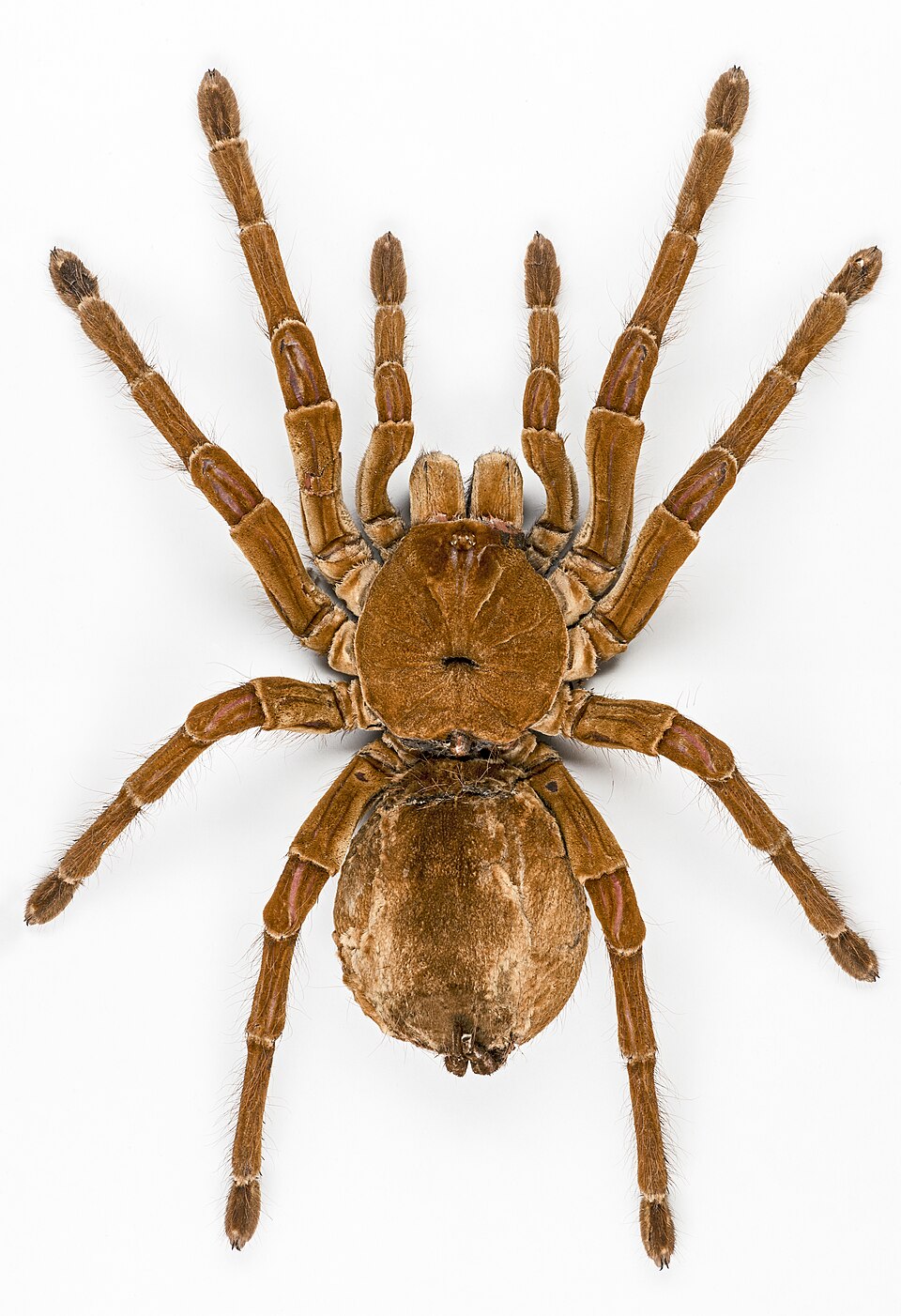
The Goliath birdeater is one of the largest spiders in the world. This impressive tarantula is characterized by a robust and hairy body of blackish-brown color, covered with stinging hairs which constitute its main defense. Despite its intimidating size, it generally remains shy and not very aggressive towards humans.
Its chelicerae are powerful and capable of biting, although the venom is of little danger to humans. Its pedipes (jaw legs) and venom fangs are well developed. It has eight eyes arranged in two rows, giving it weak vision but useful for detecting movements at close range.
Did you know?
How does a spider know when prey is caught in its web?
Characteristics
Indicative values: they vary by subspecies, sex and region.
Habitat and distribution
It lives exclusively in the tropical rainforests of South America, particularly in Venezuela, Guyana, Surinam and Brazil. It digs deep burrows in the ground or occupies hollows in trees, creating a silk web at the entrance to its refuge.
CURRENT RANGE
Its range is restricted to the tropical forests of South America, mainly in the north of the continent (Amazonia). It is not found in Africa, Asia or Tunisia.
Behaviour
It is nocturnal and sedentary, spending most of its time in its burrow or web. It is not very aggressive, preferring to flee threats or defend itself by projecting its stinging hairs. It can remain motionless for a long time waiting for prey.
Reproduction
Sexual dimorphism is remarkable: females are significantly larger than males. Mating is a risky process for the male, who must approach cautiously. Females produce silk cocoons containing hundreds of eggs, which they jealously guard for several weeks.
Peculiarities
Despite its English name "birdeater", it rarely hunts birds in reality. Its major characteristic lies in its stinging hairs: when it feels threatened, it projects these fine, barbed hairs which cause intense itching. It is the heaviest tarantula known.
Threats and conservation
Although its IUCN status is not assessed, it currently faces no major threats. However, the gradual destruction of forest habitats due to deforestation could become problematic in the long term.
Numbers and trends vary across sources and regions. See the IUCN assessment for the latest reference data.
Gallery
1 documented photographs.
References
Profile updated 28 August 2026 · Reviewed by the TunisieVet editorial team.
Comments (0)
No comments yet.
CONSERVATION STATUS
Not evaluated (NE)
IUCN source, latest published assessment.
Species health
Documented diseases for this species.
Find a veterinarianThis information is provided for educational purposes only and is not a substitute for a veterinary consultation. If you have any concerns about your animal's health, consult a veterinarian.
Related species
To discover around: Goliath birdeater
Videos, facts, stories and records linked to this species.
Similar animals
Other species documented in Animalpedia.

TunisieVet in your pocket 📱🐾 Access your veterinary services wherever you are. [ Download the app ]
Learn more