
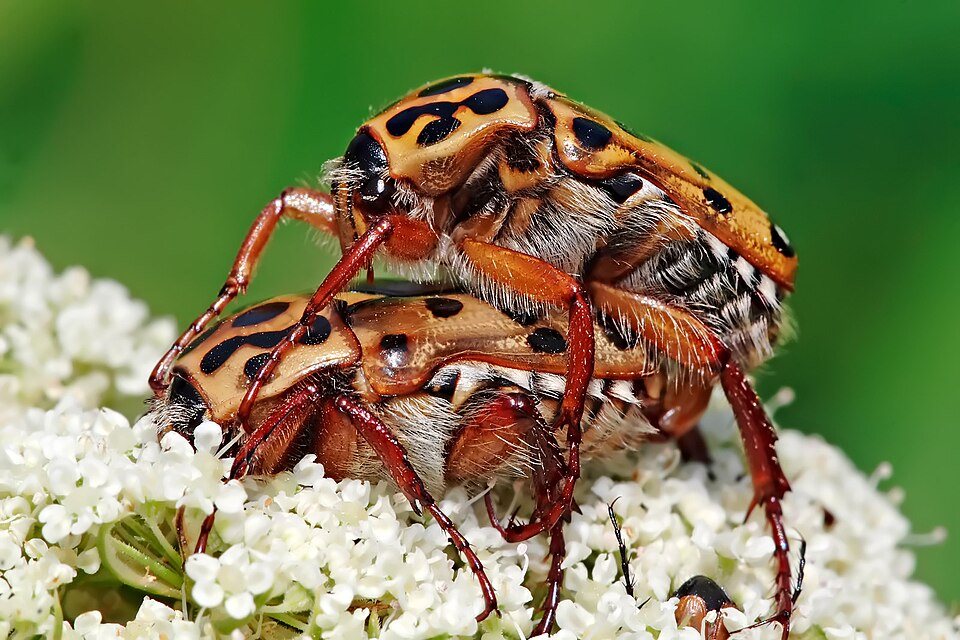
Presentation
The Beetle is a beetle belonging to the large Scarabaeidae family, which groups together several thousand species distributed across almost all continents. Its massive body, often covered with shiny elytra, gives it a silhouette recognizable among all insects. Some species feed on decomposing plant matter, others on dung or dead wood, playing an essential role in recycling organic material. The term "Beetle" designates both small common species and large rhinoceros or hercules Beetles capable of lifting considerable loads. In North Africa, several species of dung beetle Beetles are commonly observed in rural and desert areas.
The body is divided into three parts (head, thorax, abdomen) and protected by rigid elytra covering membranous wings. Coloration ranges from matte black to metallic green or bronze depending on the species. The front legs are often adapted for burrowing or shaping pellets of organic matter. Some males bear horns or cephalic protrusions used during territorial fights.
Characteristics
Indicative values: they vary by subspecies, sex and region.
Habitat and distribution
Beetles inhabit a wide range of environments: forests, grasslands, savannas, desert zones, and agricultural areas. Their presence depends mainly on the availability of organic matter (dead wood, dung, plant litter). Some desert species are adapted to extreme arid conditions.
CURRENT RANGE
The Scarabaeidae family is found on all continents except Antarctica, with particularly high diversity in the tropics. In North Africa, including Tunisia, several species of dung beetles and burrowing beetles are common in rural and desert environments.
Behaviour
Most species are active at dusk or at night, moving on the ground or in short, noisy flight. Dung beetles shape balls of dung that they roll and then bury to lay their eggs in. Some species are solitary while others gather temporarily around abundant food resources.
Reproduction
The female lays her eggs in a nutrient-rich substrate such as dead wood, organic-rich soil, or a ball of dung depending on the species. The larva, called a "white grub" in several species, develops over several months to several years before entering the pupal stage. The adult emerges following complete metamorphosis, and its active lifespan is typically short compared to the larval phase.
Peculiarities
The sacred scarab (Scarabaeus sacer) was venerated in ancient Egypt as a symbol of rebirth and associated with the god Khepri. Dung beetles are among the insects capable of pulling loads many times their own body weight. Certain species navigate using the polarized light of the Moon or the Milky Way to orient their trajectory.
Threats and conservation
Loss of natural habitats and the decline of wild herbivore populations threaten certain dung beetle populations. Intensive use of antiparasitic drugs in livestock reduces the availability of fresh dung and affects reproduction in several species. Agricultural pesticides also pose a threat to many beetle populations.
Numbers and trends vary across sources and regions. See the IUCN assessment for the latest reference data.
Gallery
1 documented photographs.
References
Profile updated 26 August 2026 · Reviewed by the TunisieVet editorial team.
Comments (0)
No comments yet.
CONSERVATION STATUS
Least concern (LC)
IUCN source, latest published assessment.
Species health
Documented diseases for this species.
Find a veterinarianThis information is provided for educational purposes only and is not a substitute for a veterinary consultation. If you have any concerns about your animal's health, consult a veterinarian.
To discover around: Beetle
Videos, facts, stories and records linked to this species.
Similar animals
Other species documented in Animalpedia.
