Presentation
The siamang (Symphalangus syndactylus) is a large gibbon native to the tropical forests of Sumatra and the Malay Peninsula. It is distinguished by its throat sac, an expandable pouch of skin beneath the throat that amplifies its calls. An arboreal species, it moves by brachiation, swinging from branch to branch using its long arms. Siamangs live in monogamous pairs with their offspring, forming stable family units. It is the largest member of the gibbon family, noticeably bulkier than its cousins in the genus Hylobates. Its powerful and complex dawn calls serve to mark territory and strengthen the pair bond.
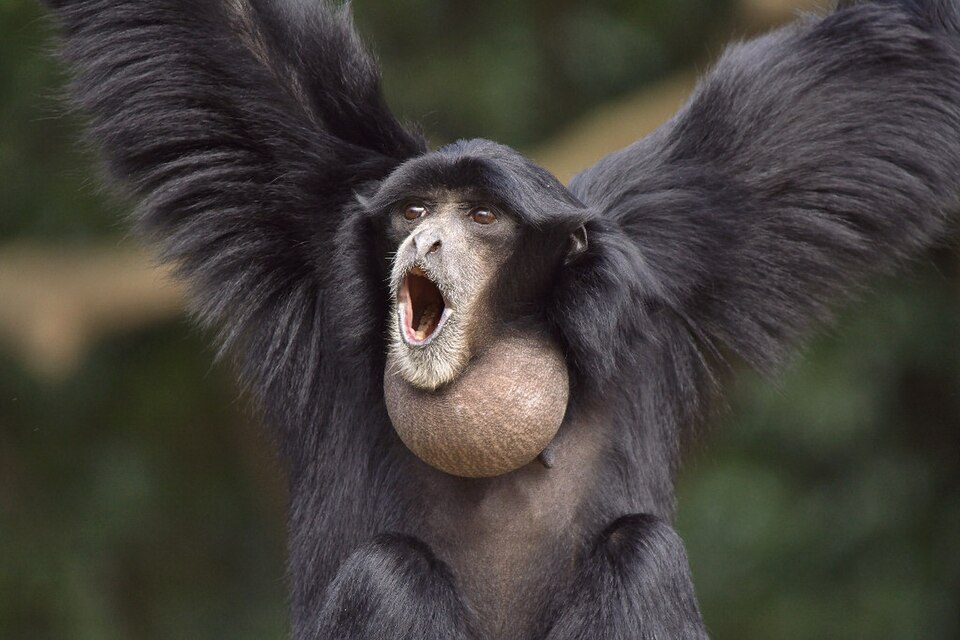
The siamang has dense black fur and a slender build adapted to arboreal life. Its arms are proportionally longer than those of other gibbons, giving it an impressive wingspan. The throat sac, which is particularly well developed, can inflate to the size of its head during vocalizations. The second and third toes of its feet are partially fused, a trait that inspired its scientific name 'syndactylus'.
Characteristics
Indicative values: they vary by subspecies, sex and region.
Habitat and distribution
The siamang inhabits primary and secondary tropical rainforests, from lowland areas to medium-altitude mountainous zones. It favors dense and continuous canopies that allow it to move without descending to the ground. The availability of foliage and fruits influences the size of its territory.
CURRENT RANGE
The species is endemic to the island of Sumatra in Indonesia and the Malay Peninsula, including certain regions of Malaysia. Its populations are fragmented by deforestation and now concentrate in protected forest massifs. No wild populations exist outside this original range.
Behaviour
The siamang is diurnal and strictly arboreal, rarely coming to the ground. It lives in small territorial family groups, defended by loud vocalizations audible over several kilometers. Pairs sing in duet at dawn, a practice that strengthens the pair bond and signals territory occupation to neighboring groups. The male actively participates in parental care, sometimes carrying the young on his back during the second year of life.
Reproduction
The female gives birth to a single infant after a gestation of approximately seven to eight months. The young remains dependent on its mother for the first two years, after which the father takes on part of its transportation and rearing. Sexual maturity is reached around six to eight years of age. The interval between successive births is typically two to three years, which limits the reproductive rate of the species.
Peculiarities
The siamang's throat sac is a unique anatomical feature among gibbons, allowing it to produce deep and resonant calls. It is the only gibbon to possess a partial fusion of two toes, a trait reflected in its scientific name. Its size and weight make it the largest member of the Hylobatidae family.
Threats and conservation
Deforestation linked to the expansion of oil palm plantations and logging represents the primary threat to the species. Poaching for the illegal pet trade also affects wild populations. Habitat fragmentation isolates family groups and reduces genetic diversity.
Numbers and trends vary across sources and regions. See the IUCN assessment for the latest reference data.
Gallery
1 documented photographs.
References
Profile updated 02 September 2026 · Reviewed by the TunisieVet editorial team.
Comments (0)
No comments yet.
CONSERVATION STATUS
Endangered (EN)
IUCN source, latest published assessment.
Species health
Documented diseases for this species.
This information is provided for educational purposes only and is not a substitute for a veterinary consultation. If you have any concerns about your animal's health, consult a veterinarian.
To discover around: Siamang
Videos, facts, stories and records linked to this species.
RECORD
Up to 90 cm and 13 kg
The largest gibbon
This measurement is taken in adults and compared to other genera in the Hylobatidae family...
Similar animals
Other species documented in Animalpedia.

Be among the first to use our app. Sign up and get early Google Play access.
Discover