
Presentation
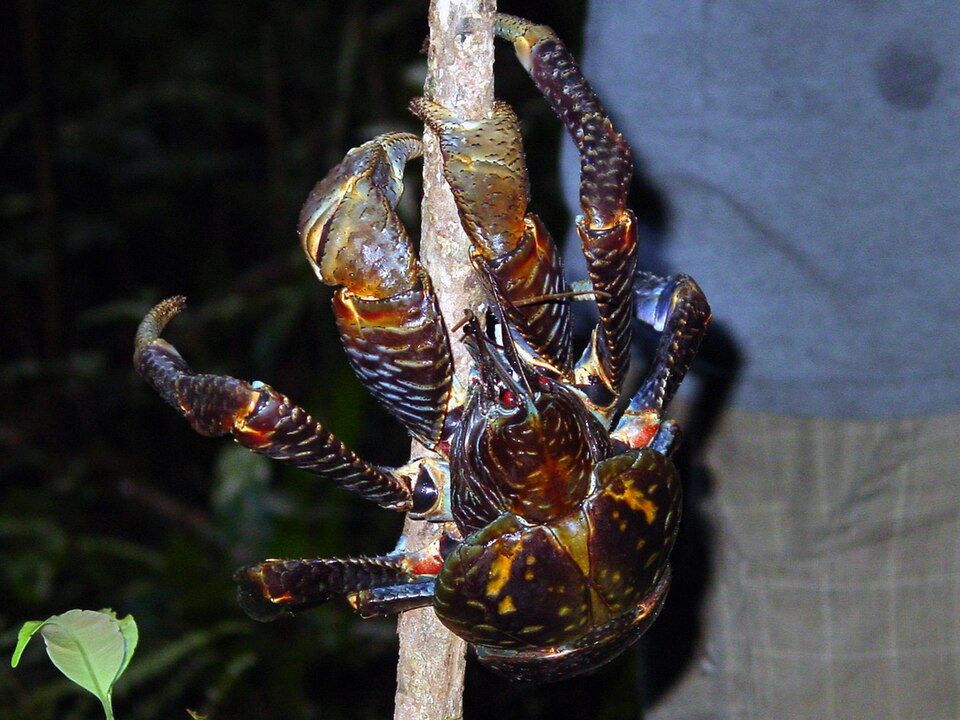
The coconut crab is the largest land arthropod in the world. This decapod crustacean belongs to the family Coenobitidae, which includes hermit crabs, though it sheds its protective shell upon reaching adulthood. It has a massive body covered in a bluish-brown exoskeleton and powerful pincers capable of cracking coconuts. It is found on tropical islands and coastlines throughout the Indian and Pacific oceans. Its predominantly terrestrial way of life and exceptional longevity make it a unique species among crustaceans.
The coconut crab can reach up to one metre in leg span and weigh several kilograms. Its body is protected by a rigid carapace, and its front pincers, which are highly developed, are used to crush tough fruits such as coconuts. Unlike other hermit crabs, the adult abandons its borrowed shell and hardens its own abdomen. It breathes through a modified gill organ adapted to air, called a branchial chamber.
Characteristics
Indicative values: they vary by subspecies, sex and region.
Habitat and distribution
The species frequents coastal forests, rocky coastal zones, and sandy beaches of tropical islands. It requires access to both land for feeding and shelter, and to the sea for reproduction. It is rarely observed far from the shoreline, as its physiology remains linked to marine humidity.
CURRENT RANGE
The coconut crab is found on numerous islands in the Indian Ocean and tropical Pacific, notably in the Seychelles, Zanzibar, Polynesia, and certain islands of Southeast Asia. It has disappeared from several areas near human populations due to hunting. Christmas Island and certain isolated atolls still harbour significant populations.
Behaviour
The coconut crab is a solitary, primarily nocturnal animal that takes shelter during the day in burrows or rocky crevices to limit water loss. It climbs trees and coconut palm trunks easily to feed or escape danger. Territorial, it can become aggressive towards other crabs when competing for food or shelter. Its growth is slow and it can live for several decades.
Reproduction
Reproduction occurs on land, but the female must return to the shore to release her fertilized eggs into seawater. Larvae spend several weeks in the planktonic marine environment before returning to land as young hermit crabs. Juveniles then use empty gastropod shells as shelter, replacing them progressively as they grow. Sexual maturity is reached late, at around five years or older.
Peculiarities
Its ability to climb coconut trees and crack open coconuts with its claws is unique among crustaceans. It holds the record for the largest living terrestrial arthropod. Its hybrid respiratory organ allows it to survive on land while retaining a marine physiological origin.
Threats and conservation
Overexploitation for its meat, considered a local delicacy, threatens populations in several regions. Destruction of coastal habitat and tourism also contribute to its localized decline. Its slow growth and late maturity make populations vulnerable to overfishing.
Numbers and trends vary across sources and regions. See the IUCN assessment for the latest reference data.
Gallery
1 documented photographs.
References
Profile updated 13 September 2026 · Reviewed by the TunisieVet editorial team.
Comments (0)
No comments yet.
CONSERVATION STATUS
Vulnerable (VU)
IUCN source, latest published assessment.
Species health
Documented diseases for this species.
Find a veterinarianThis information is provided for educational purposes only and is not a substitute for a veterinary consultation. If you have any concerns about your animal's health, consult a veterinarian.
To discover around: Coconut crab
Videos, facts, stories and records linked to this species.
RECORD
up to 1 m wingspan / 4 kg
The world's largest terrestrial arthropod
Measurement taken with legs extended in the largest adult individuals observed in the wild...
