
Presentation
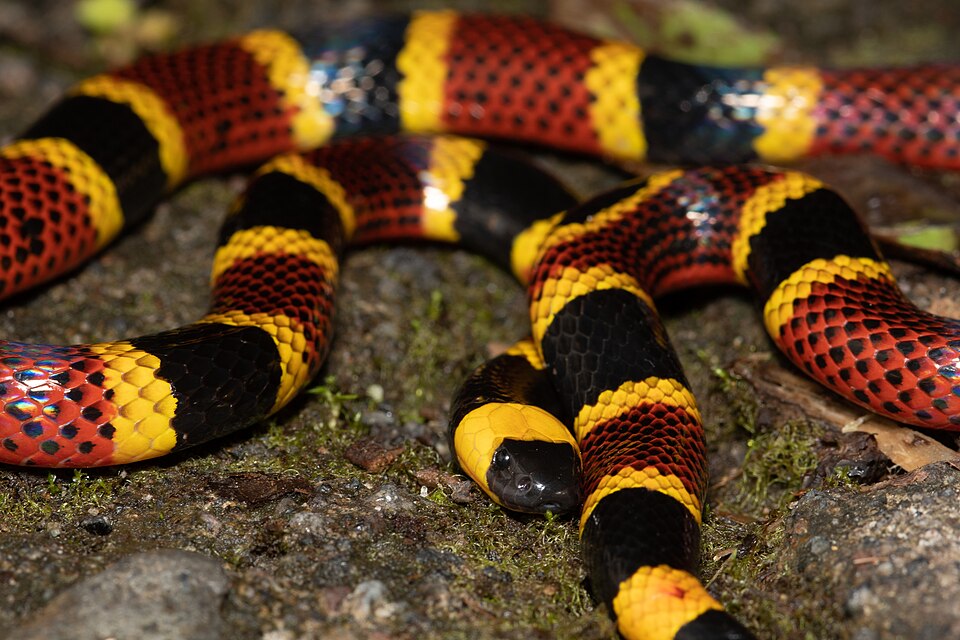
Coral snake refers to several genera of venomous snakes from America, notably Micrurus, recognizable by their colored red, yellow and black rings. These snakes belong to the Elapidae family, the same as cobras and mambas. They are discreet, burrowing and rarely observed despite their bright coloration which serves as a warning to predators. Their neurotoxic venom is powerful but bites on humans remain rare because the species avoids confrontation. Some non-venomous species, such as false coral, imitate this color pattern to protect themselves from predators. The name "coral" does not refer to marine corals but to the bright red hue of their skin.
The body is thin and cylindrical, decorated with alternating red, yellow (or white) and black rings along its length. The head is small, rounded and indistinguishable from the neck, without the triangular shape typical of vipers. The eyes are small with round pupils. The average size varies between 50 and 120 cm depending on the species.
Characteristics
Indicative values: they vary by subspecies, sex and region.
Habitat and distribution
The Coral snake frequents tropical forests, humid wooded areas, savannahs and sometimes agricultural areas close to homes. It likes soft soils, rich in plant litter, which facilitate its burrowing lifestyle. It is also found in certain wetlands and near watercourses in forest areas.
CURRENT RANGE
The species occurs mainly in Central and South America, with some species also found in North America, notably in the southeastern United States. It is absent from Africa and Europe, including Tunisia. Its distribution follows the tropical and subtropical zones of the American continent.
Behaviour
This snake is essentially burrowing and nocturnal, spending the majority of its time under litter, in loose soil or under plant debris. He is not very aggressive and favors flight or immobility rather than direct confrontation. When it feels threatened, it can adopt defensive postures, notably by hiding its head and exposing its tail which sometimes imitates the head to deceive the predator. Its bite, although rare towards humans, requires prolonged handling of the snake to occur.
Reproduction
Reproduction is oviparous, with the female laying between 3 and 18 eggs depending on the species, generally in a moist, sheltered location such as loose soil or under rotting trunks. Incubation lasts about two to three months before the young hatch, which are independent from birth. There is no parental care after laying eggs.
Peculiarities
The Coral snake coloring pattern gave rise to a popular mnemonic in the United States distinguishing venomous species from harmless species according to the order of the colored rings. This phenomenon of mimicry, where non-venomous species imitate its appearance, is a classic example of Batesian mimicry studied in evolutionary biology. Its venom acts on the nervous system and can affect breathing in cases of severe untreated envenomation.
Threats and conservation
Habitat loss linked to deforestation constitutes the main threat to certain populations. Human persecution, motivated by fear of venom, also causes direct mortality. However, most species remain widespread and are not globally threatened.
Numbers and trends vary across sources and regions. See the IUCN assessment for the latest reference data.
Gallery
1 documented photographs.
References
Profile updated 02 September 2026 · Reviewed by the TunisieVet editorial team.
Comments (0)
No comments yet.
CONSERVATION STATUS
Least concern (LC)
IUCN source, latest published assessment.
Species health
Documented diseases for this species.
See the 4 diseases of this species Find a veterinarianThis information is provided for educational purposes only and is not a substitute for a veterinary consultation. If you have any concerns about your animal's health, consult a veterinarian.
To discover around: Coral snake
Videos, facts, stories and records linked to this species.
Similar animals
Other species documented in Animalpedia.

TunisieVet in your pocket 📱🐾 Access your veterinary services wherever you are. [ Download the app ]
Learn more