
Presentation
The Snapping turtle (Chelydra serpentina) is a freshwater turtle native to North America, recognizable by its robust shell, long serrated tail and massive head. She spends most of her time submerged in calm waters, only coming out to lay her eggs. Its character is known to be aggressive out of water, which sets it apart from many other more placid turtle species. It is sometimes kept as a new pet by enthusiasts, despite the precautions required for its handling. This species is also appreciated for its remarkable longevity and its ability to adapt to varied environments.
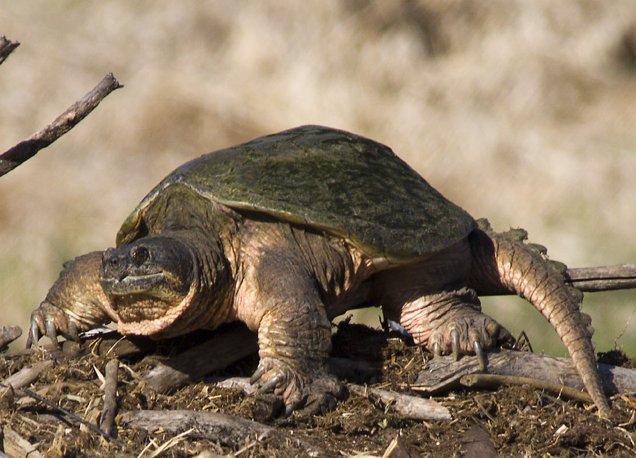
The Snapping turtle has an oval carapace, often covered in algae, that can reach 50 cm in length. Its head is large and cannot be fully retracted into the shell, unlike other turtles. Its tail, long and crested with bony plates, is reminiscent of that of a prehistoric reptile. The powerful jaws and hooked beak allow it to firmly grasp its prey.
Characteristics
Indicative values: they vary by subspecies, sex and region.
Habitat and distribution
It frequents slow-moving rivers, lakes, ponds and swamps with muddy bottoms offering good plant cover. It tolerates both fresh and slightly brackish waters near the coast. Its presence is common in wetlands rich in aquatic vegetation.
CURRENT RANGE
The species is native to North and Central America, from southern Canada to northern South America. It was introduced accidentally or intentionally into several regions of Europe and Asia via the pet trade. These introduced populations are considered invasive in some countries.
Behaviour
Discreet and mainly aquatic, it spends the majority of its time immobile at the bottom of the water or partially buried in the mud, watching for its prey. On land, especially when laying eggs, it becomes significantly more defensive and can bite sharply if it feels threatened. It is solitary outside the breeding season and hibernates at the bottom of watering holes during the winter in temperate regions.
Reproduction
Mating takes place in spring, often in an aquatic environment. The female leaves the water to dig a nest in soft soil and lay between 20 and 40 eggs. Incubation lasts approximately 9 to 18 weeks, with nest temperature influencing the sex of the juveniles. Young turtles are completely independent from the moment they hatch.
Peculiarities
Its bite is powerful and fast, capable of severing a finger in extreme cases. It is sometimes wrongly nicknamed "alligator snapping turtle", although it is a distinct species from the alligator snapping snapping turtle (Macrochelys temminckii). Its non-retractable shell makes it particularly vulnerable on land, which explains its marked defensive behavior.
Threats and conservation
It suffers from the destruction and pollution of wetlands, as well as collection for the pet trade and food consumption in some areas. Road collisions during land movements of females during the egg-laying period also constitute a local threat. Overall, its populations remain stable across a large part of its range.
Numbers and trends vary across sources and regions. See the IUCN assessment for the latest reference data.
Gallery
1 documented photographs.
References
Profile updated 01 September 2026 · Reviewed by the TunisieVet editorial team.
Comments (0)
No comments yet.
CONSERVATION STATUS
Least concern (LC)
IUCN source, latest published assessment.
Species health
Documented diseases for this species.
This information is provided for educational purposes only and is not a substitute for a veterinary consultation. If you have any concerns about your animal's health, consult a veterinarian.
To discover around: Snapping turtle
Videos, facts, stories and records linked to this species.
Similar animals
Other species documented in Animalpedia.

TunisieVet in your pocket 📱🐾 Access your veterinary services wherever you are. [ Download the app ]
Learn more