Presentation
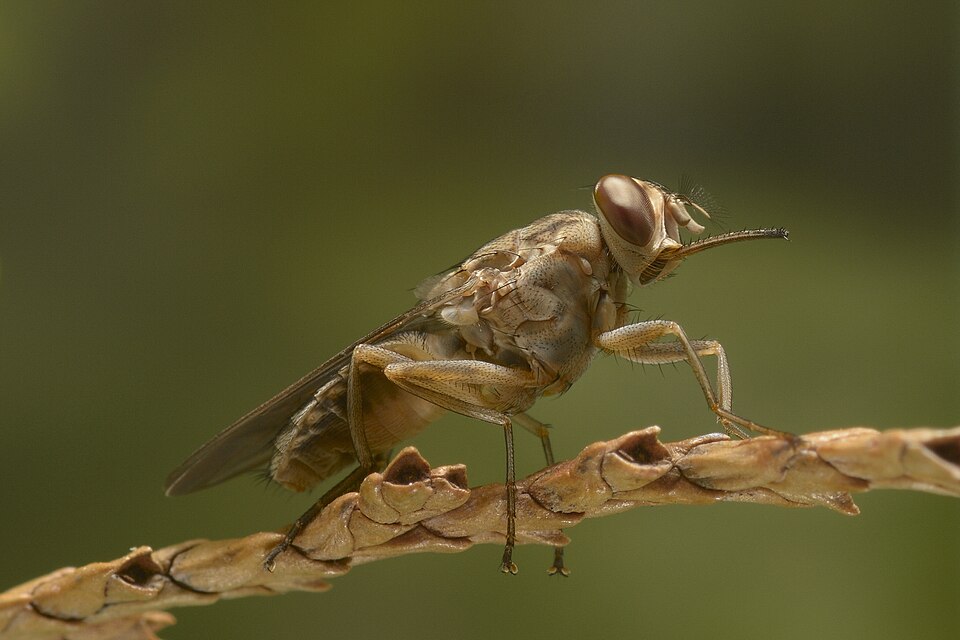
The tsetse fly is a blood-feeding dipteran insect found exclusively in Africa, known for transmitting trypanosomes that cause sleeping sickness in humans and nagana in livestock. It comprises around thirty species in the genus Glossina, distributed mainly throughout sub-Saharan Africa. Its painful bite and role as a disease vector make it a feared insect, with major health and economic consequences for rural populations and livestock farming. It is distinguished from other flies by its wings, which fold in a scissor-like pattern at rest, and its prominently visible blood-feeding proboscis.
Adults measure between 6 and 15 mm depending on the species, with a yellowish-brown to dark brown body. They have a long rigid proboscis projecting forward, used to pierce skin and feed on blood. At rest, the wings overlap completely, forming the characteristic scissor-like pattern of closed blades.
Characteristics
Indicative values: they vary by subspecies, sex and region.
Habitat and distribution
The tsetse fly frequents wooded areas, tree-dotted savannas, and forest galleries along watercourses. It seeks shade and moisture, particularly near watering points where wild and domestic animals gather. Some species are more closely associated with dense forests, others with more open savannas.
CURRENT RANGE
The genus Glossina is found exclusively in sub-Saharan Africa, over a band extending from West Africa to East and southern Africa. It is absent from North Africa, including Tunisia, where the climate is unfavorable to it. Its distribution generally follows that of the major African savanna and tropical forest zones.
Behaviour
The tsetse fly is active during the day, with peaks of activity linked to heat and light. It locates hosts through vision and smell, being attracted to movement and certain animal odours. It tends to pursue large mammals and livestock over long distances to feed.
Reproduction
The female does not lay eggs but gives birth directly to a single larva following internal gestation. This larva immediately burrows into loose, shaded soil to pupate. The reproductive cycle is slow, with only a few offspring produced by each female during her lifetime, which limits her capacity for rapid proliferation.
Peculiarities
The tsetse fly is the sole vector of African trypanosomes, which cause sleeping sickness in humans and nagana in animals. Its presence long restricted cattle farming across vast regions of Africa, a phenomenon sometimes called the "tsetse barrier." It gives birth to a fully-formed larva rather than to eggs, a rare feature among insects.
Threats and conservation
The species itself is not threatened; it is instead the subject of control and eradication programs due to its health impact. Methods used include odor-baited traps, insecticides, and the sterile insect technique. These efforts aim to reduce its range rather than to protect it.
Numbers and trends vary across sources and regions. See the IUCN assessment for the latest reference data.
Gallery
1 documented photographs.
References
Profile updated 10 September 2026 · Reviewed by the TunisieVet editorial team.
Comments (0)
No comments yet.
CONSERVATION STATUS
Least concern (LC)
IUCN source, latest published assessment.
Species health
Documented diseases for this species.
This information is provided for educational purposes only and is not a substitute for a veterinary consultation. If you have any concerns about your animal's health, consult a veterinarian.
To discover around: Tsetse fly
Videos, facts, stories and records linked to this species.
Similar animals
Other species documented in Animalpedia.