
Presentation
The White-lipped pit viper is a modest-sized venomous snake belonging to the Crotalinae subfamily, recognizable by its green color and triangular head. Native to the tropical forests of Southeast Asia, it is among the species responsible for the greatest number of envenomed bites in this region of the world. Discreet and mainly nocturnal, it lives mainly in wooded vegetation, where its camouflage makes it difficult to spot. Its hemotoxic venom causes coagulation disorders in its prey and in humans in the event of an accident. Although it is sometimes held by enthusiasts of exotic reptiles, its handling requires specific expertise due to its toxicity. The species remains common and not threatened throughout its range.
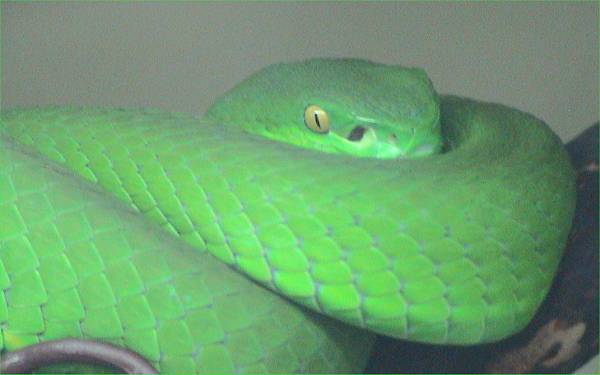
This small viperid has a triangular head distinct from the neck and vertical pupils typical of venomous snakes. Its bright green coloring, often bordered by a white or yellow lateral line, offers it effective camouflage in vegetation. The female is generally larger and more robust than the male. Its body is stocky and its tail is short, often tinged with red or brown in certain individuals.
Characteristics
Indicative values: they vary by subspecies, sex and region.
Habitat and distribution
This species frequents tropical rainforests, edges, plantations and gardens up to medium altitude. It appreciates dense vegetation near watercourses and wetlands. It also adapts to peri-urban and agricultural environments where it finds refuge in bushes and fruit trees. This tolerance of human-modified habitats explains its frequency in inhabited areas of Southeast Asia.
CURRENT RANGE
White-lipped pit viper is widely distributed in Southeast Asia, including Thailand, Vietnam, Laos, Cambodia, and parts of China and Indonesia. It is also found in North-East India. Its distribution area covers a wide variety of tropical and subtropical environments on the Asian continent. It does not occur naturally outside of Asia.
Behaviour
The White-lipped pit viper is a mainly nocturnal and arboreal snake, also capable of moving on the ground near water sources. It adopts a motionless posture waiting for prey, which it detects thanks to its heat-sensitive dimples located between the eye and the nostril. Not very aggressive if not disturbed, it can nevertheless bite quickly in the event of a perceived threat. It tolerates human proximity well, which explains its frequent presence in gardens and cultivated areas.
Reproduction
This species is viviparous, the female giving birth to young already formed after a gestation of several months. A litter generally has between 10 and 30 young, independent from birth. Breeding is not strictly seasonal in the tropical regions where it lives. Newborns already have a functioning venomous apparatus.
Peculiarities
This species is responsible for a high number of envenomed bites in Southeast Asia, due to its frequentation of inhabited areas. Its green coloring allows it remarkable camouflage in the foliage. The thermosensitive pits, common to crotalines, allow it to detect prey even in total darkness. Some populations show color variability ranging from green to yellowish.
Threats and conservation
The species is not globally threatened and benefits from a wide distribution as well as good adaptability to modified environments. Local deforestation may reduce some forest habitats, but the species compensates by colonizing agricultural and peri-urban areas. It is sometimes killed out of human fear due to its venom. The trade in exotic pets also concerns certain individuals, without significant impact on wild populations.
Numbers and trends vary across sources and regions. See the IUCN assessment for the latest reference data.
Gallery
1 documented photographs.
References
Profile updated 19 August 2026 · Reviewed by the TunisieVet editorial team.
Comments (0)
No comments yet.
CONSERVATION STATUS
Least concern (LC)
IUCN source, latest published assessment.
Species health
Documented diseases for this species.
See the 8 diseases of this species Find a veterinarianThis information is provided for educational purposes only and is not a substitute for a veterinary consultation. If you have any concerns about your animal's health, consult a veterinarian.
To discover around: White-lipped pit viper
Videos, facts, stories and records linked to this species.
Similar animals
Other species documented in Animalpedia.

TunisieVet in your pocket 📱🐾 Access your veterinary services wherever you are. [ Download the app ]
Learn more