
Presentation
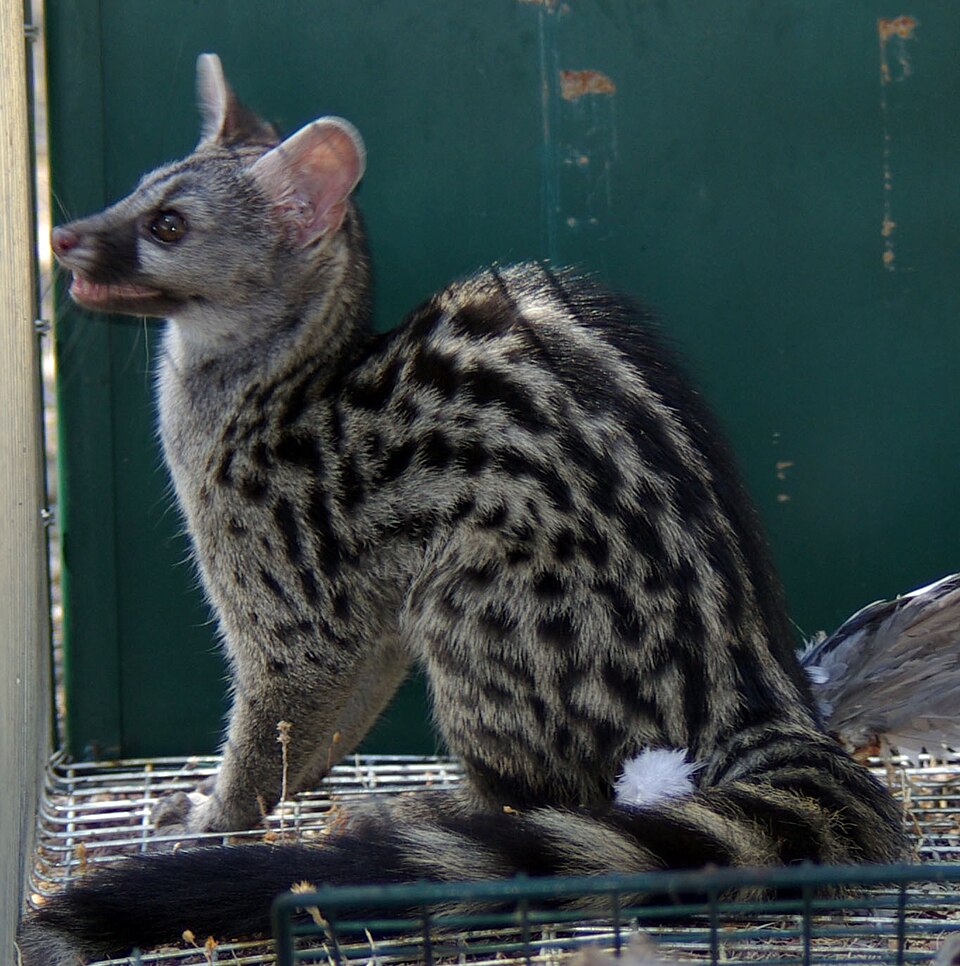
Common genet is a small, slender carnivore with a supple and muscular body, recognizable by its spotted coat and long ringed tail. It belongs to the Viverridae family, a group of small ancient predators, close to civets and linsangs.
Slender, flexible body with short legs; gray to light brown coat dotted with well-marked black spots; back with blackish erectile crest; tail long and ringed in black and white; rounded ears; large, bright eyes adapted for night vision.
Characteristics
Indicative values: they vary by subspecies, sex and region.
Habitat and distribution
The Common genet frequents deciduous forests, mixed woodlands, scrubland with dense bushes and mountains up to 2,500 meters. It prefers environments with good plant cover and proximity to water areas. It also adapts to semi-open habitats.
CURRENT RANGE
A Palearctic species, Common genet is widely distributed in North Africa (Maghreb) and southwest Europe (Iberian Peninsula and southwest France). It is present from Morocco to Libya, with isolated populations in Europe.
Behaviour
A solitary and secretive nocturnal creature, the Common genet is agile and graceful, an excellent climber capable of walking on the thinnest branches. It marks its territory with scent glands and communicates by meowing, howling and high-pitched cries.
Reproduction
Common genet reaches sexual maturity around one year of age. Mating occurs in spring, with a gestation of approximately 10 to 11 weeks. The female gives birth to 1 to 4 young per litter, which she raises alone for 2 to 3 months.
Peculiarities
Equipped with highly developed anal-perineal glands, the Common genet secretes a powerful musk for territorial marking. Her semi-retractable claws and exceptional agility make her an incomparable hunter in the trees. She can emit sounds similar to those of a cat.
Threats and conservation
Although classified as Least Concern, Common genet may be affected locally by habitat loss and fragmentation, human persecution in some areas, and the use of rodenticides that indirectly poison its prey.
Numbers and trends vary across sources and regions. See the IUCN assessment for the latest reference data.
Gallery
1 documented photographs.
References
UICN — Liste rouge des espèces menacées
Profile updated 02 September 2026 · Reviewed by the TunisieVet editorial team.
Comments (0)
No comments yet.
CONSERVATION STATUS
Least concern (LC)
IUCN source, latest published assessment.
Species health
Documented diseases for this species.
See the 4 diseases of this species Find a veterinarianThis information is provided for educational purposes only and is not a substitute for a veterinary consultation. If you have any concerns about your animal's health, consult a veterinarian.
To discover around: Common genet
Videos, facts, stories and records linked to this species.
Similar animals
Other species documented in Animalpedia.

TunisieVet in your pocket 📱🐾 Access your veterinary services wherever you are. [ Download the app ]
Learn more