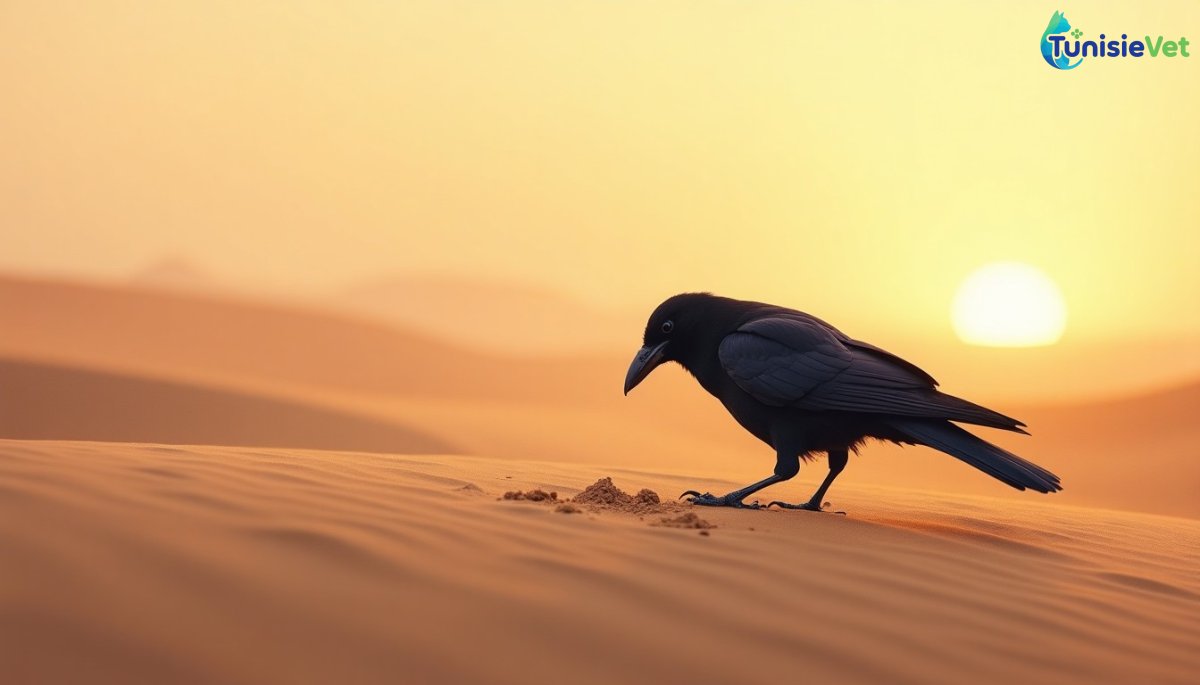
After the first tragedy of humankind, one of Adam's sons stood bewildered before his brother's body. God sent a raven to teach him, through a simple gesture, what no human had yet known how to do.
After the murder committed by one of Adam's two sons against his brother—a tragedy that the Qur'an relates in Surah Al-Mâ'ida—the man found himself facing a situation no human being had ever encountered before: he had to do something with his brother's body. There was no custom, no teaching, no example to follow. The Qur'anic text describes his bewilderment in simple and moving words.
The Bewilderment of Adam's Son
The Qur'an reports that he stood thus, not knowing what to do with his brother's remains, until God sent a raven that began to scratch the earth to show him how to cover his brother's body.
﴿ فَبَعَثَ اللَّهُ غُرَابًا يَبْحَثُ فِي الْأَرْضِ لِيُرِيَهُ كَيْفَ يُوَارِي سَوْءَةَ أَخِيهِ قَالَ يَا وَيْلَتَا أَعَجَزْتُ أَنْ أَكُونَ مِثْلَ هَٰذَا الْغُرَابِ فَأُوَارِيَ سَوْءَةَ أَخِي فَأَصْبَحَ مِنَ النَّادِمِينَ ﴾
"Then God sent a raven that scratched the earth to show him how to cover the corpse of his brother. He said, 'Woe is me! Am I unable to be like this raven and cover the corpse of my brother?' He then became one of those who feel regret."
(Surah Al-Mâ'ida, verse 31)
A Lesson from the Animal World
This verse is remarkable: it is a bird, a mere creature of the animal world, who becomes the instrument through which God teaches humanity one of its most fundamental and most dignified gestures—that of burying its dead. Adam's son, engulfed in remorse and bewilderment, watches the raven scratch the ground, dig, then cover it. This gesture, repeated before his eyes, finally reveals to him what he must do.
According to some scholars of exegesis, this raven may have dug for another raven, dead or presented for illustration, so that the lesson would be perfectly clear to the man witnessing the scene. This precise detail is not established with certainty in the Qur'anic text itself, but the central teaching is unmistakable: it was indeed through the example of an animal that God showed man how to honor his neighbor, even in death.
This account invites deep reflection. Man, endowed with reason and considered the noblest of creatures, finds himself here surpassed, momentarily, by the instinct and behavior of a mere bird. The raven does not act from conscious moral choice, yet its gesture becomes, by divine will, a universal lesson. This reminds us that all of creation, down to the smallest creatures, carries within it a wisdom and a purpose willed by God, and that nothing in nature is insignificant or devoid of meaning.
A Lesson for Our Relationship with Animals
This passage from the Qur'an teaches us to direct an attentive and respectful gaze upon the animals around us. The raven, often perceived negatively in certain cultures, is here chosen by God as a messenger of an essential teaching for all humanity. This reminds us that no creature should be scorned or regarded as worthless.
For Muslims and for all those interested in the place of animals in religious traditions, this story is an invitation to kindness toward all creatures, great or small, valued or feared. Every animal, in its own way, can be a bearer of a teaching, a wisdom, or a reminder for those who know how to observe with humility. Caring for animals, respecting their place in the world's balance, is also to acknowledge the divine wisdom that made a simple raven the first teacher of humanity in one of its most sacred gestures.