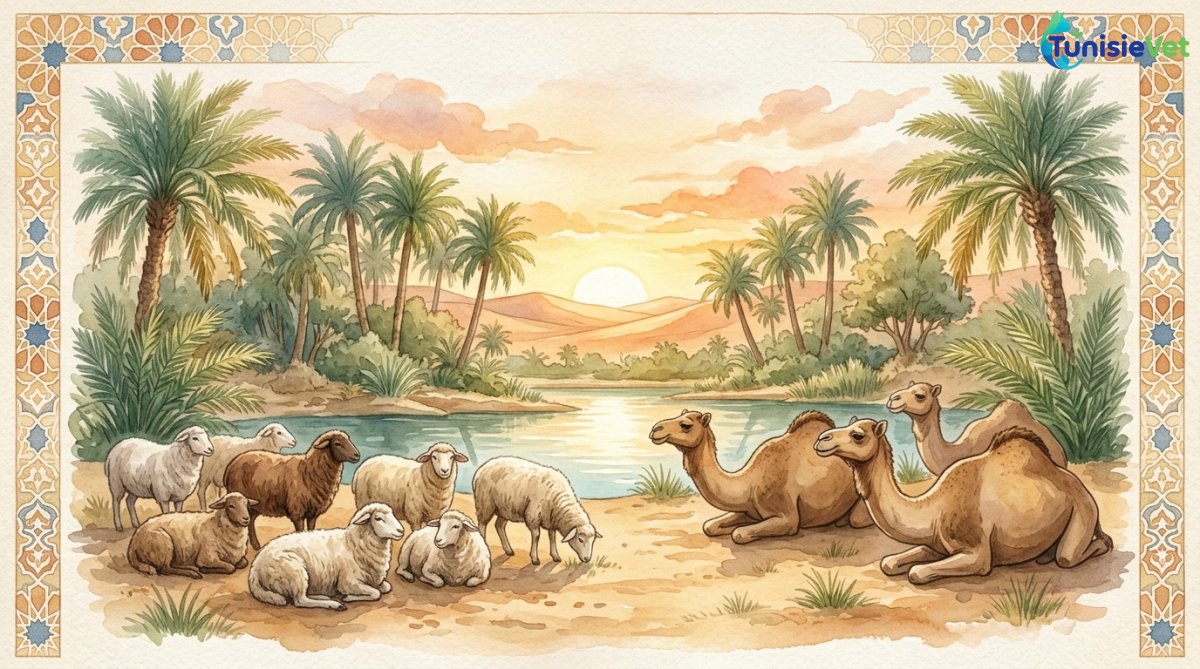
In the Quran, livestock and the beasts of the earth are presented as a blessing from Allah for humanity, yet this generosity comes with a requirement of gratitude and respect toward what nourishes us.
Among the blessings Allah recalls to humanity in the Quran is the creation of livestock, provided as a source of nourishment, warmth, and benefit. This divine generosity is never presented as a matter of course: it calls for recognition and responsible conduct toward what is consumed.
Livestock, a Blessing Recalled in the Quran
The Quran mentions several times the livestock (al-an'âm) — cattle, sheep, goats, and camels — as a creation placed at the service of humanity. Surah An-Nahl, whose name means "The Bees," opens precisely with an enumeration of these blessings linked to animals: their flesh as food, their wool and hair for clothing, their milk for drink. It is reported in this surah that these beasts carry the burdens of people to lands they would not have been able to reach except with great difficulty, a sign among others of the Creator's care.
Likewise, Surah Al-An'âm, whose very name means "The Livestock," devotes considerable space to reflection on these animals: their origin, their diversity, and the way they have been made lawful for consumption. The Quran emphasizes here that it is Allah who created these beasts "in pairs," and that it is the duty of humanity not to stray into prohibitions or practices invented without foundation, but to follow what has been clearly established.
Consumption Guided by Gratitude
This permission to nourish oneself from animals is never separated from a moral requirement. The Quran calls repeatedly to eat "of the good things" Allah has granted, while being grateful. According to certain exegetes, this constant association between food and gratitude reminds us that the animal consumed is not simply a resource, but a gift that carries responsibility: that of not wasting, not mistreating, and of acknowledging the source of this blessing.
It is also reported in the prophetic tradition that the Prophet ﷺ taught precise rules concerning the manner of treating animals intended for food, notably the prohibition of inflicting unnecessary suffering on a beast before its slaughter. A hadith reported by Imam Muslim relates that the Prophet ﷺ said: "Allah has prescribed excellence (al-ihsân) in all things. If you kill, kill well; if you slaughter, slaughter well. Let each of you sharpen his blade and spare suffering to the beast he slaughters." This teaching shows that even in the act of nourishing oneself, kindness toward the animal remains a central requirement.
Nourishment That Does Not Erase the Dignity of the Creature
Thus, the Quran and the prophetic tradition agree on a principle: animals offered as nourishment remain creatures of Allah, worthy of regard even in their final moment. Permission to consume their flesh or their products permits neither waste, nor cruelty, nor forgetting the divine source of this blessing. This is why the repeated mention, in the Quran, of the necessity to be grateful for these gifts invites the believer never to consider the animal as mere matter, but as an element of creation deserving of respect.
This lesson resonates still today: caring for animals, ensuring their well-being and dignified conditions, whether in their raising or their treatment, is a natural extension of this teaching. To nourish oneself from the blessings of creation is also to accept the responsibility that accompanies it toward each creature entrusted to us.