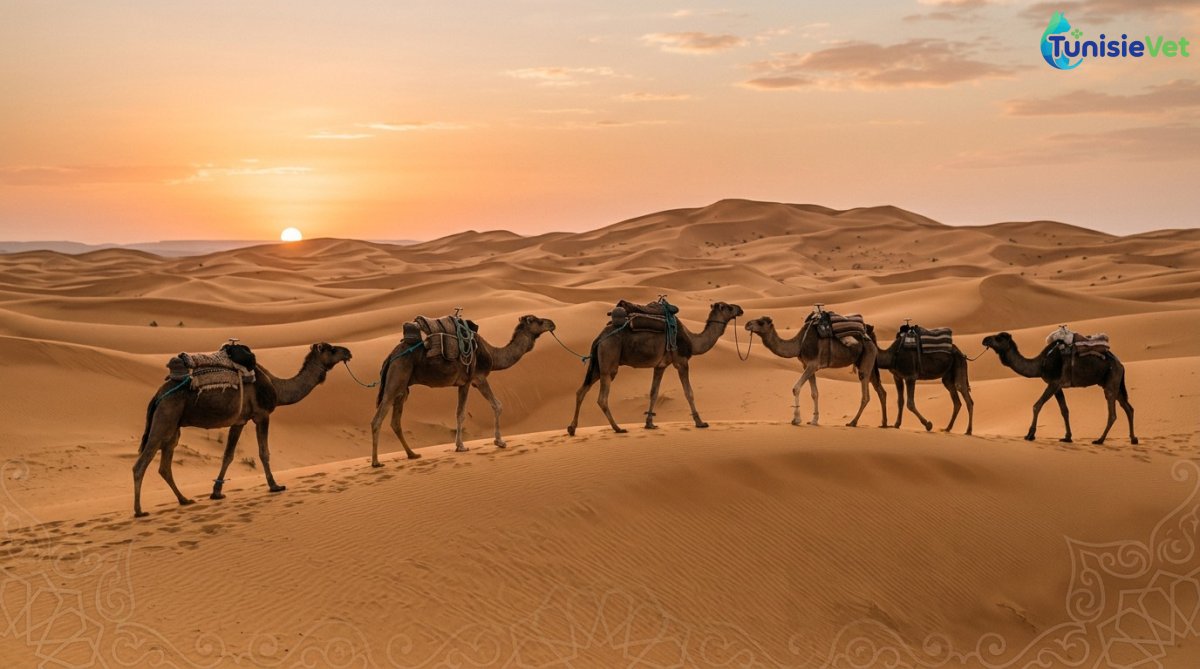
From the camel crossing the desert to the horse galloping toward the horizon, the Qur'an describes mounts as blessings bestowed upon humanity, worthy of respect and gratitude.
Across the vast Arabian desert, where distances were measured in days of walking under a relentless sun, pack animals were far more than simple means of transport — they were companions in survival. The Qur'an, which spoke to people living that reality, did not fail to remind them that these creatures were among the blessings granted by Allah.
Livestock: Blessing and Mount
In Surah An-Nahl, several verses speak of livestock — camels, cattle, sheep — created for humankind. They remind us that these animals provide warmth, food, and crucially, that they carry burdens to lands that could not be reached except with great difficulty. The text also emphasizes the creation of horses, mules, and donkeys, serving both for transport and as adornment — that is, as elements of beauty in human life.
Scholars note that this passage invites reflection on the camel's robustness, capable of traversing arid expanses without water for long periods, as a sign of the Creator's wisdom. The camel is mentioned elsewhere in the Qur'an as a creature to be observed carefully, in Surah Al-Ghashiya, where the question is posed: "Do they not consider how the camel has been created?" — an invitation to meditate upon a creature so perfectly adapted to its environment that it becomes proof of divine greatness.
The Mount: A Trust Entrusted
Beyond the Qur'an, prophetic tradition clarified the proper conduct toward these burden-bearing animals. It is reported in Sahih Muslim that the Prophet ﷺ forbade using the backs of mounts as mere seats for rest or idle talk, reminding believers that many such beasts are more enduring and valuable than those who ride them without regard for their fatigue. This admonition shows that the mount was never viewed as an interchangeable object, but as a living being whose strength must be preserved.
Similarly, several accounts relate the Prophet's recommendation not to overload pack animals nor to make them travel beyond their capacity, especially on long journeys. It is also reported that the Prophet ﷺ encouraged feeding and watering mounts before attending to one's own rest after a day's travel — a sign of constant concern for their welfare.
A Lesson in Gratitude
What the Qur'an and tradition teach through their mention of these mounts is gratitude toward creatures that make possible what humankind could not accomplish alone: crossing the desert, transporting goods, connecting distant peoples. This gratitude finds expression also in an invocation reported to be recited when boarding an animal or vehicle, reminding us that the taming of these animals is itself a grace that could not have been obtained without divine permission.
Thus, far from being mere instruments, animals of transport emerge in these texts as partners in human existence, deserving of respect, care, and recognition. This vision invites each person, even today, to treat with gentleness the animals that serve us — whether bearing a rider across the desert or simply sharing our daily life — for caring for them is honoring the wisdom that presided over their creation.