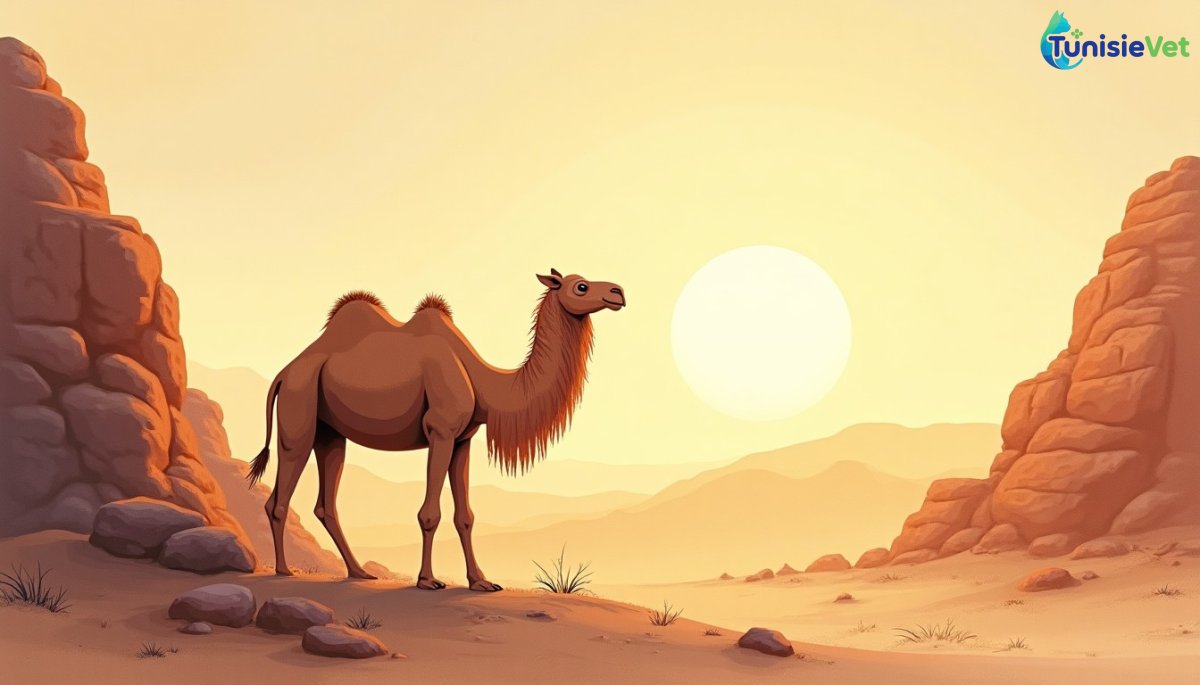
From the Arabian desert to the miraculous she-camel of the prophet Salih, the camel appears throughout the prophetic narratives as a sign of divine power and a faithful companion to believers.
Among the animals most present in the stories of the prophets, the camel holds a special place. An essential companion to life in the Arabian desert, it appears in the Qur'an not only as a useful creature, but also as a sign (ayah) of the Creator's greatness and, in the story of the prophet Salih, as an extraordinary miracle.
The She-Camel of the Prophet Salih
The most striking account concerning a camel in the Qur'an is that of the she-camel sent to the people of Thamud in response to the prophet Salih. This people, known for their hardness and disbelief, had asked for a sign proving the authenticity of Salih's mission. God then brought forth a she-camel miraculously from a rock, as clear proof.
Salih warned his people to let this she-camel drink and graze freely, without harming her, on pain of severe punishment. The Qur'an mentions this episode in Surah Ash-Shams:
﴿ فَقَالَ لَهُمْ رَسُولُ اللَّهِ نَاقَةَ اللَّهِ وَسُقْيَاهَا ﴾
"The Messenger of Allah said to them: '[Respect] Allah's she-camel and her right to drink!'"
(Surah Ash-Shams, verse 13)
Despite this warning, the people of Thamud, in their pride and rejection of the divine message, ultimately killed the she-camel. This act of cruelty toward an innocent animal, protected by a divine command, brought about a terrible punishment that destroyed this people, as recalled in several Qur'anic surahs, notably Al-A'raf and Ash-Shu'ara.
The Camel as a Sign of Divine Creation
Beyond this prophetic narrative, the Qur'an invites believers to reflect on the creation of the camel itself as proof of Allah's power and wisdom. In Surah Al-Ghashiya, people are asked to observe how this animal was fashioned:
﴿ أَفَلَا يَنظُرُونَ إِلَى الْإِبِلِ كَيْفَ خُلِقَتْ ﴾
"Do they not consider how the camel has been created?"
(Surah Al-Ghashiya, verse 17)
This verse invites deep reflection on the extraordinary adaptation of the camel to its environment: its ability to withstand heat, to go without water for long periods, and to carry heavy loads across the desert. For the Arab peoples of that time, familiar with this animal, this reminder held a particularly concrete dimension.
The Camel in the Life of the Prophet ﷺ
The camel also accompanied the life of the Prophet Muhammad ﷺ and his companions. His she-camel, named Al-Qaswa, is mentioned in several accounts of the prophetic tradition, notably during the episode of the Hijra, the migration from Mecca to Medina. It is reported that the Prophet ﷺ allowed his she-camel to freely choose the place where she would kneel in Medina, considering this a sign, and at that precise spot the first mosque was built.
These narratives teach us that animals, including the camel, hold a respected place in the Islamic tradition, at times as a divine sign, at times as a faithful companion to humankind. The tragic fate of Salih's she-camel powerfully reminds us that it is forbidden to mistreat or kill without legitimate reason an innocent creature. Caring for animals, respecting their need for food and water, and reflecting on the perfection of their creation, as the Qur'an suggests regarding the camel, remains a precious and timeless teaching for every believer concerned with compassion toward living beings.